‘ Call to arms’ – Dave Prentis addresses Conference

In a speech to delegates at UNISON’s National Conference, the union’s General Secretary, Dave Prentis, said:

March 26th, what a day it was. We marched together, But this week we march on. Because this is our week, together not beaten. Here to experience the unique solidarity of our conference. To share, to learn, to inspire. And be inspired by the struggles of others. To show the world that we’re strong, determined, united.

They’ve declared war on our public services. With Tory donors, City firms, hedge funders back in the heart of government. Financiers like John Nash whose private equity firm, sovereign capital, buys and flogs care homes for the fun of it.

Conference, A year ago, we could have been beaten, lost our way. But in this past year we’ve grown our membership for the 17th year running. We’ve strengthened organising, a new army of organisers. Our branches, fighting back where they can.

Mike Tucker, in Southampton, John Burgess, in Barnet – their necks on the line. 40 branches in dispute, 34,000 members, balloted or taking action. Conference, this union salutes them all and what they are doing to save our members jobs and services.

And we are told that there is no alternative. And as long as they keep preaching that mantra that there is no alternative, I will state on every platform that there are alternatives. Clegg and Cameron could have the guts to go back to the banks, the spivs, the speculators, and tell them on our behalf, “you created this mess – you clear it up.” And I’ll say it again; “If there’s money to bail out the banks, if there’s money to protect their bonuses. If there’s money for war and replacing Trident, there’s money available for our local services and our NHS. If there has to be a pay freeze, make it for the bankers, get them to do more for less.

Full speech here and short video here

The Barnet 500 on the march

(above is Barnet resident)

I was proud to be able to take part in the first Barnet community march outside the borders of Barnet.

500 residents/trade unionists/from Barnet congregated outside the Savoy Hotel yesterday morning (site of Peasants Revolt 1381).

As we snaked through the capital, chants of “no to easy council no to easycouncil” provoked some bemused reactions. It was all good fun and the 500 all seemed to be inspired by marching with so many others. The banners and home made placards were fantastic as were some of the chanting.

It took us 5 and half hours to march from Embankment to  Hyde Park! I was exhausted when I reached Hyde Park (a note for me,we must find lighter banner poles for our banner).

It is disappointing to see the media focusing on the violence that took place last night. On the whole, it was a peaceful march,I never saw any violence, n fact it was almost a carnival atmosphere.

We will never know how many were there but it must have been close to a million. Feeder marches kept joining the main march, but even if we say it was as low as 500,000, the media by focussing on the behaviour of 0.04% let themselves down again.

The real story is the open attack on our public services and the resolve of communities everywhere to stand up to defend them.

Britain’s Secret Fat Cats who profit at our expense

Unusually I found myself at home and able to watch the Dispatches programme on Channel Four ‘Britain’s Secret Fat Cats’

For those who missed the programme I strongly suggest you watch it on catch up TV here

The thing is that the Public know so little about what has gone on and the serious amount of public money going into the coffers of private sector companies. Whilst Town Halls have become the target of community groups and angry residents and trade unions as a result of massive cuts to budgets, private sector companies are revealing massive profits for shareholders all paid for from public money from ME AND YOU!

Whilst I maybe the last to fight the corner for senior officer pay rates, at least this is subject to public scrutiny. If these companies are allowed to take over the rest of public services the audit trail will disappear altogether.  

I am positive that 99.9% of UNISON members would be shocked, angry and disgusted about how public money can hived off for private sector companies at a time when public services and local communities are being decimated.

A thought which has often crossed my mind, is how much longer will the community continue to put with this nonsense?

Almost every person I speak to either officially and unofficially admit the private sector are in for themselves and whatever happens they never lose, they don’t take the consequences when it all goes wrong.

Worrying was the admission in the programme that ‘privatisation is one way street.’ The collapse of Connaught’s was covered in tonight’s programme (with regards Norwich) and all the things the Norwich councillor claimed, were allegedly taking place in Barnet. Last summer as rumours circulated about the future financial viability of Connaught’s, Barnet UNISON lobbied Barnet Homes asking for the service to be brought back in-house before service collapsed. Needless to say our request was not taken up. Connaught’s went bust, now we have Lovell’s and they are not even waiting 6 months before looking to attack member’s terms and conditions.

No wonder the big private sector companies are getting excited with the prospect of even more lucrative contracts where they make massive profits at no risk to themselves. I saw an article in the Daily Mail; please note I am not a reader of the Daily Mail

“They are private companies but they are also the creation of the Government’s drive to outsource services. The lion’s share of their turnover – and of their executives’ enormous pay packages – comes from the public purse. But there is little in the way of public accountability.

These outsourcers already account for £79 billion of state expenditure every year, a figure which is set to grow if the Government fulfils its pledge to put nearly all state-run services out to contract.

A White Paper on the subject is due soon and the companies with their foot already in the door are delighted.

Over the past few weeks big outsourcing companies have given extraordinarily upbeat assessments of their position.

Paul Pindar, the chief executive of Capita – which does everything from collecting TV licence fees to placing social workers – is gleeful about the prospect of a public-spending squeeze.”

Read more: http://www.dailymail.co.uk/news/article-1365695/Revealed-The-new-public-service-Fat-Cats-theyre-immune-cuts.html#ixzz1Gc4gWD8e

Future Shape Project – now you see me now you don’t!

The Development & Public Health Services Future Shape Project formerly known as the Regulatory Services Bundle was published online here

Open the PDf and scroll down to page 20. Click on the table entitled Options Scoring Matrix. Copy and paste into a word document and ‘Hey Presto’ you can see the scoring.

I have never seen this sort of thing before, is it deliberate or is it a mistake and why should the details be secret?

The Trade Unions will be producing a report in response to the Options Appraisal which even from a cursory glance is full of contradictions assumptions without supporting evidence and quite insulting to staff. Just what were thinking when they wrote this “But it is also very clear that the services require a fresh injection of intellectual capital..”

Many of our members working in this area have let me know they have been hurt by this comment.

If I was a Barnet tax payer I would be pleased to see that almost all of these services are  high performing and low cost. It is difficult to see where the 25% cuts and the 20% profits for the private sector are going to come from……or is it?

Answers on a postcard.

My guess it has to be staffing or something more fundamental a cut back on what is provided.

It is not too late if you have any question on the content of this Options appraisal please send your comments to john.burgess@barnetunison.org.uk

£123 Billion lost every year!

The following report has been produced by the PCS trade union in response to the latest proposal to cut posts. The report provides an analysis and data on a major income deficit (£123 Billion a year) which in the current financial climate you would think a responsible government should be addressing. Instead they are targeting Benefit Fraud (£1.5bn a year).

Report begins:

The financial crisis was not caused by excessive public spending. That is vital to bear in mind when we hear all around us that the ‘deficit’ must be cut.

This is not a spending crisis this is an income crisis.

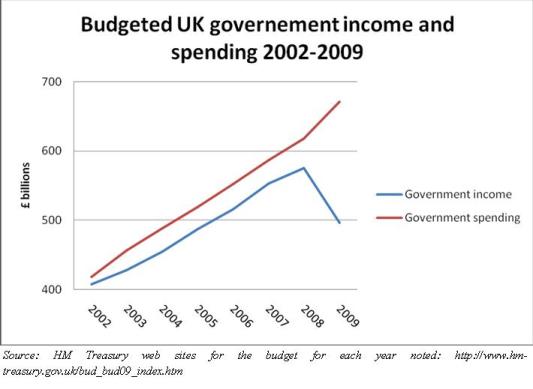
In the above chart the ‘deficit’ is the gap or difference between what the government spends (the top line in the chart) and what it receives in income (shown on the bottom line of the chart). That deficit for this year was originally estimated to be £178 Billion. That original estimate has now been revised using more up to date figures and is now estimated to be £156 Billion. A difference between the two estimates of £22 Billion.

The lack of tax revenue did not cause the current financial crisis. The reason for that substantial fall in government income you can see on the chart in 2008 was as a result of the downturn in economic activity – the recession sparked by the near collapse of the worlds banking system. Bailing out the banks in the UK cost £1.3 Trillion, which is 1,300 Billion pounds. The recession increased unemployment and hit tax revenues.

 What the Con Dem government don’t want to talk about is the Tax Gap.

That is the difference between what the government would receive in tax if everyone paid what they should pay and what it actually receives. The difference between what it should receive and what it actually receives is the tax gap; estimates from the PCS union indicate the gap to be £123 Billion, which is 123,000 million pounds.

I repeat that figure again because members are being bombarded by anti-public services propaganda every day.

Tax Gap £123 Billion

PCS asked Richard Murphy a Chartered Accountant and a Tax expert to research and calculate the size of the tax gap. That research has now been published and the tax gap is estimated at £123 Billion, which is 123,000 million pounds per year.

That £123 Billion is made up of three amounts:

·         £25 Billion avoided.

·         £70 Billion evaded.

·         £28 Billion not collected.

The difference between tax avoidance and tax evasion is as Denis Healy once said “the thickness of a prison wall”. Tax is avoided by exploiting loopholes in tax law. 

The TUC pamphlet “The missing Billions” estimates that £25 Billion each year is avoided by corporations and rich individuals. The pamphlet gives examples of some of the measures used to avoid tax.

One well known example is the tax avoidance used by rich individuals running private equity firms who by classifying their income as capital gains pay 22% less tax than they would otherwise pay if they declared it as income and were subject to income tax at the top rate. Hence one multi-millionaire private equity partner admitted that he paid less tax than his cleaner. The reason for this was, at the time, Capital Gains Tax stood at a rate of 18% whereas the top rate of income tax stood at 40%, a difference of 22%. In his budget speech on 22 June George Osborne said,

“Some of the richest people in this country have been able to pay less tax than the people who clean for them.

That is not fair – and it stems from the avoidance activity that has exploited the wider gap between the rate of Capital Gains Tax and the top rates of income tax.

These practices are costing other taxpayers over £1 Billion every year”

And he raised Capital Gains Tax from 18% to 28%. Great you may think. However, what he did not point out was that the top rate of income tax is now 50%, so with Capital Gains Tax now at 28% the gap between the two is still 22%. Those richest people in the country will still be exploiting that loophole.

£70 Billion Tax evaded

The Richard Murphy report estimates tax evaded to be £70 Billion. The report shows why the official HMRC estimate of tax avoided and evaded totalling £40 Billion is way too low particularly for tax evaded. This is because HMRC concentrates its efforts on those who do make tax returns and ignore the significant elements in society who evade the system altogether. By definition tax evasion is a criminal offence and (surprise, surprise) those evading tax do not tell HMRC about their activities. By relying on data supplied to HMRC they are missing the evasion that is completely outside the tax system.

However, for indirect taxes such as VAT, HMRC employs a ‘top-down’ approach. The gap is estimated by comparing the net theoretical tax yield, which involves assessing the total amount of expenditure in the economy that is liable to VAT, with actual VAT receipts. The difference is the VAT gap. This approach is rational because it seeks to establish the likely tax due independent of data submitted to HMRC. This ‘top- down’ method is the approach adopted by Richard Murphy in his report.

An example of tax evasion was demonstrated in a recent criminal case where an organised gang were convicted of defrauding HMRC of £4.5 Million. They submitted refund claims in the names of fictitious migrant labourers claiming they had overpaid income tax. Now at this point you may think that there is a bit of a flaw in this cunning plan. Given that the details provided to HMRC are for people who don’t actually exist, and haven’t actually paid any income tax, how can they get a refund on tax they haven’t paid? Not a problem. HMRC made the repayments without checking, the gang got £4.5 million from HMRC. This is because HMRC adopted the attitude of ‘pay now, check later’. The judge Christopher Hardy in sentencing the gang also raised concerns about HMRC’s system, “Trust has become a very risky and unwise basis in this day and age with which to disperse millions of pounds of public money”

We agree with the judge. Hence one of the recommendations in the Richard Murphy report is that HMRC should engage staff to check tax repayments before they are made. This isn’t rocket science.

£28 Billion Tax not collected

This is not an estimate. It is the published figure from HMRC as at 31 March 2010 for monies that have been declared or assessed but not paid to HMRC. That debt does not come in by magic and HMRC employs part of its workforce in the Debt Management and Banking section. A section that has also been cut, in the HMRC drive to close offices and reduce its staffing.

Richard Murphys report and PCS say:-

·         More staff should be employed to tackle tax avoidance.

·         More staff should be employed to tackle tax evasion.

·         More staff should be employed to recover tax not collected.

·         We want tax justice. We all have to pay our tax. The banks, the big corporations, the super rich and the criminals should pay their tax too.

End.

Barnet Council Support Services & Adult Social Care staff ‘shock World Cup exit’

For the last two years the Trade Unions have been seeking to ensure that the Future Shape programme is:

1.     The process is open and transparent

2.     There is genuine trade union and staff engagement in delivering an in-house option for the Options Appraisal.

On Wednesday 30 June I attended the first of two ‘Away Days’ being provided for staff delivering services such as Finance, Legal Services, Customers Services, Libraries, Audit, IS, Procurement, Property Services, HR, Pay Roll, Pensions, Revs & Bens. 

The purpose of the meeting was to launch the creation of the New Support Services Future Shape project and to explain the reasons behind it.  The major staffing revelation was that the Council has decided not to include the Option of an in-house bid in the Options Appraisal process. Staff were told that they would be looking to the services of one of the big top 100 FTSE companies e.g. IBM, SERCO, MOUCHEL, CAPITA

Whilst this should not have come as such a shock to staff, hearing officially that the Council would not be giving them the opportunity to compete clearly upset some staff.

More important is on what basis an in-house bid has been ruled out of the Options Appraisals. No data has been produced or provided to the Trade Unions which could demonstrate the rationale for this decision. Last year I sought a meeting with the previous Leader of the Council because of fears that in spite of the Future Shape jargon, what we was seeing was old style privatisation with a 21st century makeover!

The meeting was useful and he provided the following quote:

“Once we get to look at the ‘who’ it may be that we partner with other organisations to provide a service in a different way.  Equally, it may be that we continue to provide a service because we are the only organisation that can achieve sufficiently high quality at sufficiently low cost.  This is an interpretation the Council does what only the Council can do. Clearly we have many excellent services and we would not embark on unnecessary disruption, but we would be in favour of change if we were confident it would bring significant improvements in quality and value for money”.

which we published last year for the full article click here

The question which remains unanswered for the 700 staff is

“How can the Council be ‘confident’ they can bring in a private sector partner to deliver better value and service improvements if they do not put up an in-house option in the Option Appraisal process?”

This would be a massive contract for the private sector and we along with other Councils have had our fingers burnt by the private sector. If we really have learnt lessons then “why are we ‘shunning’ in-house bids?”

Options Appraisal or Group Stage explained

One of the regular criticisms of Future Shape has been the jargon used. To try and help members understand the process I am using the analogy of World Cup group stage qualification process.

Service Delivery Options

Points scored

In-house team


Management Buy Out (MBO)


Barnet Homes


Local Authority Trading Company (LATC)


Joint Venture


Private Sector sale


Closure of Service


 Please note: We have asked the Council, but have had no response as to how many Options go through to the next stage where a Full Business case will be produced (Followers of the real World Cup will know that only the top two go through to the next stage).

MEMBER ALERT: If you do not progress to the next stage you are out. If the in-house option is discarded at this stage staff will be facing the prospect of being transferred out of the Council.

To help understand the process and implications it is often best to see a live example.

Below is a table showing the scores of an

Options Appraisal for the Future Shape Adult Social Care Provision.

Options

Strategic Fit for Transforming Social Care

Deliverability

Acceptability

VFM

Totals

Customer

Council

Staff

Transfer to Barnet Homes

5

5

4

4

3

4

25

LATC

4

4

3

4

3

3

21

Social Enterprise (start-up)

4

3

2

3

3

3

18

Remain In-House

2

3

4

2

3

1

19 15*

Tender/Trade Sale

4

2

2

3

1

2

14

Closure of Service

1

1

1


1

1

1

6

* Please note the table sent to the Trade Unions (see above) scored the in-house option 19 but as you can see the total is 15.

The Trade Unions have registered a ‘failure  to agree’ over the Options Appraisal process to council officers and have requested a Corporate Joint Negotiation Consultation Committee with councillors in order we can formally discuss our concerns. The example above has been shrouded in secrecy from the outset once the decision to exclude the Trade Unions was made. We have attempted to engage in the process. We have submitted 46 questions to the Adult Social Care Future Shape Project team and to date we have not had a response.

Welcome to the Barnet UNISON Twilight Zone

Welcome to the Barnet UNISON Twilight Zone.  You unlock this door with the key of imagination. Beyond it is another dimension – a dimension of sound, a dimension of sight, a dimension of mind. You’re moving into a land of both shadow and substance, of things and ideas.

You’ve just crossed over into the Barnet UNISON Twilight Zone. 


The story of our branch being privatised has not happened. 

What is happening is our Council Services are at risk as a result of the recent 6.3 Billion budget cuts package and the likely level of cuts to funding to the Council as a result of the emergency budget on 22 June.

Fire Sale of the Public Sector?

It is important that the process of deciding what the Council does and doesn’t do in the future is open and transparent. Whilst Ministers ‘spin’ the myth that there are thousands of residents looking to set up co-ops/social enterprises etc to run services the reality is very different. Banks are not lending, and if they do, it is likely to be to multi-nationals e.g. IBM, Mouchel, Capita, BT.  In the knowledge that the Government are announcing their intention that the Public Sector debt must be cut back, the multi-nationals are circulating the public sector like sharks waiting for big public sector contracts to keep them afloat. It is the multi-nationals which will be looking to run our schools and it is easy to understand why. If they take over a school it means they take over the property (currently the schools are owned by us the public). Schools are one of the last massive public property assets and if the ‘Fire Sale’ goes ahead they could all be gone by the end of the Con-Dem first term in Government.

The Trade Unions have a responsibility to organise. But to organise in a way that they have never done for a long long time. In the past there has been too much rhetoric from General Secretary’s about joint working. History is clear that they have not delivered except for one day in the defence of the Pensions in the Public Sector. That was only one day. The fight over the survival of Public Services can only be won by working within our own communities.

Defend Council Housing National Conference

‘A Manifesto for Council Housing’ Congress House, London.

Throughout the conference every speaker recognised the good work that Alan Walter had done to defend council housing prior to his untimely death. Speakers in the first part of the morning spoke of the housing situation in their own boroughs as well as an overview of the national picture. They all spoke of a need to make serious financial reforms.

Austin Mitchell MP reported that a major council house building and renovation programme will meet the urgent need of the 1.8 million households on council waiting lists. He stated that £2,000 grants to first time buyers and notional 10% shares for tenants will drive up house prices and encourage yet more borrowing by those least able to afford it. In his view the Governments latest Reform proposals to allow councils to keep more of tenants’ rents are welcome but do not go far enough. ‘The government has been willing to write off all the debt for homes in stock transfers. It is unjust that they are refusing to do the same for council tenants.’

Frank Dobson MP spoke of the ‘rent robbery’ whereby for decades the government had been taking rent monies and not giving enough money for the upkeep of council homes. Ministers claim much of this money is used to pay for ‘historic debt’. A large amount of the debt is actually new debt finance for the ALMOs. Despite its claims the government put no new money into ALMOs; rather council tenants collectively pay from their rents. He spoke of the fact that bad housing affects lives, as in health and education.

Other speakers included Pete Challis, National Housing Officer for UNISON who spoke of the Tories who have said they will give money for housing but who will take from other services such as refuse and homecare in order to pay for it. Simon Hughes MP mentioned the Labour Manifesto that wanted councils to be able to borrow at a lower rate of interest and promised a mass new build programme with apprenticeships. Insulation would be offered for homes and local authorities would be able to use section 606 money to build housing or renovate estates. Jack Dromey, Deputy General Secretary UNITE,  Linda McNeil, Leeds Tenants Federation, Paul O’Brien, APSE Scottish Tenants Organisation, Cllr Deborah Edwards, exec member for Housing, Reading City Council and the Chair – Eileen Short of DCH all contributed.

The second part of the morning was taken up with a workshop concentrating on Finance Reforms – are they good for tenants?

Councillor Catherine Smart, exec member housing, Cambridge City Council, gave her views as a member of the Lib Dems. She spoke of the stupidity of rents being set only two weeks before tenants are informed and how this does not allow for any planning.

Councillor Phil Waker, exec member housing for Barking and Dagenham Council, explained how it was impossible to get money to pull down old buildings and in his borough they had 5 regeneration estates that needed to be knocked down. He also spoke of the large amount of residents in private rented accommodation, paying high rents that are being paid for by Housing Benefit. If there were more council properties available this money would be saved. In his area the BNP are using housing as a means to attract members by saying that immigrants are taking all the council housing.

Steve Partridge, Chartered Institute of Housing then gave a detailed explanation of the expected Reform. Six local councils piloted the scheme in 2006 -08. A project team was set up from a range of services and organisations. There had been three work streams – Financial detail, Technicalities, and Capacity and Awareness building. The last group will be holding workshops for tenants later in the Spring. Consultation will continue over the election period and a response will be given at the end of June/July.

Requests for willingness to work with the scheme will go out in April 2011.

The proposal is to dismantle 30yrs worth of future HRA subsidy in one go and share it out nationally to 172 local authorities. Rents will be retained locally as will Right to Buy receipts. The system of council grants on offer is not enough money for repairs and decent homes’ works. The new system will allow more transparency on what is paying for what.

Recommendations for the future included

  • Ring fencing the national Housing Revenue Account and ensuring that all council tenants’ rents are spent on their homes.
  • Raise allowances for management, maintenance and major repairs. To be set at a level determined by independent research.
  • Ensure that any formula for allowances is based on a 30 year settlement for long term stability.
  • Ring fence all right to buy receipts to be used to improve existing and new build council housing.
  • Write off or take direct responsibility form the cost of historic debt and remove this element from the housing subsidy system.
  • The government must fulfil its promise to provide capital grants to meet the backlog of work for both Decent Homes and other elements.
  • Local ring fencing, enforce a set of accounting rules to ensure that the costs of all shared services are correctly apportioned between the Housing Revenue Account and the general fund.
  • Provide a public sector safety net as part of any self financing agreement.
  • Enable a massive programme of new build council building
  • Moratorium on stock transfer and other privatisation of council housing assets and land until Review outcome and implications are fully implemented.
  • Protect secure, affordable and democratically accountable council housing – no undermining, means testing or time limiting secure tenancies
  • Improve the guidance on stock transfer ballots to ensure a fair and balanced debate.

Anne Denison. UNISON Convenor for Barnet Homes.

“2P or not 2P”

Pensions & Pay

More headlines in the newspapers and airwaves about our supposed “gold plated” public sector pensions.  Over the next 8 months we are going to see an increase in scaremongering from the media about our pension scheme.

The latest UNISON report states “The average LGPS pension in payment is still only around £4000pa and the average for women is around £2000pa that’s hardly gold plated!

If members [not just in Barnet] working in public services want to keep their pensions then they need to start defending them now. The government are making plans now, hence the press releases which will increase the nearer we get to the general election.

In the past the union has provided pro forma letters for members to send to their MPs, if members want to stop this attack on your future then you need to approach you MP now. If you can’t make it to one of your MP’s surgeries, email your MP with your letter. Ask the question:
 
“Will they vote to dismantle our pension scheme?”

Don’t be fooled by the alternatives, they are not acceptable and if implemented will not be sustainable for the future. Younger workers will see no benefit in joining such a scheme.

You might feel you are living quite comfortably now, but if the pension scheme is dismantled it will push millions of families into poverty and increase the burden on the state. How crazy is that?

Unfortunately, until we can have a grown up conversation about pensions we are going to have to deal with ‘headline grabbing sound bites’ from politicians seeking votes at the next general election.

What you can do
Contact your MP
Become a UNISON rep in your team
Start discussing the pension scheme in your work place

Pay

Our response to this years pay ballot has not been great, but having a ballot in the middle of the summer doesn’t help. There are two ways pay can improve, nationally and locally for example in a restructure your grade may increase.
National Pay ballot is looking at 1%, according to UNISON report most councils budgeted between 2- 2.5%. Our council budgeted for 2%. Amongst the London Councils there appears to be strong feeling that there should have been no increase except for the lower grades (no details). There were reports  that London councils were considering pulling out of the national pay talks machinery.
“Merrick Cockell (Con), chairman of London Councils, said the decision, worth 1% to most staff and 1.25% to the lowest paid, was likely to prompt the capital bloc to consider joining the 40 or so other authorities which set their own pay and conditions.”

Whilst this is unlikely to happen this time, it is something for ALL members to note as there is clear government policy for more local negotiation thus undermining national bargaining.

Local Pay
The average council worker goes through a restructure almost on an annual basis in which case there is an opportunity for an increase in pay. The LBB procedure for all restructures is covered in Managing Change. Staff should be consulted at the beginning of the process and given opportunity to comment on the content of role profiles. It is only after agreement on the RP’s will HR grade the posts, afterwards the Trade Unions grade the posts and compare with the HR scores. It is becoming increasingly the case that the trade unions grading scores are different to HR scores. In such cases we sometimes have to carry out a consultative ballot of the members concern to see how strongly members feel about what could be an increase of one or two increments. In these harsh economic times who can afford to lose a possible small increase in pay?

Accept it or you will be privatised!
This is not something new, but it is something that all public sector workers will have heard before but I predict something similar will be heard across public sector workplaces across the UK. I believe that the 2010 version may read “accept it & be privatised”, despite the fact that it is generally accepted privatisation does not save the public purse!

What about Barnet?
Despite media headlines which were simply quite mad, the future is still very uncertain, the sooner we have something concrete for staff to consult on the better.

I expect something much more transparent than in Phase 2 which saw a chosen few discuss the future for public services, whilst in the background, consultants were busy providing the financial case. By that I mean the efficiency savings, it is clear from looking at the contributions on the intranet that the groups were not party to the figures given for the Cabinet report in July this year. The Trade Union concern still remains that these figures were crude estimates with little or no substance.

Nationally one of the biggest criticisms of councils going into strategic partnerships has been the poor analysis of actual savings. Exaggerated claims are made to councillors quite understandably worried about the next poor financial settlement from central government. A consultant comes in and promises them the ‘Golden Fleece’. Is it no wonder that they agree to these sort of poorly conceived remedies to the increasingly poor state of public sector finances.

The only winners are the consultants, KPMG, Deloittes, PwC who grow fat on fees from the public sector organisations desperately looking for the magic pill to solve all ills.

When are public bodies going to learn? When are we going to tap the experience & expertise within our own organisations? When we use consultants, we should do so using robust performance monitoring of their contributions to the project.

Barnet College update

Barnet College UNISON, along with the teaching Unions, has recently participated in a joint lobbying with the College Principal of Hendon MP Andrew Dismore to call for a review of the Learning Skills Council’s funding strategies. We now await further developments following the recent publication of the Foster Report into the College Sector capital funding crisis.


College UNISON reps are continuing to have regular meetings with the HR Director to address ongoing issues following on from the conclusion of the recent S188 restructuring and redundancy consultations.

In particular, we are still waiting for outcomes from the consultation process over the proposed restructuring of the Facilities and Estates Department. We anticipate further developments on this issue once SMT have met to agree a finalised structure.

1 … 29 30 31 32
