

Barnet UNISON message to members about National Pay 2026-27 trade union claim
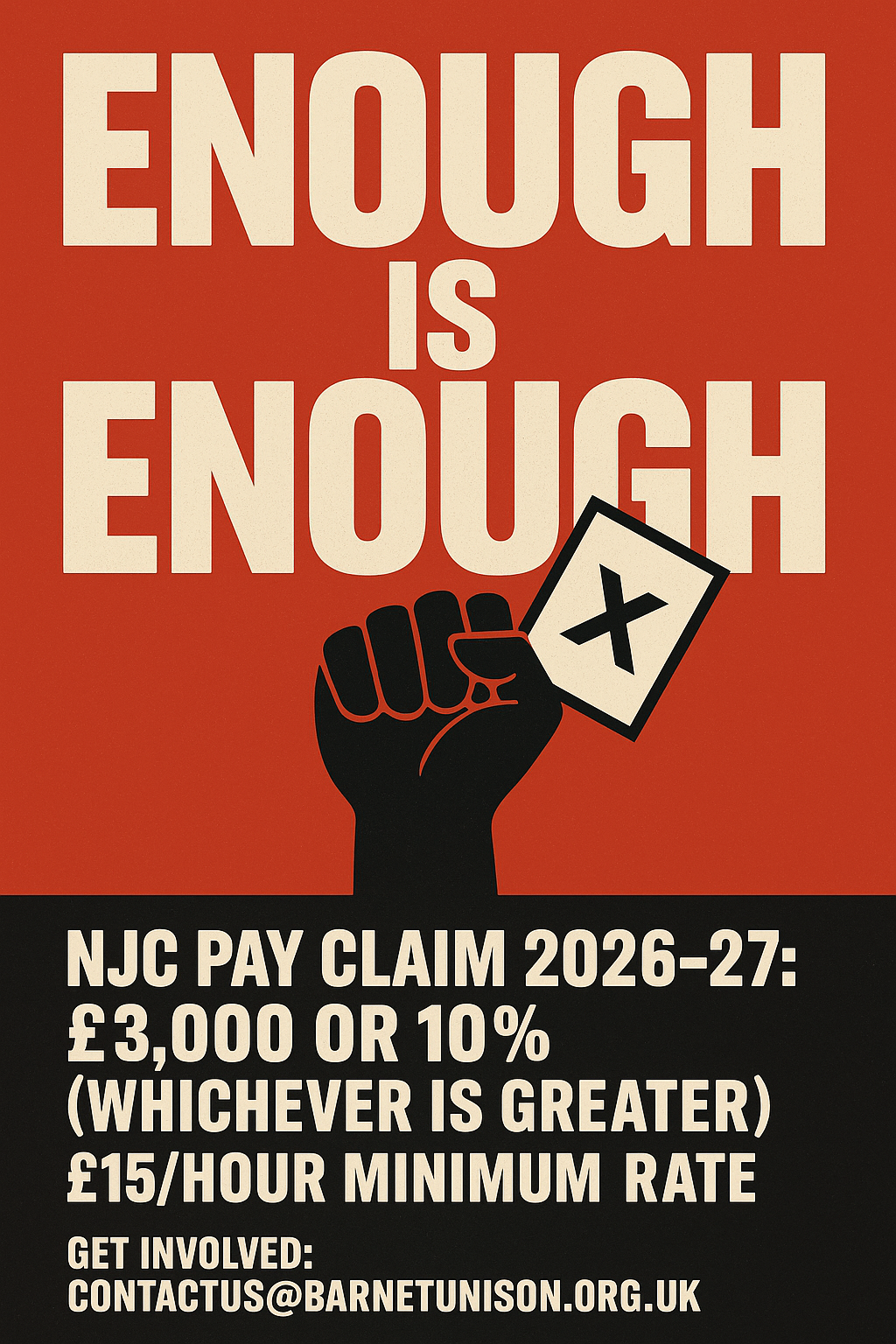
2026–27 NJC Pay Claim: £3,000 or 10% (whichever is greater) — and a £15 minimum hourly rate
Barnet UNISON members: this is the moment to stand together — and to get ready to fight for what we’re worth.
Unions representing 1.4 million council and school staff across England, Wales and Northern Ireland have submitted a pay claim for 2026–27 calling for:
- At least £3,000 or 10% (whichever is greater) for all staff
- A minimum hourly rate of £15
This claim is about respect, retention, and repairing years of pay cuts. Since 2010, the real value of local government pay has fallen by more than 26%. That isn’t a statistic — it’s rent you can’t cover, a food shop that costs more every week, travel that eats your wages, and bills that don’t stop climbing.
And in Barnet — in London, one of the most expensive cities in the world — that squeeze is brutal.
A message from your Barnet UNISON Branch Chair
“This pay claim is about dignity. It’s about saying clearly that the workers who keep Barnet running — in our schools, libraries, depots and frontline services — deserve better than falling wages and rising pressure.
We are building a pay campaign that’s strong, visible and member-led. That means every workplace, every team, every grade — standing together and backing this claim. Talk to your colleagues. Share the campaign messages. And please get involved with the branch so we can support you and keep you updated.
If you want to help build the campaign in your workplace, or if you’ve got questions about the claim and what happens next, contact us at contactus@barnetunison.org.uk.
And when the time comes to use our democratic vote, we must be ready. Because when members act together, we have real power — and we can win.”
— Helen Davies Barnet UNISON Branch Chair
London prices. Public service pay. Something has to give.
Our members are keeping services going under pressure that has become normalised: rising caseloads, constant vacancies, growing demand, and relentless change. People are exhausted — not because they don’t care, but because they care every day and are asked to do more with less, while pay falls behind again and again.
This is the reality Barnet workers are living with:
Depot worker: “I’m doing overtime just to stand still. Rent goes up, travel goes up, food goes up — but my pay doesn’t. I work hard, I do my bit, and I’m still worrying every month.”
Teaching assistant: “I love the kids and the job matters. But it’s getting harder to justify staying when I can’t afford basics. You shouldn’t need a second job to work in a school.”
School admin worker: “We’re the front door of the school. We keep everything running. But the pay doesn’t reflect the responsibility — or the stress.”
Coach escort: “I’m responsible for children’s safety. I shouldn’t be choosing between topping up the gas meter and paying for travel to work.”
Library worker: “People come to us for help with benefits forms, job searches, loneliness, crisis support — we’re more than books. But we’re paid like we’re disposable.”
Social worker: “Caseloads are huge, recruitment is hard, and experienced staff are leaving. Pay is part of it. You can’t build stable services on burnout and goodwill.”
OT: “We keep people safe and independent at home, preventing hospital admissions. That work saves money. But our pay has been eroded for years.”
Early Help: “We’re trying to stop families reaching crisis point, but we’re stretched thin. It’s ‘do more, do faster, do it all’ — and then be told there’s no money for pay.”
These are not complaints. They are warnings. If pay doesn’t rise properly, more experienced staff will leave for better-paid work, vacancies will widen, and services will be pushed to breaking point — not because workers failed, but because the system refused to value them.
“Enough is Enough” — and the power is in our hands
There’s a phrase that captures the mood across workplaces right now: Enough is Enough.
Enough of being told to be grateful.
Enough of “tight budgets” while workloads soar.
Enough of essential workers being treated as optional.
This claim is a line in the sand. And winning it will take more than a document — it will take members.
Not just the loudest. Not just the most confident. Every single one of us.
This is not a ballot — but it is the start of the campaign
To be crystal clear: we are not at the ballot stage. This claim has just been submitted to the employer. But we’re telling you now because the next stages matter:
In a couple of months’ time, we are likely to be asked to consult and to show where members stand. If we wait until that moment to start talking, we’re already behind. We build strength now — by understanding the claim, talking to colleagues, updating details, and preparing ourselves to use the most powerful tool working people have: our democratic vote.
When the time comes: return your vote — because silence is a “no”
If we reach the point where Barnet UNISON members are sent a ballot paper to their homes, one thing will matter immediately:
Returning your paper.
Not “meaning to.” Not “I’ll do it later.” Not “I’m not sure it will change anything.”
Ballots are won and lost on turnout. The employers and the government know it. They bank on people being busy, tired, moving house, thinking someone else will do it.
That’s why our message is simple — and serious:
When the vote arrives, the power is in your hands. Use it.
Because a mass return of papers is how we send a message that cannot be ignored:
schools and council workers will no longer put up with low pay.
What you can do right now
- Talk about the claim in your team — make it normal, make it shared, make it collective.
- Make sure Barnet UNISON has your up-to-date home address and contact details so nothing is missed later.
- Encourage a colleague to join UNISON — the bigger we are, the stronger we are.
- Watch out for updates as the employer response develops.
- To get involved or to find out more, email contactus@barnetunison.org.uk.
This is about dignity — and the future of our services
Refuse collectors, care workers, librarians, cleaners, school staff, social workers, OTs, Early Help workers, depot staff — we are the workforce that keeps Barnet functioning. We do it with skill, compassion, professionalism and pride.
But pride doesn’t pay the bills.
A real pay rise is not a luxury. It’s the minimum required to keep experienced staff, recruit new workers, and deliver services the public relies on.
Enough is Enough.
The claim is in. The campaign starts now. And when the time comes, we will be ready — together.
Barnet UNISON: we are the union. And the power is in our hands.
End.