FOR IMMEDIATE RELEASE — 17 JULY 2026 BARNET HOUSING AND CARE WORKERS MOVE TOWARDS STRIKE BALLOTS

FOR IMMEDIATE RELEASE — 17 JULY 2026

BARNET HOUSING AND CARE WORKERS MOVE TOWARDS STRIKE BALLOTS

Barnet Homes and Your Choice Barnet workers say “Enough is Enough” after TBG refuses to negotiate on pay, terms and pensions.

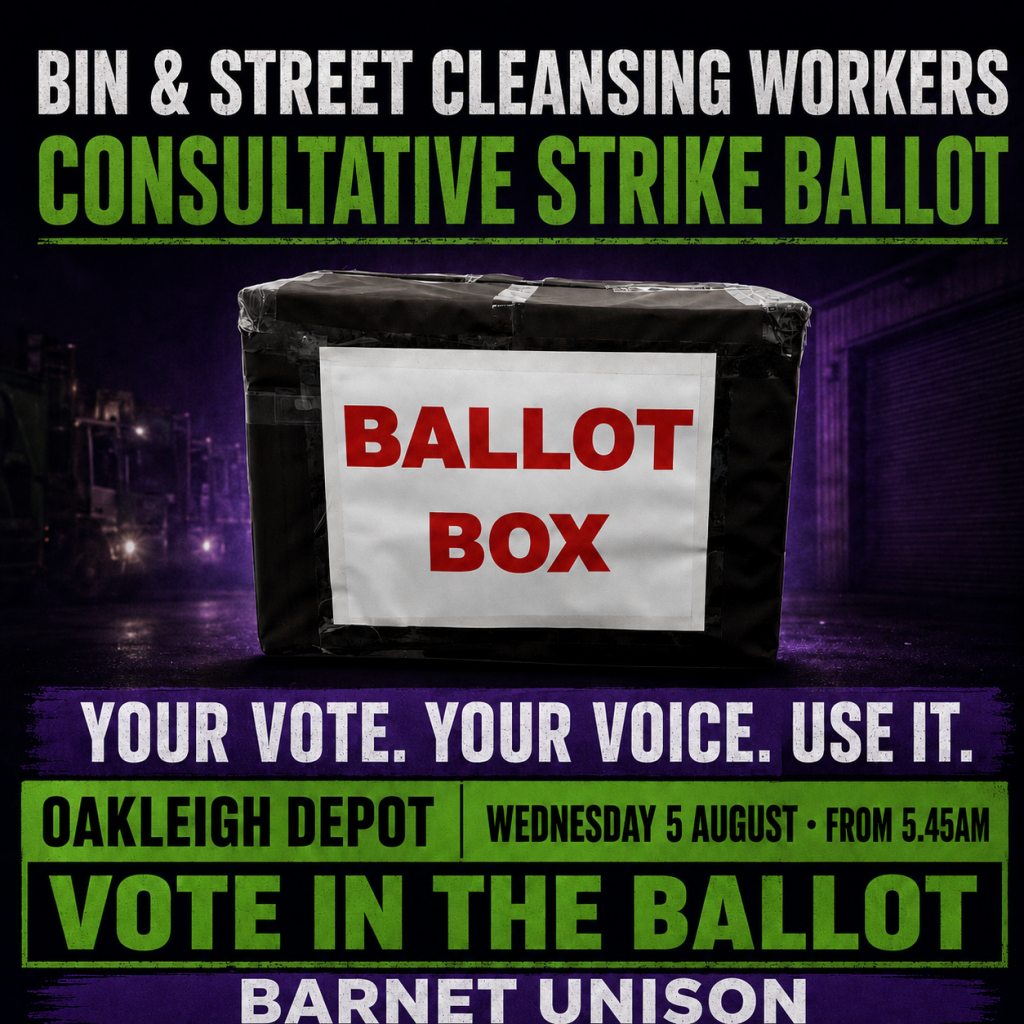
Barnet UNISON is preparing to request two separate formal industrial action ballots for members working in Barnet Homes and Your Choice Barnet, following a Special JNCC meeting with The Barnet Group today.

UNISON reported the results of two separate consultative ballots:

  • 97% of Your Choice Barnet members voted for industrial action
  • 100% of Barnet Homes members voted for industrial action

Despite these results, The Barnet Group confirmed at the meeting that it was not willing to negotiate on any part of UNISON’s claims.

The claims cover:

  • a proper pay increase, including a £15-an-hour minimum
  • improved terms and conditions
  • movement towards council-standard terms
  • access to the Local Government Pension Scheme

Barnet UNISON formally registered a failure to agree at the Special JNCC and advised TBG that the branch will now seek approval for separate statutory industrial action ballots for housing workers and care workers.

A Barnet Homes worker said:

“We deliver council housing services, but we are not treated like council workers. We work longer hours, receive worse terms and have no access to LGPS. Members have had enough of being told there is never any money for us.”

A Your Choice Barnet care worker said:

“We support vulnerable adults every day, often under huge physical and emotional pressure. Then we go home worrying about rent, food and bills. We are doing essential work in one of the most expensive cities in the world, but we are still treated as second-class.”

Helen Davies, Barnet UNISON Branch Chair and UNISON SGE representative for London, said:

“These ballot results send a powerful message. Housing and care workers are angry, organised and no longer prepared to accept second-class treatment. TBG has rejected every part of the claim and has now refused to negotiate, even after hearing that members are ready to take action. Enough is enough. Barnet Council owns The Barnet Group and cannot stand back while the workers delivering its services are treated this way.”

Barnet UNISON is calling on The Barnet Group and the London Borough of Barnet to return to negotiations with a serious proposal before the dispute escalates further.

Notes to editors

  • The Barnet Group is wholly owned by the London Borough of Barnet.
  • Barnet Homes provides housing services.
  • Your Choice Barnet provides adult social care services.
  • The consultative ballots were separate from the formal statutory industrial action ballots now being prepared.
  • Industrial action has not yet been authorised or called.

Media enquiries: contactus@barnetunison.org.uk

FOR IMMEDIATE RELEASE — JULY 2026 BARNET COUNCIL WORKERS UNDERPAID FOR TWELVE YEARS — AND OFFERED A FRACTION OF WHAT THEY ARE OWED

FOR IMMEDIATE RELEASE — JULY 2026

BARNET COUNCIL WORKERS UNDERPAID FOR TWELVE YEARS — AND OFFERED A FRACTION OF WHAT THEY ARE OWED

Barnet UNISON publishes the council’s offer and begins member consultation — as depot workers demand a strike ballot

Barnet UNISON is today publishing details of a formal settlement offer from the London Borough of Barnet following twelve years of holiday pay underpayments affecting council workers across waste and recycling, street cleansing, grounds maintenance, libraries, social care and other services.

The offer — six months’ backdated pay at 8.33% of non-contractual overtime — has been condemned by Barnet UNISON as wholly inadequate. The union is now consulting all affected members over the next four – six weeks.

What the offer means in real money

The law — confirmed at Supreme Court level — requires that regular non-contractual overtime is factored into holiday pay calculations. It was not, for twelve years. The table below shows what the council’s offer means for two typical depot roles, compared to what workers are actually owed on the same calculation:


Role Owed (12 years) Council offer (6 months)
Loader (Grade B) approx. £9,600 approx. £400
Driver (Grade F) approx. £14,400 approx. £600

(These figures are based on real overtime earnings for two depot roles and are given as examples only. Individual amounts will vary depending on how much overtime was worked over the twelve years. For some members it will be less — for others it could be considerably more.)

On the council’s own methodology, the full twelve-year liability runs to approximately £6 million. The council is offering £250,000 — shared across all affected Council staff.

That is roughly 4p for every £1 owed.

How it came to light

The council’s HR department did not raise this as an error. HR meets with Barnet UNISON at least once a week. Not once in twelve years did it acknowledge that holiday pay was being calculated incorrectly.

The issue came to light in April 2025 when members working in the depots noticed new payments on their payslips after Liberata took over the payroll contract from Capita and came to UNISON asking what they were. Low-paid workers reading their own payslips is what finally brought twelve years of underpayments to the surface.

Capita — the contractor at the centre of this failure

Capita ran the council’s payroll from October 2013 to 31 March 2025 — throughout the entire period the underpayment occurred and went uncorrected. The moment Liberata replaced Capita, the correct calculation began.


The Capita record at Barnet — by the numbers

•      Total paid to Capita since 2013: approximately £670 million — around £246 million more than the original contract value of £424 million (source: published council supplier payment data, analysed by independent researcher John Dix / Mr Reasonable)

•      Final year with most services returned in-house: Barnet still paid Capita £24 million — £2 million per month — for just three remaining services

•      A Capita employee stole £2,063,972 through fictitious compulsory purchase order payments. He was jailed for five years

•      Grant Thornton review (Project Rose) found: no budgetary controls, no basic bank detail checks, inexperienced managers handling large sums, no written financial procedures. The review cost up to £500,000 of public money

•      Around 170 council workers had pension contributions deducted from their wages by Capita but were never enrolled into the pension scheme

•      Barnet became the first public service pension scheme in the country to be fined by the Pensions Regulator — on Capita’s watch

•      Capita required to repay the council £4.12 million for delivery failures under the contract

The One Barnet programme was awarded by the previous Conservative administration in 2013 and described at the time as a model for efficient public services. The Guardian later described it as a “disastrous ideological outsourcing spending spree” that handed an array of local services to Capita. The promised savings never materialised. The bills kept growing.

The previous Conservative administration initially refused to publish the Grant Thornton report into the fraud, claiming it was not in the public interest. It was eventually published quietly on the council website with no announcement.

The offer — and the questions it raises

The council has cited severe financial pressure and described the payment as a “gesture of goodwill.” Barnet UNISON does not accept that framing. This is not a gesture of goodwill. It is money workers earned and were legally entitled to. The council’s own financial difficulties do not diminish what is owed.

They do, however, raise a direct question: has the council formally approached Capita about its financial responsibility for a payroll failure that persisted for twelve years under its management? If the council is under financial pressure, the answer is to pursue the contractor that failed — not to offer workers as little as possible.

The council also noted in its formal offer that it is “out of time” to make a backdated payment — yet simultaneously offered a backdated payment. Barnet UNISON has taken note of that contradiction.

What happens next

Barnet UNISON is today launching a four-week consultation of all affected members. If you have worked regular overtime at any point in the last twelve years, this may affect you. Members are encouraged to read the full details and contact the branch with any questions.

Barnet UNISON can confirm that one group of workers — depot staff in waste, recycling, street cleansing and grounds maintenance — have already made clear they regard this offer as wholly unacceptable and have demanded that UNISON ballot them for industrial action if the offer is not substantially improved.

If the consultation produces a strong vote to reject, Barnet UNISON will seek an urgent meeting with the Chief Executive to press for a substantially improved offer. If the employer refuses to negotiate further, Barnet UNISON will contact UNISON HQ with a view to proceeding to a formal, lawful strike ballot.

John Burgess, Branch Secretary, Barnet UNISON

This is what outsourcing looks like when it goes wrong and nobody is held to account. Capita ran Barnet’s payroll for twelve years. In that time, they failed to calculate holiday pay correctly, failed to enrol workers into their pensions properly, presided over a £2 million fraud, and walked away with the best part of £670 million of public money — around £246 million more than the contract was worth. The council either could not or would not hold them to account. And now, when the workers who were underpaid throughout all of that ask for what they are owed, the employer says there is no money.


There is always money when it comes to paying private contractors. There was apparently no money when it came to paying the people who empty the bins, clean the streets and keep this borough running.


This is a grave injustice. It is a clear example of how outsourcing damages workers and how weak this council was at holding Capita to account. We are consulting our members. Depot workers have already told us they want a ballot. We will be listening to what all of our members say — and we will act on it.

Get in touch

If you are an affected member and have questions about this offer, contact Barnet UNISON at contactus@barnetunison.org.uk or visit barnetunison.me.uk


Notes to Editors

Barnet UNISON represents approximately 3,000 workers employed by the London Borough of Barnet, The Barnet Group, Barnet Education and Learning Skills, and a range of contractors and associated employers. Members include street cleansing and waste workers, care workers, school support staff, social workers, council office staff and caretakers.

The legal obligation to include regular non-contractual overtime in holiday pay calculations arises from the Working Time Regulations 1998 and has been confirmed through a series of appellate decisions culminating in the Supreme Court judgment in Chief Constable of the Police Service of Northern Ireland v Agnew [2023].

The £670 million total Capita payment figure is sourced from John Dix’s independent annual analysis of Barnet Council’s published supplier payment data, available at reasonablenewbarnet.blogspot.com. The original combined contract value over ten years was approximately £424 million (source: Grant Thornton Project Rose review, published September 2018). The figure of £670 million should be attributed to published supplier payment data rather than cited as an official council figure.

The Grant Thornton Project Rose review is publicly available on the Barnet Council website. Trishul Shah was convicted of fraud and jailed for five years.

The holiday pay calculation was corrected from 1 April 2025, coinciding with Liberata taking over the payroll function from Capita.

Example figures (Loader approx. £400 offer / approx. £9,600 owed; Driver approx. £600 offer / approx. £14,400 owed) are illustrative, based on real overtime earnings data for those roles. Individual amounts will vary.

Media enquiries: contactus@barnetunison.org.uk

BARNET COUNCIL QUIETLY HALVED ITS PASSENGER ASSISTANT WORKFORCE — AND NEVER TOLD THE UNION

BARNET COUNCIL QUIETLY HALVED ITS PASSENGER ASSISTANT WORKFORCE — AND NEVER TOLD THE UNION

Trade union demands answers on outsourcing by stealth and the employment standards of workers supporting children with complex SEN needs

Barnet UNISON has formally challenged London Borough of Barnet and BELS management over the steady dismantling of the directly employed Passenger Assistant workforce — the staff who accompany children with special educational needs on school transport routes across the borough every day.

The directly employed workforce has been cut from approximately 85 in January 2021 to 42 today — a reduction of more than 50%. There are now 61 externally commissioned Passenger Assistants working on regular routes, outnumbering directly employed council staff. The council’s own documents confirm that vacancies have not been routinely refilled and that commissioned workers are used to meet continuing demand. No formal outsourcing exercise took place. No trade union consultation happened. No equality impact assessment was carried out.

Outsourcing in all but name

UNISON’s formal response — submitted to the JNCG chaired by the Chief Executive on 16 June 2026 — sets out that the council has effectively outsourced a public service through attrition: allowing permanent posts to disappear and replacing them with externally commissioned workers, without ever putting that decision to elected members as a workforce question or consulting the trade union.

A Cabinet report in May 2025 approved an external provider framework worth up to £1 million per year — £8 million over eight years. The same report records “None” under Consultation. The council is now saying that restoring direct employment would cost £225,000 per year more than the current model. That comparison has never been presented to Cabinet.

UNISON Branch Secretary John Burgess said: “The council hasn’t formally outsourced this service — it’s just stopped replacing people when they leave and handed the work to external providers instead. The outcome is the same. You’ve gone from 85 directly employed staff to 42, with 61 commissioned workers on regular routes doing the same job. No consultation, no equality assessment, no transparency. We need a straight answer: does the council intend to keep an in-house Passenger Assistant service or doesn’t it?”

Workers’ terms and conditions unknown

UNISON does not know what pay, sick pay, pension provision or continuity protections apply to the 61 commissioned Passenger Assistants currently working on regular routes. At the JNCG on 15 June, management confirmed they could not say what sick pay arrangements applied to commissioned workers.

For Passenger Assistants working daily with children who have complex health conditions and, in some cases, compromised immune systems, that is a direct health and safety concern. Workers without occupational sick pay are more likely to come in when unwell.

UNISON has also raised serious questions about health and safety incident reporting. Three separate reporting channels exist across the split management structure — none of them currently provides a complete picture of incidents involving Passenger Escorts on PTS routes. Management acknowledged at the JNCG that near misses are likely under-reported.

The Trade Union Engagement Framework, signed by the Chief Executive in December 2024, commits the council to sharing information with trade unions on service reviews and outsourcing matters, consulting on decisions affecting staffing, and giving serious consideration to keeping services in-house. UNISON has identified seven specific provisions that have not been honoured in this case. None of them were disputed at the JNCG.

A conflict of interest at the heart of the service

UNISON has also raised a structural concern about BELS’s role in the service. BELS simultaneously decides which routes are needed, manages contracts with external Passenger Assistant providers, and line-manages the directly employed LBB Passenger Assistants whose work the external contracts are displacing. UNISON has asked whether that arrangement has ever been subject to a formal governance review.

John Burgess added: “These are some of Barnet’s most vulnerable children. They build relationships with their Passenger Escorts over years. The council cannot say these workers are part of a commissioned model and then refuse to account for the employment standards that apply to them. We don’t know if they’re being paid the London Living Wage. We don’t know if they have sick pay. We don’t know what happens to a child’s regular escort if that worker isn’t available. That is not good enough.”

UNISON has set a 20-working day deadline for written responses. If those responses are not received, UNISON has indicated it will treat the matter as a formal failure to agree and will pursue the available routes.

NOTES TO EDITORS

Barnet UNISON represents approximately 3,000 members across the London Borough of Barnet, including employees of the council itself, its local authority trading companies (The Barnet Group and Barnet Education and Learning Services), schools, FE colleges, care services, environmental services, depots, and a range of contractors and outsourced providers.

The Passenger Transport Service provides school transport for children with special educational needs across 133 routes in Barnet.

The Trade Union Engagement Framework was signed by the Chief Executive of London Borough of Barnet in December 2024.

UNISON is separately pursuing an equal pay claim on behalf of more than 700 members against LBB, The Barnet Group, and BELS, with a preliminary Employment Tribunal hearing listed for September 2026.

Contact: Barnet UNISON — contactus@barnetunison.org.uk


Are you paying the right UNISON subscription?

Are you paying the right UNISON subscription?

One of the most common — and most easily fixed — membership problems we see is members paying the wrong subscription rate. With more people now joining online directly rather than through their employer’s payroll, your subscription doesn’t automatically go up when your pay does. That means many members are unknowingly undersubscribed.

This matters. UNISON’s rules are clear: your subscription must reflect what you actually earn. If it doesn’t, it can affect your access to representation and legal support when you need it most. That’s not a risk worth taking.

How subscriptions work

Your UNISON subscription is based on your annual salary. It’s calculated as a percentage of your earnings, so the more you earn, the more you pay — but the rates are genuinely affordable. Here’s what you should currently be paying:

Annual salary Monthly subscription
Up to £2,000 £1.30
£2,001 – £5,000 £3.50
£5,001 – £8,000 £5.30
£8,001 – £11,000 £6.60
£11,001 – £14,000 £7.85
£14,001 – £17,000 £9.70
£17,001 – £20,000 £11.50
£20,001 – £25,000 £14.00
£25,001 – £30,000 £17.25
£30,001 – £35,000 £20.30
Over £35,000 £22.50

Students and qualifying apprentices pay just £10 a year. Northern Ireland members have slightly different rates — contact the branch if that applies to you.

You can also claim tax relief on 70% of your subscription, which reduces the real cost further.

Check your subscription now

If you’ve had a pay rise — even a small one — check whether you’ve moved into a higher band. If you joined online and pay by direct debit, your rate won’t update automatically. You need to do it yourself.

You can update your details through My UNISON at unison.org.uk/my-unison or contact us at the branch and we’ll help you sort it.

Why it matters

UNISON’s support — whether that’s representation in a disciplinary, backing for a grievance, legal advice, or the equal pay work we’re doing right now — is only available to members who are in good standing. Paying the correct subscription is the foundation of that. It’s also how we fund the work: campaigns, organising, negotiations, and casework all depend on members being properly subscribed.

If you’re not sure what you’re paying or whether it’s right, get in touch. It takes five minutes to check and fix.

Contact Barnet UNISON: 0208 359 2088 or email contactus@barnetunison.org.uk


School Meals Workers — UNISON Needs to Hear From You

June 2026

If you work for ISS Catering in a Barnet school, please read this.

The council’s contract with ISS is coming to an end in March 2027. That does not necessarily mean your job ends — it may mean a change of employer, or it may mean staying with ISS under a new arrangement — but there will be changes, and UNISON needs to be on top of this from the start to protect your rights.

I have already been into meetings with Barnet Council management about what this means for catering staff and I will be going back in. I am pushing hard on the things that matter most — your pay, your London Living Wage, your pension, and making sure any transfer is handled properly and fairly. I am also making the case directly to the council and to elected councillors that bringing this service back in-house — so that you become council employees again — is the right thing to do. That fight is ongoing.

But I need to hear from you.

Our membership records are not always up to date, and things may have changed since many of you moved from the council to ISS back in 2016. I cannot represent you properly without knowing your current situation.

Please get in touch and let me know:

  • What job you are currently doing and which school you are based at
  • Whether your terms and conditions have changed since you moved to ISS — for example your pay, your hours, your holiday entitlement
  • Whether you are still in the Local Government Pension Scheme (LGPS) or whether your pension arrangements have changed
  • Whether your contact details or home address have changed
  • Whether you have any concerns or issues you want me to know about

Everything you tell me is treated in confidence. It comes to me directly and stays with me — I am not passing anything to ISS or to the council.

I know many of you will have questions I cannot fully answer yet. Things are still being worked out and I would rather be honest with you than give you information that turns out to be wrong. What I can tell you is that UNISON is in the room, I am attending every meeting, and your rights under TUPE mean your core terms and conditions are legally protected through any transfer.

Even if you have no concerns right now, please still get in touch with your current role and contact details. Every reply strengthens our position.

Contact Barnet UNISON directly: 📧 contactus@barnetunison.org.uk 📞 020 8359 2088

Not yet a UNISON member?

If a colleague has shared this with you and you are not yet in UNISON, now is exactly the right time to join. You can sign up at unison.org.uk/join or contact John directly and he will help you join over the phone.

End.

CAPITA CONTRACT ENDING — WHAT YOU NEED TO KNOW

CAPITA CONTRACT ENDING — WHAT YOU NEED TO KNOW

I want to let you know that the Capita contract with the London Borough of Barnet is coming to an end. New providers will be taking over a range of services from 1 October 2026.

I am currently in discussions with LBB management about what this means in practice — for services, for staffing, and for you as UNISON members. I will update you as things become clearer, but I didn’t want to wait until everything was finalised before making contact.

WHAT IS TUPE AND DOES IT APPLY TO ME?

The process that will apply to most of you is called TUPE — Transfer of Undertakings (Protection of Employment Regulations). In plain terms, this is the legal framework that is supposed to protect your job and your terms and conditions when a service changes hands. I will be involved in that process on your behalf.

But I can only do that job properly if I know who you are, what you’re doing, and what your current situation is.

I NEED TO HEAR FROM YOU DIRECTLY

Here’s the problem — our records may not be up to date. Some of you will have changed roles, moved to a different service area, or had changes to your terms and conditions since you left LBB. We may not have your current contact details.

If I’m going into bat for members in a TUPE process, I need accurate information, not outdated records.

Please email me directly at contactus@barnetunison.org.uk and let me know:

  • What is your current job title?
    • Which service area are you working in (e.g. Customer Services, Revenues and Benefits, IT, Payroll)?
    • Have your terms and conditions changed since you were with LBB — pay, leave, sick pay, anything?
    • Are you still in the Local Government Pension Scheme (LGPS)?
    • Have you moved address, or have your personal contact details changed?
    • Do you have any concerns or issues you want to flag to me now?

Please don’t assume someone else will pick this up. I need to hear from you individually.

IF YOU ARE WORRIED — CONTACT ME NOW

If there are things already worrying you — about your job, your pension, what happens next — tell me now. This is exactly the time to raise it, not after transfer letters have landed.

I will be in touch again as things develop. In the meantime, my door is open.

You can contact me at: Email: contactus@barnetunison.org.uk

In solidarity,

John
Branch Secretary, Barnet UNISON


CLIVE LEWIS MP BACKS BARNET’S CLEANERS IN FIGHT AGAINST NORFOLK-OWNED CONTRACTOR

Norwich South MP writes to Norfolk County Council demanding action over Norse Group’s 12-day pay lag

Barnet UNISON has welcomed the intervention of Clive Lewis MP, Member of Parliament for Norwich South, who has written to Norfolk County Council demanding it use its ownership powers to force Norse Group to pay its lowest-paid workers on time.

Read letter to Leader of Norfolk Council RE Norse Group Clive Lewis MP

https://www.barnetunison.me.uk/wp/wp-content/uploads/2026/06/26-06-04-Letter-to-Leader-of-Norfolk-Council-RE-Norse-Group-Clive-Lewis-MP.pdf

Norse Group — the largest Local Authority Trading Company in the country, wholly owned by Norfolk County Council — operates the cleaning contract for the London Borough of Barnet. The company imposes a pay arrangement that forces cleaners to wait 12 days after completing every four-week working period before receiving their wages. Norse’s own pay schedule confirms the 12-day gap applies to every single pay period throughout the year without exception.

These are London Living Wage workers in one of the most expensive cities in the world. At any given moment, Norse holds approximately six weeks’ worth of earned wages belonging to its lowest-paid staff.

Clive Lewis MP wrote to the Leader of Norfolk County Council stating:

“The lowest-paid workers on the contract are subsidising Norse’s payroll operation with 12 days of their earned wages per period. That is not an ethical business model, and it is not consistent with the values that a publicly owned company ought to embody.”

His letter directly challenges Norse’s claim that the arrangement is required for HMRC compliance, calling it a commercial and administrative choice rather than a legal requirement, and rejects the company’s suggestion that workers should take credit union loans to bridge the gap as “an indictment of the arrangement.”

Helen Davies, Branch Chair of Barnet UNISON & UNISON SGE rep for London Region, said:

“We are grateful to Clive Lewis for acting quickly and decisively. He has gone straight to the heart of the matter — Norse is owned by Norfolk County Council, and the Council cannot wash its hands of responsibility for how this company treats its workers. Norfolk created Norse, Norfolk owns Norse, and Norfolk receives an annual dividend from Norse. The workers making that dividend possible deserve to be paid on time.

“We now call on Norfolk County Council to respond without delay and direct Norse to change this arrangement — not just for our members in Barnet, but for all 1,725 Norse employees across the country subject to the same pay lag.”

Barnet UNISON has also written to all 31 Barnet Labour Councillors, the four Barnet Labour MPs, and Green Councillor Charli Thompson calling for urgent intervention and a commitment to bring the cleaning contract back in-house when it expires in 2027.

The Barnet UNISON petition calling on Norse to pay workers on time and for the cleaning service to be insourced in 2027 remains open.

Sign the petition: https://www.megaphone.org.uk/petitions/pay-barnet-s-cleaners-on-time-and-bring-cleaning-back-in-house?source=rawlink&utm_source=rawlink&share=67ca7052-c387-43a8-bd8f-201c05771705

ENDS

For media enquiries contact: Barnet UNISON contactus@barnetunison.org.uk


BARNET’S CLEANERS FORCED TO WAIT 12 DAYS FOR WAGES THEY HAVE ALREADY EARNED

FOR IMMEDIATE RELEASE:

BARNET’S CLEANERS FORCED TO WAIT 12 DAYS FOR WAGES THEY HAVE ALREADY EARNED

Barnet UNISON demands action from councillors and MPs as Norse Group — a Local Authority Trading Company owned by Norfolk County Council

Barnet UNISON, representing workers across the London Borough of Barnet, is calling on Labour councillors and MPs to urgently intervene after Norse Group imposed a pay arrangement that forces cleaners to wait 12 days after completing four weeks of work before receiving their wages.

Norse Group, owned by Norfolk County Council, was awarded the contract to clean Barnet Council’s buildings. The company’s own 2025/2026 pay schedule — obtained by Barnet UNISON — confirms, without a single exception across all 17 pay periods, a uniform 12-day gap between the end of every working period and every payday. By the time a cleaner is paid, they are already nearly a fortnight into their next four-week working period.

These are London Living Wage workers in one of the most expensive cities in the world. At any given moment, Norse is holding approximately six weeks’ worth of earned wages that belong to our members.

Helen Davies, Branch Chair of Barnet UNISON, said:

“These cleaners get up before dawn to clean the Council’s own buildings. They work four weeks. Then they have to wait another 12 days for money that is rightfully theirs. In the meantime, they cannot pay their rent, their travel costs, their energy bills. They are being forced into overdrafts and debt to cover basic living costs while Norse sits on their wages.

“Norse told us this is about payroll compliance. That is not credible. The reality is that these workers — the lowest paid in public services — are being made to finance Norse’s payroll processing. Their solution was to offer our members a loan. We rejected that with contempt. You should not have to take a loan to access wages you have already earned.

“This is happening under a contract commissioned by Barnet Council. Labour councillors and Labour MPs have the power to act. After last week’s elections and the Prime Minister’s own words about fighting for working people who have been let down, we expect them to use it.”

The detriment to workers is concrete and serious:

  • Workers on the London Living Wage cannot meet rent, bills, and travel costs on the dates they fall due because 12 days of earned wages are withheld
  • Workers on Universal Credit face assessment period distortions caused by the irregular pay timing, causing fluctuating UC awards they depend upon
  • Workers are pushed into overdraft and high-cost credit to cover living costs in the gap between earning and receiving their wages
  • Norse’s proposal that new starters take credit union loans was firmly rejected by UNISON — workers should not go into debt to access money they have earned

Norse’s justification does not stand up. The company has argued that its payroll arrangement is required for compliance with HMRC’s National Minimum Wage framework. Barnet UNISON rejects this entirely. The NMW classification of “time work” determines how minimum wage compliance is calculated — it says nothing about how many days after a period ends an employer may delay payment. Thousands of hourly-paid workers across the public and private sectors are paid within five days of a period’s end. A 12-day lag is a commercial choice, not a legal requirement.

Barnet UNISON is calling for:

  1. Labour councillors and MPs to write formally to Norse Group demanding the pay lag be reduced to a maximum of five working days from period end
  2. Barnet Council to review whether the Norse contract complies with its obligations under the Public Services (Social Value) Act 2012
  3. A commitment from Barnet’s Labour administration that when the Norse contract expires in 2027, the cleaning service will be brought back in-house, with workers employed directly by the Council on proper terms and conditions
  4. Public support from Labour councillors and MPs for the Barnet UNISON petition, which is being formally launched this week

Background:

Norse Group is the largest Local Authority Trading Company in the country, generating profit for its shareholder, Norfolk County Council, through service contracts with other councils. Barnet UNISON has held two formal meetings with Norse management. On both occasions the company refused to change the pay arrangement. Barnet UNISON has also written previously to the Leader of Barnet Council and to all Labour councillors, without the response this situation demands.

The Prime Minister, in his speech to Labour members on 11 May 2026, acknowledged that “for working people, tired of a status quo that has failed them, change cannot come quickly enough.” For Barnet’s cleaners, change means being paid promptly for work they have done. That is not an unreasonable demand.

ENDS

For media enquiries contact: contactus@barnetunison.org.uk

Notes to Editors:

  • Norse Group is a Local Authority Trading Company wholly owned by Norfolk County Council, operating across the country through contracts with local authorities
  • The Norse Group 2025/2026 pay schedule, obtained by Barnet UNISON, shows a consistent 12-day gap between period end and payday across all 17 pay periods in the schedule
  • The current Norse cleaning contract with the London Borough of Barnet is due to expire in 2027
  • Barnet UNISON represents over 3,000 members working across Barnet Council, schools, FE colleges, depots, care services, and contracted services
  • The London Living Wage is set annually by the Living Wage Foundation and is higher than the statutory National Living Wage

Barnet UNISON condemns “back door privatisation” of Passenger Escort service and escalates dispute to meeting with Chief Executive

FOR IMMEDIATE RELEASE: Barnet UNISON condemns “back door privatisation” of Passenger Escort service and escalates dispute to meeting with Chief Executive

Barnet UNISON has escalated its concerns about the future of Passenger Escorts at Barnet Council after formally registering a failure to agree with management.

The union says the Council has been cutting directly employed Passenger Assistant posts and using external provision instead, without proper transparency or meaningful consultation with UNISON.

Management have confirmed that vacancies were not being refilled and that part of the service requirement was being met through externally commissioned Passenger Assistants. Barnet UNISON says this amounts to back door privatisation of a vital frontline service supporting children and young people with special educational needs and disabilities.

The union has now referred the matter to the Joint Negotiation and Consultation Group, where it will be raised with the Chief Executive.

A Barnet UNISON spokesperson said:

“We have had enough outsourcing in Barnet. We are opposed to back door privatisation and we do not accept low-paid women being made to carry the burden of yet more austerity and hardship.

This is happening in the middle of the worst cost of living crisis in a lifetime, in one of the most expensive cities in the world. It is wrong.

Passenger Escorts do difficult, responsible and essential work supporting children with special needs. They deserve decent pay, decent terms and conditions, access to a pension, proper training, proper management support and the security of direct employment by the Council.

Barnet UNISON has formally escalated this matter to a meeting with the Chief Executive because council jobs should stay council jobs. We will not stand by while low-paid frontline services are hollowed out by stealth.”

Barnet UNISON is calling on Barnet Council to:

  • provide a full and accurate breakdown of the current Passenger Assistant workforce across the service, including how many are directly employed by LBB, how many are agency, and how many are employed by contractors or commissioned providers
  • stop any further erosion of directly employed Passenger Assistant posts
  • begin recruiting Passenger Escorts directly to Barnet Council posts rather than relying on agency or external arrangements
  • return Passenger Escorts to direct management under the Passenger Transport Service
  • ensure Passenger Escorts have decent pay, decent terms and conditions, pension access, proper training and proper support to carry out this essential role

Barnet UNISON says the issue is not just about staffing numbers. It is about fairness, accountability and the future of public services in Barnet.

Ends

For media enquiries contact: contactus@barnetunison.org.uk

Barnet UNISON response: working people must come first

UNISON General Secretary Andrea Egan has issued a clear message: working people cannot be treated as an afterthought.

For Barnet UNISON members, this speaks directly to what we are seeing every day in our workplaces. Our members are dealing with the cost-of-living crisis, rising rents, food bills, debt, stress, unsafe staffing levels and services under pressure. Too many workers delivering public services are still low paid, outsourced, denied decent pensions and left on inferior terms and conditions.

That has to change.

Andrea’s message is important because it says clearly that politics must return to its basic purpose: improving the lives of working people. That means proper pay restoration for public service workers. It means investment in councils, schools, care, housing, cleaning, transport, social work and all the services our communities rely on. It means ending the failed model of outsourcing, where public money is siphoned away from services while workers are left on poorer pay, poorer pensions and poorer conditions.

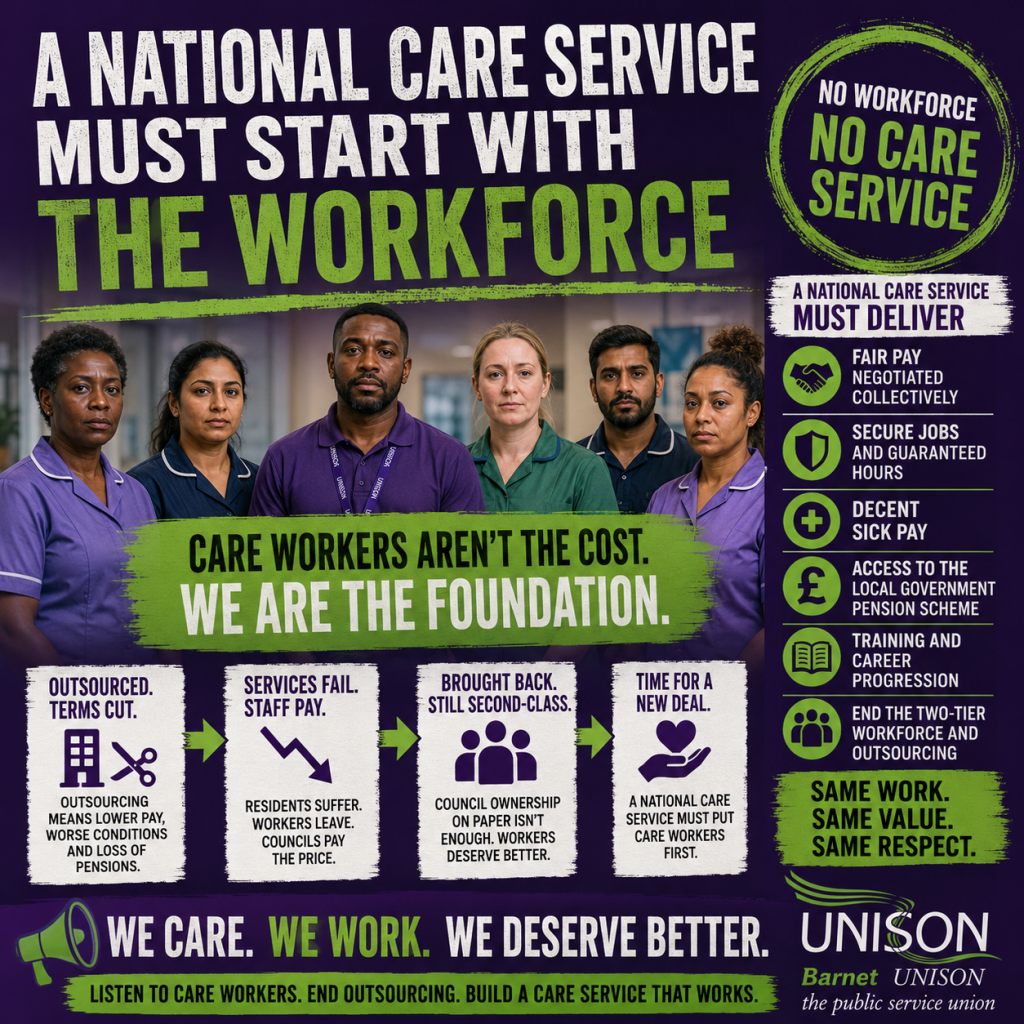
In Barnet, we know exactly what outsourcing has meant. It has meant low-paid workers being pushed to the margins. It has meant cleaners, care workers, housing workers, parking workers, security staff, catering workers and others being treated differently from directly employed staff, even though they are delivering public services for our community.

Barnet UNISON’s position is simple: public services should be delivered by properly paid, properly supported, directly employed public service workers.

We welcome Andrea Egan’s call for radical change because our members cannot wait. The cost-of-living crisis is not an abstract political debate. It is the daily reality of workers choosing between bills, food, travel and supporting their families. It is the stress members bring into work every day. It is the reason we are campaigning on pay, pensions, equal pay, holiday pay, insourcing and better terms and conditions.

Barnet UNISON will continue to organise, campaign and speak up for our members. We will not be silent when low-paid workers are struggling. We will not accept outsourcing as normal. We will not accept public services being run down while workers are told to do more with less.

The message from our General Secretary is clear: working people must come first.

That is our message too.

Barnet UNISON will keep fighting for:

  • fair pay and pay restoration
  • equal pay for low-paid women workers
  • insourcing of outsourced services
  • decent pensions for all public service workers
  • proper staffing levels
  • safe workplaces
  • dignity and respect at work
  • public services run for people, not profit

Our members built these services. Our members keep them running. Our members deserve better.

Barnet UNISON will continue to put working people first.

End.

Background: 

Opinion: I want Labour to succeed, but that means radical change

1 2 3 67