

BARNET COUNCIL QUIETLY HALVED ITS PASSENGER ASSISTANT WORKFORCE — AND NEVER TOLD THE UNION
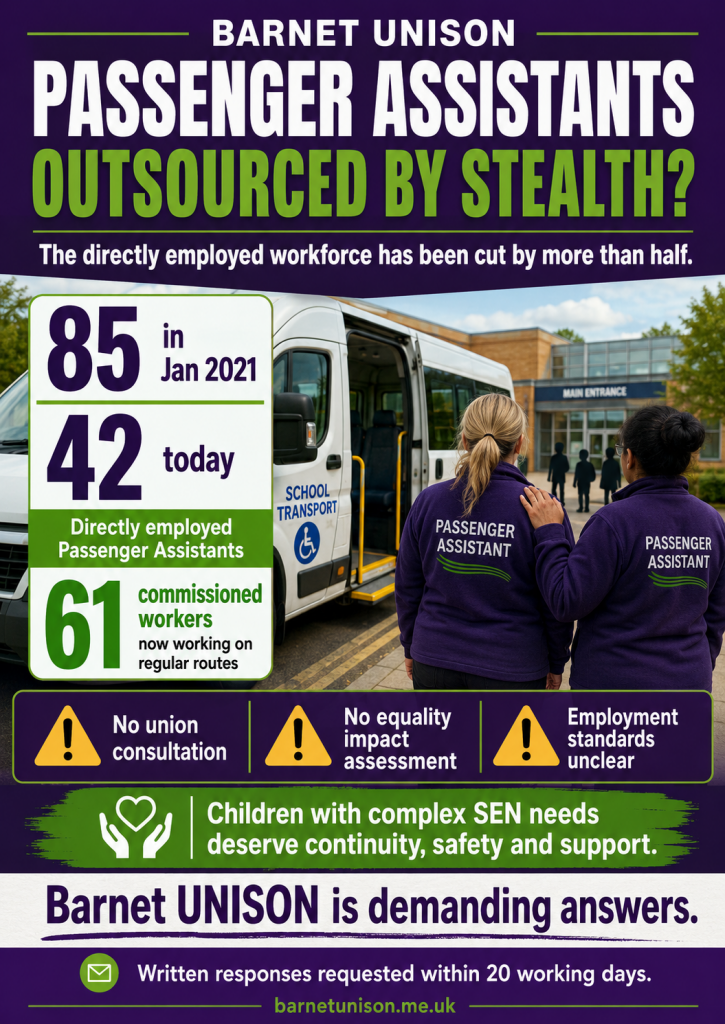
BARNET COUNCIL QUIETLY HALVED ITS PASSENGER ASSISTANT WORKFORCE — AND NEVER TOLD THE UNION
Trade union demands answers on outsourcing by stealth and the employment standards of workers supporting children with complex SEN needs
Barnet UNISON has formally challenged London Borough of Barnet and BELS management over the steady dismantling of the directly employed Passenger Assistant workforce — the staff who accompany children with special educational needs on school transport routes across the borough every day.
The directly employed workforce has been cut from approximately 85 in January 2021 to 42 today — a reduction of more than 50%. There are now 61 externally commissioned Passenger Assistants working on regular routes, outnumbering directly employed council staff. The council’s own documents confirm that vacancies have not been routinely refilled and that commissioned workers are used to meet continuing demand. No formal outsourcing exercise took place. No trade union consultation happened. No equality impact assessment was carried out.
Outsourcing in all but name
UNISON’s formal response — submitted to the JNCG chaired by the Chief Executive on 16 June 2026 — sets out that the council has effectively outsourced a public service through attrition: allowing permanent posts to disappear and replacing them with externally commissioned workers, without ever putting that decision to elected members as a workforce question or consulting the trade union.
A Cabinet report in May 2025 approved an external provider framework worth up to £1 million per year — £8 million over eight years. The same report records “None” under Consultation. The council is now saying that restoring direct employment would cost £225,000 per year more than the current model. That comparison has never been presented to Cabinet.
UNISON Branch Secretary John Burgess said: “The council hasn’t formally outsourced this service — it’s just stopped replacing people when they leave and handed the work to external providers instead. The outcome is the same. You’ve gone from 85 directly employed staff to 42, with 61 commissioned workers on regular routes doing the same job. No consultation, no equality assessment, no transparency. We need a straight answer: does the council intend to keep an in-house Passenger Assistant service or doesn’t it?”
Workers’ terms and conditions unknown
UNISON does not know what pay, sick pay, pension provision or continuity protections apply to the 61 commissioned Passenger Assistants currently working on regular routes. At the JNCG on 15 June, management confirmed they could not say what sick pay arrangements applied to commissioned workers.
For Passenger Assistants working daily with children who have complex health conditions and, in some cases, compromised immune systems, that is a direct health and safety concern. Workers without occupational sick pay are more likely to come in when unwell.
UNISON has also raised serious questions about health and safety incident reporting. Three separate reporting channels exist across the split management structure — none of them currently provides a complete picture of incidents involving Passenger Escorts on PTS routes. Management acknowledged at the JNCG that near misses are likely under-reported.
The Trade Union Engagement Framework, signed by the Chief Executive in December 2024, commits the council to sharing information with trade unions on service reviews and outsourcing matters, consulting on decisions affecting staffing, and giving serious consideration to keeping services in-house. UNISON has identified seven specific provisions that have not been honoured in this case. None of them were disputed at the JNCG.
A conflict of interest at the heart of the service
UNISON has also raised a structural concern about BELS’s role in the service. BELS simultaneously decides which routes are needed, manages contracts with external Passenger Assistant providers, and line-manages the directly employed LBB Passenger Assistants whose work the external contracts are displacing. UNISON has asked whether that arrangement has ever been subject to a formal governance review.
John Burgess added: “These are some of Barnet’s most vulnerable children. They build relationships with their Passenger Escorts over years. The council cannot say these workers are part of a commissioned model and then refuse to account for the employment standards that apply to them. We don’t know if they’re being paid the London Living Wage. We don’t know if they have sick pay. We don’t know what happens to a child’s regular escort if that worker isn’t available. That is not good enough.”
UNISON has set a 20-working day deadline for written responses. If those responses are not received, UNISON has indicated it will treat the matter as a formal failure to agree and will pursue the available routes.
NOTES TO EDITORS
Barnet UNISON represents approximately 3,000 members across the London Borough of Barnet, including employees of the council itself, its local authority trading companies (The Barnet Group and Barnet Education and Learning Services), schools, FE colleges, care services, environmental services, depots, and a range of contractors and outsourced providers.
The Passenger Transport Service provides school transport for children with special educational needs across 133 routes in Barnet.
The Trade Union Engagement Framework was signed by the Chief Executive of London Borough of Barnet in December 2024.
UNISON is separately pursuing an equal pay claim on behalf of more than 700 members against LBB, The Barnet Group, and BELS, with a preliminary Employment Tribunal hearing listed for September 2026.
Contact: Barnet UNISON — contactus@barnetunison.org.uk