

A National Care Service must start with the workforce
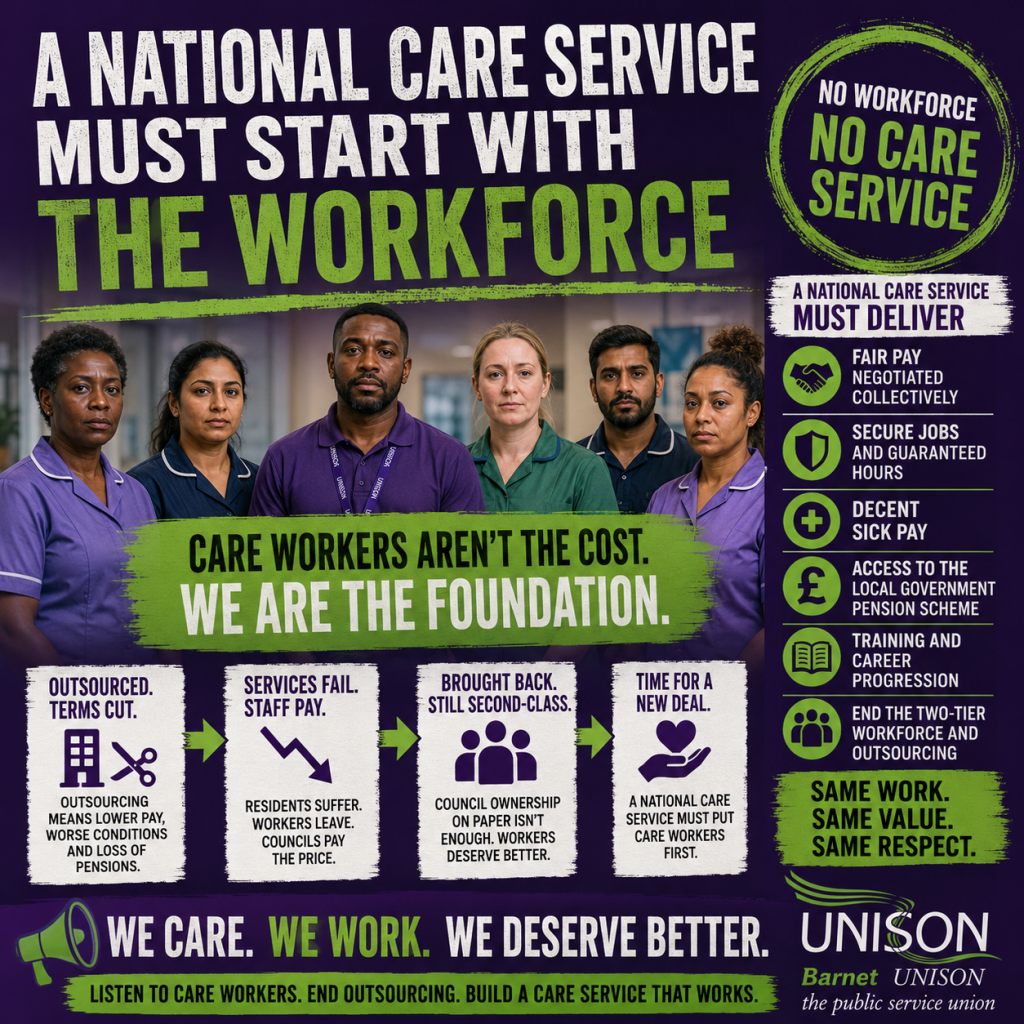
A National Care Service must start with the workforce
Rebecca Long-Bailey is right to argue that social care should become a universal public service, built on the same principle as the NHS: care according to need, not ability to pay.
But after 31 years as a UNISON representative, and decades organising and representing care workers in Barnet, I believe something fundamental is still missing from the national debate.
Politicians and the media repeatedly ask how much a National Care Service will cost and how it should be funded.
Those are important questions, but they are not the only questions.
We also need to ask who will provide the care, who will employ them, and on what pay, pensions and conditions.
There is no National Care Service without a national care workforce.
Three decades of outsourcing in Barnet
My first major involvement with care workers began in the late 1990s, when Barnet Council decided to outsource its residential care homes and day services.
The case put forward was that outsourcing was needed to secure investment in new and improved buildings.
Barnet UNISON opposed the proposal. We organised members and produced alternative reports challenging the argument that outsourcing was the only way to improve services.
At the same time, the council was implementing the national Single Status agreement. Care workers were moved from spot salaries onto a career-grade structure intended to provide fairer and more consistent pay.
The ink was barely dry on those new arrangements before the workers were told they were being outsourced.
The staff transferred to the Fremantle Trust. A few years later, the employer moved to impose significantly worse contracts.
Our members faced cuts to pay, sick pay and annual leave. Barnet UNISON members resisted through strike action, rallies, campaigning and meetings in Parliament.
We fought hard, but the cuts were imposed.
Much of the progress achieved through Single Status was undone. Skilled care workers delivering a public service were left with lower pay and weaker employment protections.
That experience taught us an important lesson.
Improvements negotiated through collective bargaining can be taken away when workers are transferred outside direct public employment.
The outsourcing model failed workers and services
The care-home contract later became the subject of a major financial dispute between Barnet Council and Catalyst Housing, which had partnered with Fremantle in the contract.
The dispute went to arbitration and resulted in substantial costs for the council.
Barnet Council eventually withdrew from the remaining contract. The services and staff transferred to Your Choice Barnet, part of the council-owned Barnet Group.
But the service did not return directly to the council.
The workers remained employed at arm’s length, outside council terms and conditions.
The history continued with the closure of Apthorp Care Home.
Residents had to leave their home and staff who had worked throughout the pandemic faced redundancy.
The building was reported to require millions of pounds of repairs despite being relatively new.
Once again, residents and workers carried the consequences of decisions made above them.
Home care followed the same pattern
Barnet UNISON also fought to retain the council’s in-house home-care service.
That service was outsourced.
Years later, part of the outsourced provision transferred to Aquaflo Care. The transfer ran into serious difficulties and the service was subsequently brought into The Barnet Group.
Several years later, The Barnet Group announced plans to close its Enablement Home Care Service.
The pattern has repeated itself throughout my time representing care workers:
A public service is outsourced.
The workforce is transferred.
Pay, pensions and conditions become fragmented.
The contract or provider runs into difficulty.
The service may eventually return to a council-owned organisation, but the workers do not necessarily regain council employment, council conditions or access to the Local Government Pension Scheme.
This is not history—our members are living it now
Today, Barnet UNISON is involved in a major dispute involving care workers employed by Your Choice Barnet.
These workers deliver essential adult social care services on behalf of Barnet Council.
They supported vulnerable residents throughout COVID. They carried on working when the risks to themselves and their families were very real.
Yet they remain part of a two-tier workforce.
They do not have the same core pay, terms and pension arrangements as directly employed council staff.
Our members are seeking fair pay, improved terms and conditions, a transparent pay structure and access to the Local Government Pension Scheme.
They should not have to consider strike action to secure basic fairness from an organisation wholly owned by the council.
This dispute exposes the gap between political promises about the future of social care and the reality experienced by the workforce.
The Prime Minister can speak about creating a National Care Service, but those words will mean little to care workers who remain underpaid, excluded from decent pensions and treated as second-class public-service workers.
A National Care Service cannot be credible if public bodies continue to deliver care through employment models that keep staff on inferior conditions.
The employment model matters
A National Care Service cannot simply be a new funding stream poured into the existing fragmented care market.
It cannot succeed while care remains dependent on outsourcing, low pay, insecure employment, inadequate sick pay and poor pension provision.
Nor is it enough to transfer services into council-owned companies while keeping the workforce outside council employment standards.
Public ownership must mean more than ownership on paper.
There must be no compromise about the employment model for care.
Care should be delivered as a public service through publicly accountable organisations.
Care workers should have:
- fair pay determined through collective bargaining;
- secure employment and guaranteed hours;
- decent occupational sick pay;
- nationally recognised training and genuine career progression;
- equal treatment across the workforce;
- and access to the Local Government Pension Scheme or an equivalent high-quality public-service pension.
There must also be a clear route for outsourced care services and their workers to return to direct public employment without losing existing contractual rights.
Listen to care workers
Any government serious about creating a National Care Service must speak directly to care workers and their trade unions before deciding how it will operate.
Care workers are not an afterthought.
They are not simply a cost in a funding model.
They are the people who make the service possible.
They understand what repeated outsourcing, fragmented commissioning and staff shortages mean in practice.
They know what happens when experienced workers leave because they cannot afford to remain in care.
They understand the impact that workforce instability has on older and disabled people who rely on consistent, trusted support.
For more than three decades, I have watched politicians praise care workers while supporting or tolerating employment models that hold down their pay, remove access to decent pensions and weaken collective bargaining.
Warm words are not enough.
Medals are not enough.
Calling workers heroes is not enough.
The care workforce is predominantly female, and many care workers are Black or Asian. They carry out skilled, physically demanding and emotionally demanding work.
They need justice at work, not another political promise that leaves their employment conditions untouched.
A National Care Service must be built around the people who provide the care.
It must end outsourcing and the two-tier workforce.
It must provide fair pay, decent conditions, collective bargaining and proper pensions.
The Prime Minister should start by looking at what is happening to care workers now, including those employed by council-owned companies such as The Barnet Group.
If the Government is serious about a National Care Service, it should support an employment model that treats care workers as public-service professionals—not as a source of savings.
Without a respected and properly rewarded workforce, there is no National Care Service.
Anything less is not good enough.
John Burgess
Branch Secretary, Barnet UNISON
UNISON representative for 31 years and lead representative for approximately 3,000 members