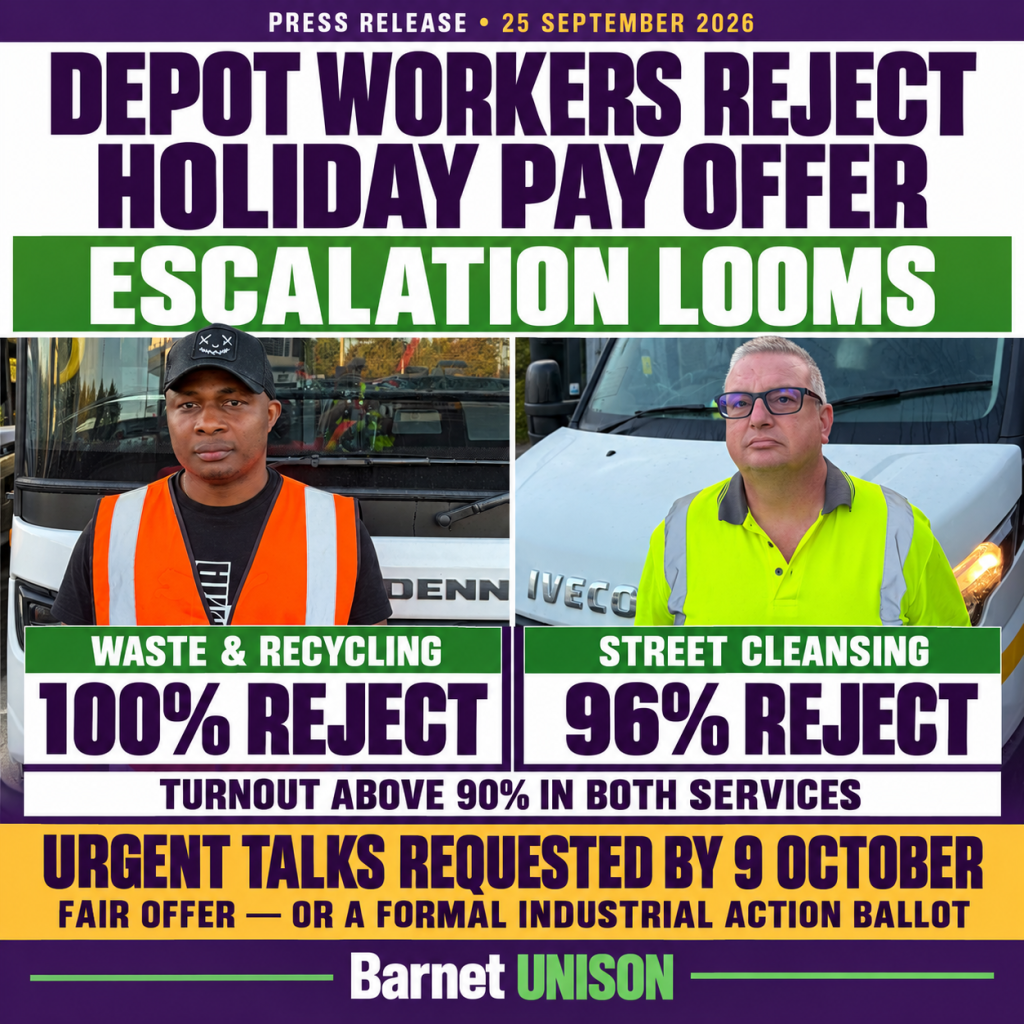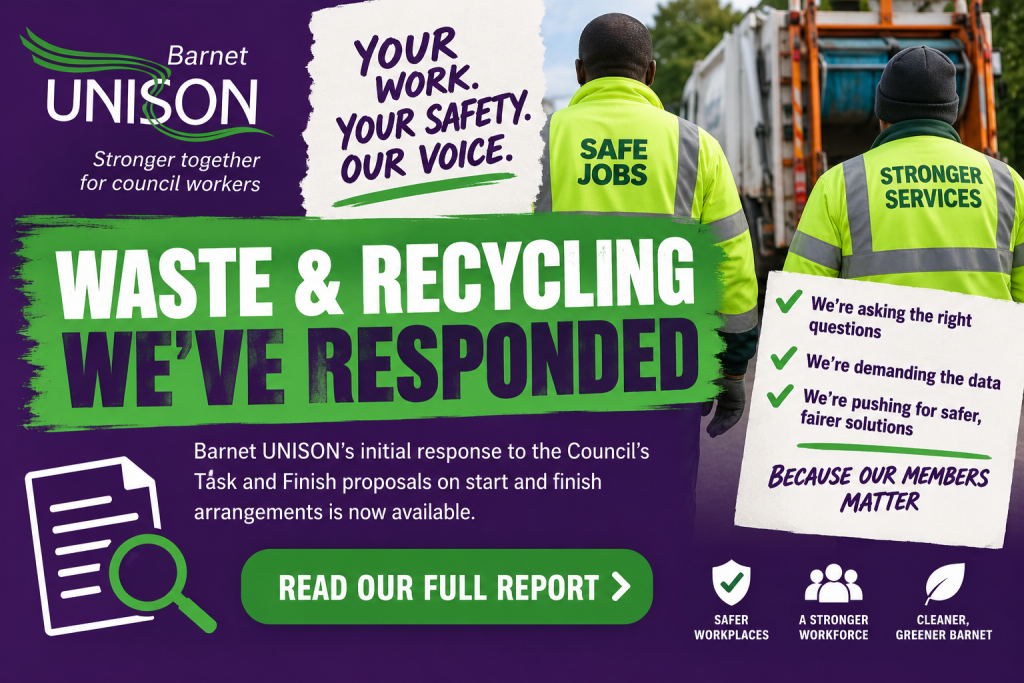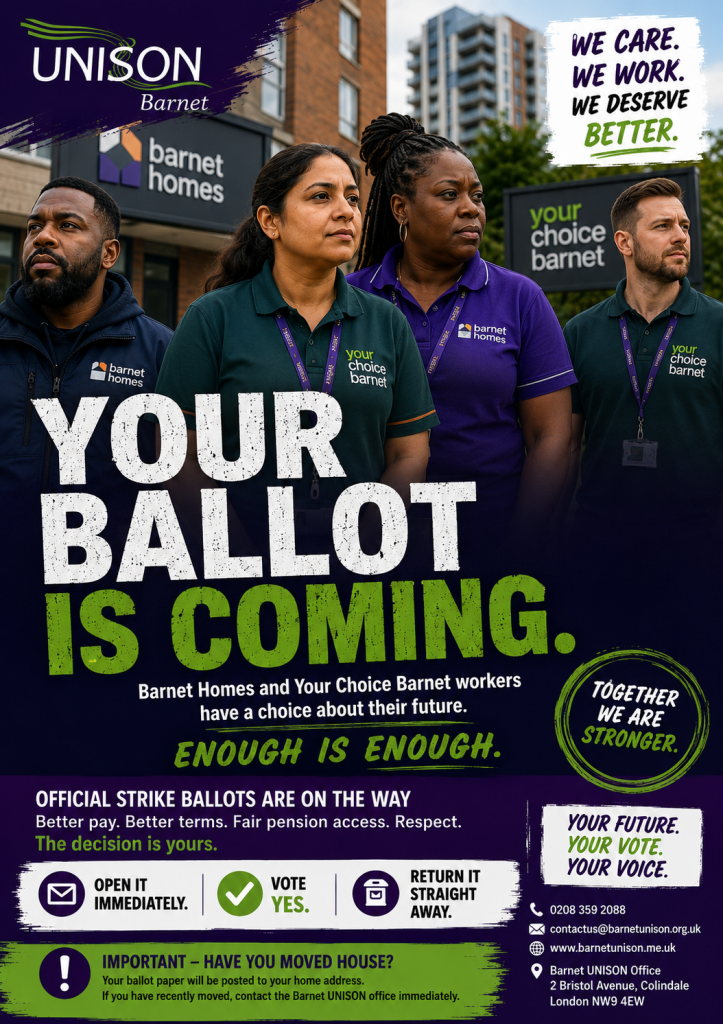
TBG UNISON members formal strike ballot looms

Barnet Voice TBG Ballot ready
read newsletter below
https://www.barnetunison.me.uk/wp/wp-content/uploads/2026/07/Barnet-Voice-TBG-Ballot-ready.pdf

read newsletter below
https://www.barnetunison.me.uk/wp/wp-content/uploads/2026/07/Barnet-Voice-TBG-Ballot-ready.pdf

BARNET COUNCIL QUIETLY HALVED ITS PASSENGER ASSISTANT WORKFORCE — AND NEVER TOLD THE UNION
Trade union demands answers on outsourcing by stealth and the employment standards of workers supporting children with complex SEN needs
Barnet UNISON has formally challenged London Borough of Barnet and BELS management over the steady dismantling of the directly employed Passenger Assistant workforce — the staff who accompany children with special educational needs on school transport routes across the borough every day.
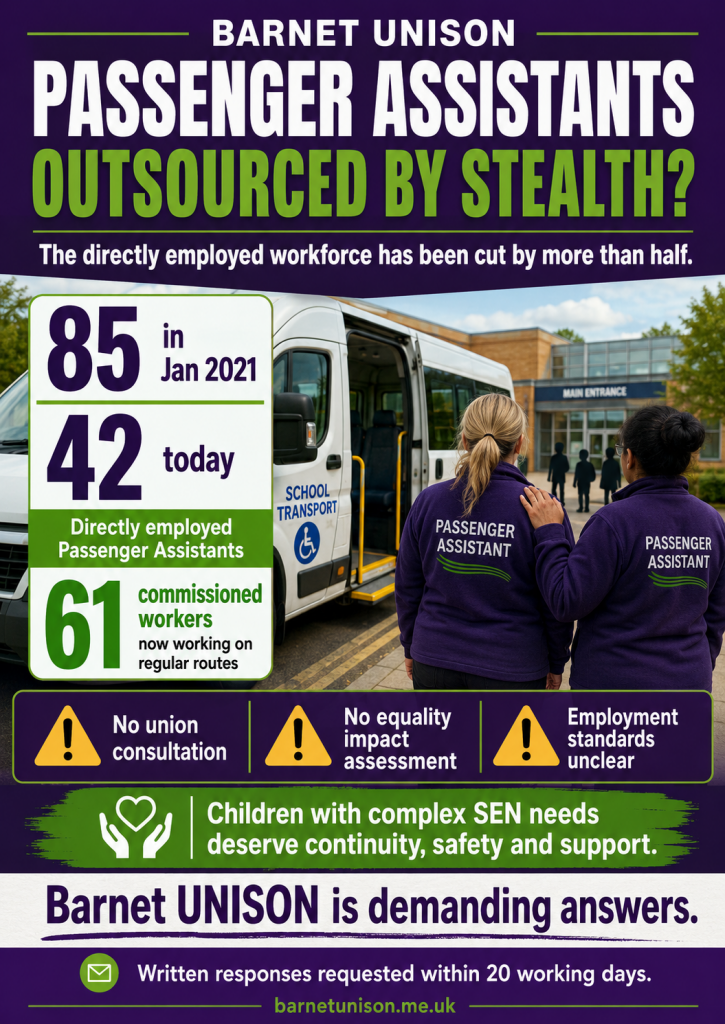
The directly employed workforce has been cut from approximately 85 in January 2021 to 42 today — a reduction of more than 50%. There are now 61 externally commissioned Passenger Assistants working on regular routes, outnumbering directly employed council staff. The council’s own documents confirm that vacancies have not been routinely refilled and that commissioned workers are used to meet continuing demand. No formal outsourcing exercise took place. No trade union consultation happened. No equality impact assessment was carried out.
Outsourcing in all but name
UNISON’s formal response — submitted to the JNCG chaired by the Chief Executive on 16 June 2026 — sets out that the council has effectively outsourced a public service through attrition: allowing permanent posts to disappear and replacing them with externally commissioned workers, without ever putting that decision to elected members as a workforce question or consulting the trade union.
A Cabinet report in May 2025 approved an external provider framework worth up to £1 million per year — £8 million over eight years. The same report records “None” under Consultation. The council is now saying that restoring direct employment would cost £225,000 per year more than the current model. That comparison has never been presented to Cabinet.
UNISON Branch Secretary John Burgess said: “The council hasn’t formally outsourced this service — it’s just stopped replacing people when they leave and handed the work to external providers instead. The outcome is the same. You’ve gone from 85 directly employed staff to 42, with 61 commissioned workers on regular routes doing the same job. No consultation, no equality assessment, no transparency. We need a straight answer: does the council intend to keep an in-house Passenger Assistant service or doesn’t it?”
Workers’ terms and conditions unknown
UNISON does not know what pay, sick pay, pension provision or continuity protections apply to the 61 commissioned Passenger Assistants currently working on regular routes. At the JNCG on 15 June, management confirmed they could not say what sick pay arrangements applied to commissioned workers.
For Passenger Assistants working daily with children who have complex health conditions and, in some cases, compromised immune systems, that is a direct health and safety concern. Workers without occupational sick pay are more likely to come in when unwell.
UNISON has also raised serious questions about health and safety incident reporting. Three separate reporting channels exist across the split management structure — none of them currently provides a complete picture of incidents involving Passenger Escorts on PTS routes. Management acknowledged at the JNCG that near misses are likely under-reported.
The Trade Union Engagement Framework, signed by the Chief Executive in December 2024, commits the council to sharing information with trade unions on service reviews and outsourcing matters, consulting on decisions affecting staffing, and giving serious consideration to keeping services in-house. UNISON has identified seven specific provisions that have not been honoured in this case. None of them were disputed at the JNCG.
A conflict of interest at the heart of the service
UNISON has also raised a structural concern about BELS’s role in the service. BELS simultaneously decides which routes are needed, manages contracts with external Passenger Assistant providers, and line-manages the directly employed LBB Passenger Assistants whose work the external contracts are displacing. UNISON has asked whether that arrangement has ever been subject to a formal governance review.
John Burgess added: “These are some of Barnet’s most vulnerable children. They build relationships with their Passenger Escorts over years. The council cannot say these workers are part of a commissioned model and then refuse to account for the employment standards that apply to them. We don’t know if they’re being paid the London Living Wage. We don’t know if they have sick pay. We don’t know what happens to a child’s regular escort if that worker isn’t available. That is not good enough.”
UNISON has set a 20-working day deadline for written responses. If those responses are not received, UNISON has indicated it will treat the matter as a formal failure to agree and will pursue the available routes.
NOTES TO EDITORS
Barnet UNISON represents approximately 3,000 members across the London Borough of Barnet, including employees of the council itself, its local authority trading companies (The Barnet Group and Barnet Education and Learning Services), schools, FE colleges, care services, environmental services, depots, and a range of contractors and outsourced providers.
The Passenger Transport Service provides school transport for children with special educational needs across 133 routes in Barnet.
The Trade Union Engagement Framework was signed by the Chief Executive of London Borough of Barnet in December 2024.
UNISON is separately pursuing an equal pay claim on behalf of more than 700 members against LBB, The Barnet Group, and BELS, with a preliminary Employment Tribunal hearing listed for September 2026.
Contact: Barnet UNISON — contactus@barnetunison.org.uk


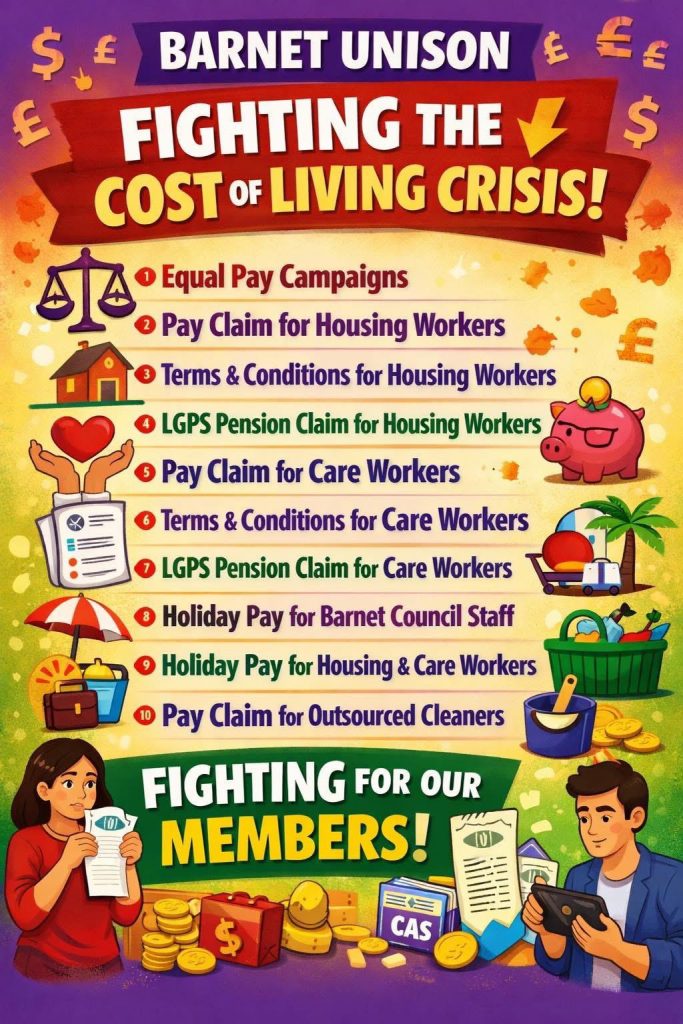
Every week Barnet UNISON speaks to members who are doing essential public service work — and struggling to make ends meet. That should never be normal. Yet in one of the most expensive cities in the world, too many Barnet workers are facing rising rents, higher food bills, increased energy costs, and transport fares that keep going up while pay falls behind.
We are seeing the reality on the ground: members skipping meals, taking second jobs, worrying about heating bills, and telling us they feel worse off now than at any time in their working lives.
Barnet UNISON has not stood back and watched this happen. We have built a coordinated Cost-of-Living response based on organising, bargaining and legal challenge. We are currently running ten separate cost-of-living campaigns across the employers where our members work.
1. Equal Pay campaign across three employers
2. Pay claim for housing workers
3. Terms and conditions claim for housing workers
4. LGPS pension claim for housing workers
5. Pay claim for care workers
6. Terms and conditions claim for care workers
7. LGPS pension claim for care workers
8. Holiday payments claim for Barnet Council workers
9. Holiday payments claim for housing and care workers
10. Pay claim for outsourced cleaners
This is one of the most extensive cost-of-living responses our branch has ever mounted. It reflects what members have told us repeatedly: the problem is not one single issue — it is pay, pensions, insecure terms, unpaid entitlements, and historic inequality all combining to squeeze household incomes.
Low pay is not accidental. It grows when employers hold down wages, delay reviews, outsource services, and maintain unequal pay structures.
Meanwhile, the cost of living in London continues to rise. Housing costs remain among the highest in the country. Inflation over recent years has pushed up the price of everyday essentials. When wages lag behind prices year after year, workers get poorer even while working just as hard — or harder — than before.
That is not sustainable for individuals, for families, or for the services we provide.
Our job as your union is to turn frustration into leverage. That means submitting claims, negotiating firmly, campaigning publicly, using legal routes where appropriate, and — when members support it — preparing for industrial action.
Across all ten campaigns, we are pressing employers to negotiate seriously and settle fairly. Some campaigns focus on immediate pay uplift. Others address structural unfairness that has cost members money over many years. All are about restoring value to your work.
There is one point we want to be absolutely clear about:
Members decide.
Ballots matter. Consultations matter. Voting matters. Whether a claim settles, escalates, or moves to the next stage depends on member participation and member votes.
The future of each of these campaigns will not be decided in a boardroom alone — it will be determined by how members vote.
When we organise and vote together, we are strongest.
End.

I’m a cleaner on a Council contract. I’m proud of the work I do — it matters. But I want people to understand what it’s really like trying to live and raise a family in London on the London Living Wage.
When people talk about the cost-of-living crisis, it can sound like something on the news. For me, it’s everyday life.
Food is so expensive now. Sometimes it’s hard to buy even basic food. And it’s even harder when you have children — they’re hungry all the time, and you can’t just tell them to wait. You do everything you can to make it work, but it never feels like enough.
Then there are clothes. Children grow so fast and they still need what everyone else needs: shoes that fit, warm coats, school things. On top of that I have to find money for gas and electricity. Those bills don’t stop. They don’t care what you earn.
Sometimes I have to borrow money from family. That’s not easy. It’s embarrassing and it’s painful, because you want to stand on your own feet. But when everything costs more and your wages stay the same, you end up with no choice.
What makes it even harder is the way we’re treated at work compared to other people around us.
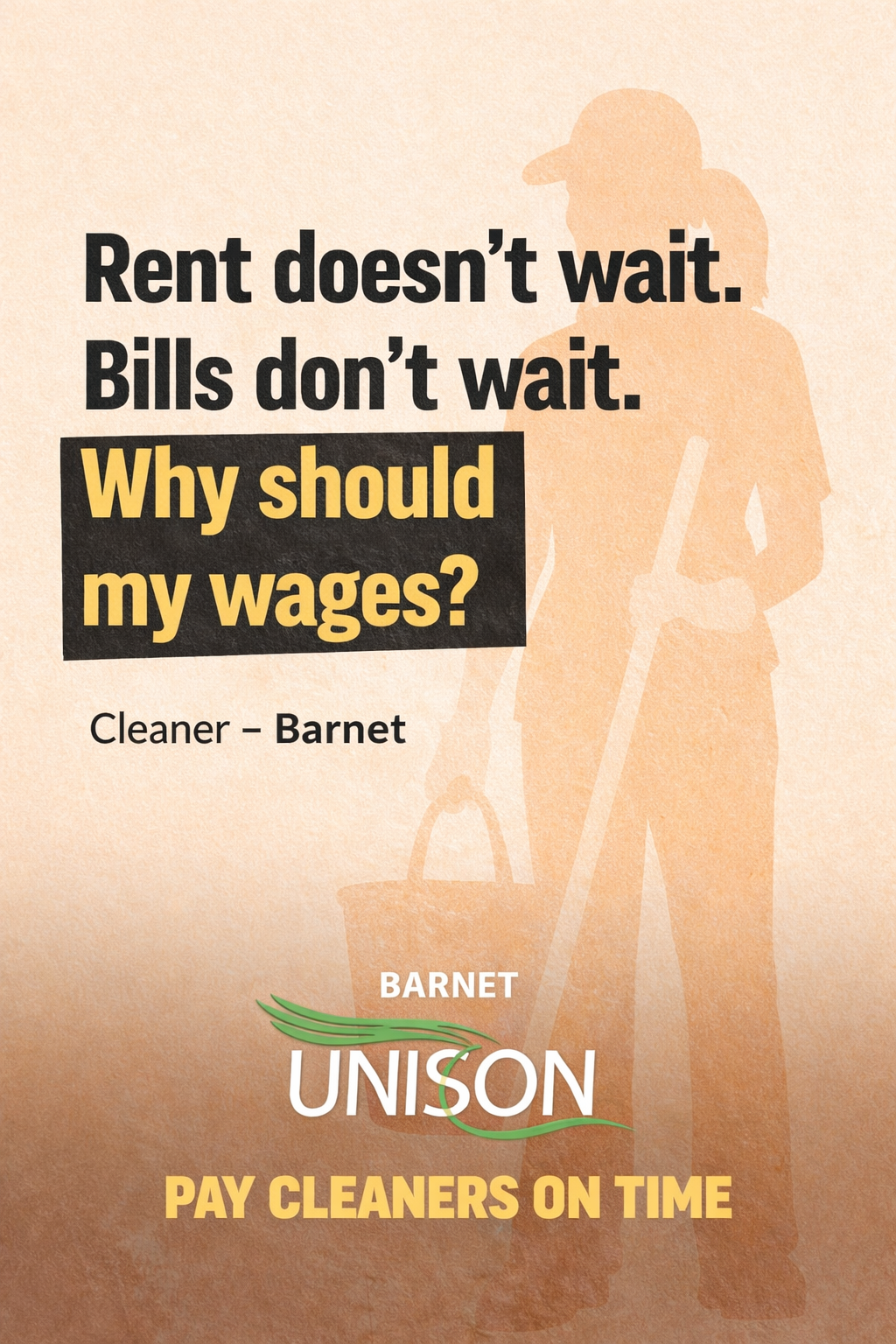
It’s unfair that my employer holds onto my pay for another 12 days before they pay me. I’m working alongside council workers who get their pay at the end of the month. They don’t have to wait for the wages they’ve earned. Why are we treated differently?
We’re doing our jobs. We’re turning up. We’re keeping places clean, safe and working properly. But we are the lowest paid staff — and everything is made that much harder for us.
We only get the London Living Wage. We don’t get sick pay. That means if I’m ill, or if something happens, it’s not just a health worry — it becomes a money worry too. You start thinking, “If I can’t work, how will I pay bills? How will I buy food?” That’s not how anyone should have to live.
And another thing that doesn’t feel right is the delay in getting the London Living Wage increase. The new rate is announced in October, but a lot of employers don’t bring it in until 1 April. That’s about six months of waiting.
But prices don’t wait six months. Rent doesn’t wait. Food doesn’t wait. Gas and electricity don’t wait. If the London Living Wage is the rate people need to live on, then it should be paid from the moment it’s announced — not half a year later.
London is an expensive city. I work hard. I’m not asking for special treatment. I just want fairness — and to be treated like my council worker colleagues. I want to be paid on time. I want proper sick pay. And I want the London Living Wage paid when it’s announced, because that’s when families like mine actually need it.
That’s why I support Barnet UNISON’s campaign to make sure Council contracts include a clause so the new London Living Wage rate is applied from the announcement date — not months later. Because people like me shouldn’t have to struggle this much just to get by.
End.

Barnet UNISON has raised serious concerns about a new requirement for parking enforcement staff to wear body-worn cameras that are switched on for the entire duration of their shifts.
The change, reportedly requested by senior officers at Barnet Council and being implemented by private contractor APCOA, marks a significant departure from the current practice — where body cameras are only activated when a Penalty Charge Notice is issued.
John Burgess, Branch Secretary of Barnet UNISON, said:
“We are deeply concerned about the impact this could have on our members’ right to privacy at work — as well as on the rights of Barnet residents, including children and vulnerable people, who may be filmed without their knowledge or consent.
We believe this change is excessive and disproportionate, and we’ve asked for an urgent explanation from both APCOA and Barnet Council. We are still waiting for a response.”
UNISON recognises that body-worn cameras can play a role in supporting staff safety in certain situations. However, blanket surveillance throughout an entire shift risks creating a culture of mistrust and surveillance, without evidence that it improves outcomes.
The union has now launched a consultation with its members on the contract to seek their views on the change.
“We want to hear directly from the staff affected. We’ve launched a confidential survey asking if they support having the camera on all day — and if they’d be prepared to take further action if this policy is forced through without proper consultation,” said Burgess.
UNISON has called on both APCOA and Barnet Council to pause implementation of the policy until full consultation has taken place and the privacy and data protection implications have been properly addressed.
Notes to editors:
End.

On 1 August 2025, Barnet Council went ahead with a 33% cut to Barnet UNISON’s facility time.
This is an attack on our ability to support, defend, and organise our members. It is a political choice that takes us back to Tory-era cuts, at precisely the moment when staff are under the most pressure.
What the cut means for members
Facility time is what allows us to:
With a 33% cut, our ability to respond will be slowed down. Members may wait longer for casework support. Some of the key meetings and consultations we should be present in will be harder to attend.
But let’s be crystal clear: this cut will not gag Barnet UNISON. We will continue to speak out and fight back against the appalling issues our members face every single day.
The wider context
This cut comes when:
The Council has just come through a financial crisis so severe it applied for Exceptional Financial Support (EFS).
Consultants such as PeopleToo are embedded in the Council, planning further restructures and potential redundancies.
UNISON has confirmed a major Equal Pay case, which we are pursuing to protect the rights and pay of our lowest-paid workers.
Our branch is leading campaigns to defend frontline services, stop unsafe workloads, resist outsourcing, and protect the rights of disabled staff.
In other words, the demand on UNISON is growing—yet the Council has chosen to reduce the time we have to represent staff.
Our response
We are not naïve. We know the impact of this cut will be felt in longer waits, heavier workloads for our reps, and an increase in pressure. But this branch has been here before. We survived outsourcing, mass redundancies, austerity, and Tory attacks—and we are still here, still fighting.
A call for solidarity
We are calling on:
📩 Send solidarity to: contactus@barnetunison.org.uk

We’ve been here before – and we always have your backs
Barnet UNISON has faced attacks before, and every time we have come through stronger—because we never forget why we are here.
No cut, no Council, no employer will ever take that away from us.
We will always have the backs of our members.
In solidarity,
Barnet UNISON

Barnet UNISON has today published a report challenging Barnet Council’s proposal to close The Network, a long-standing community mental health prevention and recovery service.
The Council’s own consultation shows 73% of respondents opposed closure — including 100% of carers — yet officers are still recommending that Cabinet votes to shut the service.
Barnet UNISON’s report sets out detailed evidence showing that:
The report also includes:
UNISON Statement
John Burgess, Branch Secretary of Barnet UNISON, said:
“Closing The Network is a false economy. It costs very little but saves the NHS and the Council huge sums by keeping people well, in work, and out of crisis. The consultation shows residents, carers, and professionals overwhelmingly oppose closure. Labour nationally is committed to expanding mental health support. Why would a Labour council do the opposite?”
Christina McAnea, UNISON General Secretary, has said:
“Slashing vital services that keep people well and independent is a false economy. Care should be a human right and a public service.”
Jon Richards, UNISON Assistant General Secretary, has warned:
“Cutting already overstretched services abandons some of the most vulnerable people in our communities.”
UNISON’s call to Barnet Council Cabinet
Barnet UNISON is urging Cabinet members to:
Notes for editors
Ends.

Barnet UNISON is calling on Barnet Council to end the failed outsourcing of school catering and bring the service back in-house.
At the upcoming Cabinet Committee meeting on 21 July 2025, Barnet Council will be asked to approve the continuation of an outsourced school meals contract. Barnet UNISON is demanding the Council reverse this recommendation and recognise the devastating impact outsourcing has had on schoolchildren, workers, and Barnet’s local economy.
John Burgess, Barnet UNISON Branch Secretary, said:
“For over a decade Barnet UNISON has warned of the dangers of outsourcing. Those warnings were ignored – and the result has been catastrophic. Low-paid Black women workers dismissed, children denied hot meals, and a kosher kitchen built with public money now left empty. Enough is enough.”
The Case Against Outsourcing:
A Better Alternative: In-House Services
Barnet Council ran a successful in-house school catering service for decades. In 2014–15, it generated a £190,000 surplus. Schools had confidence in the service and trusted its quality and reliability.
There has been no serious financial modelling on bringing the service back in-house. Despite citing inflation and “market pressures,” the current Cabinet report presents no updated analysis of how in-house provision could now be rebuilt to meet modern needs.
Council Equality Commitments Undermined
Barnet Council’s corporate values include a commitment to equality and inclusion, yet outsourcing has overwhelmingly harmed Black, female, low-paid workers – a group protected under the Equality Act 2010.
“This decision contradicts the Council’s equality duties,”.
“How can you talk about inclusion while outsourcing continues to hurt the very communities you claim to support?”
Labour Party Policy Backs Our Call
Continuing to outsource the school meals contract undermines Labour values in one of the most diverse boroughs in the UK.
UNISON Demands:
For further information or interview requests, please contact:
Barnet UNISON at contactus@barnetunison.org.uk
End.

Dear members,
We are proud to report that South Cambridgeshire District Council has become the first council in the UK to adopt a four-day week as permanent policy — on full pay, for all staff. This is a landmark moment in the fight for a better work/life balance and stronger public services.
Barnet UNISON visited this council and spoke directly with staff and trade union colleagues. Their message was clear: this is not a gimmick — it’s a serious, evidence-based reform that has delivered for staff, services, and residents alike.
The official Council report presented on 17 July 2025 outlines clear, independent evidence https://scambs.moderngov.co.uk/documents/b50013885/Four-day%20Week%20Update%20and%20Future%20Arrangements%20-%20Update%20from%20Scrutiny%20and%20Overview%20Committee%20Thursday.pdf?T=9 :
This was not a “soft” trial. It included independent analysis by the Universities of Cambridge, Salford, and Bradford, and national performance benchmarks. A public consultation — despite predictable scaremongering from anti-public sector groups — found no evidence of serious decline in services and strong public support in many areas.
Already, opponents of decent working conditions are attacking this result.
Let’s be honest — this isn’t new.
When trade unions first demanded:
But unions stood strong. Members like you fought back. And we won every time.
The same fear tactics are being recycled today — against a four-day week.
This win matters. And it’s achievable here too.
Barnet UNISON will:
A trade union is not just a grievance handler — it’s a fighting force for better pay, safer work, and better lives. The four-day week is the next big leap.
Change never comes without a fight — but this shows it can come. And Barnet UNISON is ready.
In solidarity,
Barnet UNISON Branch

https://www.barnetunison.me.uk/wp/wp-content/uploads/2025/07/extreme-weather-flyer.pdf