

Category: Insourcing
They Were Heroes During Covid. Now They Are Fighting for Fair Pay. We Must Stand With Them.
They Were Heroes During Covid. Now They Are Fighting for Fair Pay. We Must Stand With Them.
Branch Secretary Blog — John Burgess, Barnet UNISON
On Tuesday 13 October, Barnet UNISON announced that our members working for The Barnet Group had voted overwhelmingly for strike action.
88% voted YES on a 55% turnout.
That is a powerful result, and I want to explain why this dispute matters to every Barnet UNISON member, not just those working for The Barnet Group.
Who are The Barnet Group workers?
The Barnet Group (TBG) is a company wholly owned by Barnet Council. It includes Barnet Homes, which provides housing services, and Your Choice Barnet, which provides social care and support services.
These are not optional services. Housing and social care are essential public services which councils have statutory responsibilities to provide or arrange.
Our members include care and support workers looking after vulnerable adults, and housing workers helping residents with their homes, repairs and housing needs.
They are public service workers. They work for organisations owned by Barnet Council. But they are not treated the same as Barnet Council employees.
Many members reading this may be surprised to learn that TBG workers do not automatically receive the same pay, annual leave, sick pay, overtime rates or other terms and conditions as Council staff.
They also do not have the same access to the Local Government Pension Scheme (LGPS).
How can that be right?
Remember when care workers were called heroes?
I want members to think back to Covid.
When much of the country was told to stay at home, our care workers continued going to work.
They supported vulnerable residents who depended on them. They worried about catching Covid, about passing it on to the people they cared for, and about bringing it home to their own families.
They went to work because people needed them.
Remember the weekly applause? Remember people standing outside their homes banging saucepans to show their appreciation for NHS and care workers?
They were called heroes then. So why are they still fighting for fair pay, decent conditions and pension rights now?
You cannot pay the rent with applause. You cannot pay your energy bills with praise.
And you certainly cannot build a decent retirement on warm words.
One Council. Two Workforces. That Must End.
Barnet UNISON has been campaigning for years against outsourcing and the creation of a two-tier workforce.
Barnet Homes and Your Choice Barnet were once Council services. Moving them outside direct Council employment has left workers doing essential public service jobs without the same contractual protections and benefits as their Council colleagues.
Our members are demanding better pay and conditions, including improved annual leave, sick pay, working hours, overtime rates, a fair pay structure and access to the LGPS.
The Barnet Group has rejected the claim.
Our members have responded by voting for strike action.
Nobody takes a decision to strike lightly, especially workers who care for vulnerable people and support residents.
But when employers refuse to negotiate seriously, what choice are workers left with?
This is why Barnet UNISON is calling on The Barnet Group and Barnet Council to sit down with us and negotiate a fair settlement.
My Message to Every Barnet UNISON Member
I have spent 31 years representing workers in Barnet, including 23 years as Branch Secretary.
I have seen what outsourcing does to workers. I have seen the divisions it creates, the inequalities it produces and the damage it can do to morale.
I have also seen what happens when workers stand together.
Our TBG members have shown courage. They have voted to challenge their employer because they believe they deserve better.
Now I am asking every Barnet UNISON member reading this blog to do something simple.
Take a few minutes to send a message of solidarity to our housing and care workers.
It doesn’t have to be long. Just a few words to let them know they are not alone.
You might work in a school, a library, a depot, an office or another Council service. You might never have met a TBG worker.
That doesn’t matter.
We are all UNISON members, and when one group of workers is fighting for fair treatment, they deserve the support of the rest of us.
Please email your message of support to contactus@barnetunison.org.uk.
I will make sure our TBG members get to read your messages.
I want them to know that thousands of fellow UNISON members across Barnet recognise their fight and stand alongside them.
They were there for our community during Covid.
Now it’s our turn to be there for them.
Solidarity.
John Burgess
Branch Secretary
Barnet UNISON
ONE COUNCIL. ONE WORKFORCE. EQUAL TERMS.
ONE COUNCIL. ONE WORKFORCE. EQUAL TERMS.
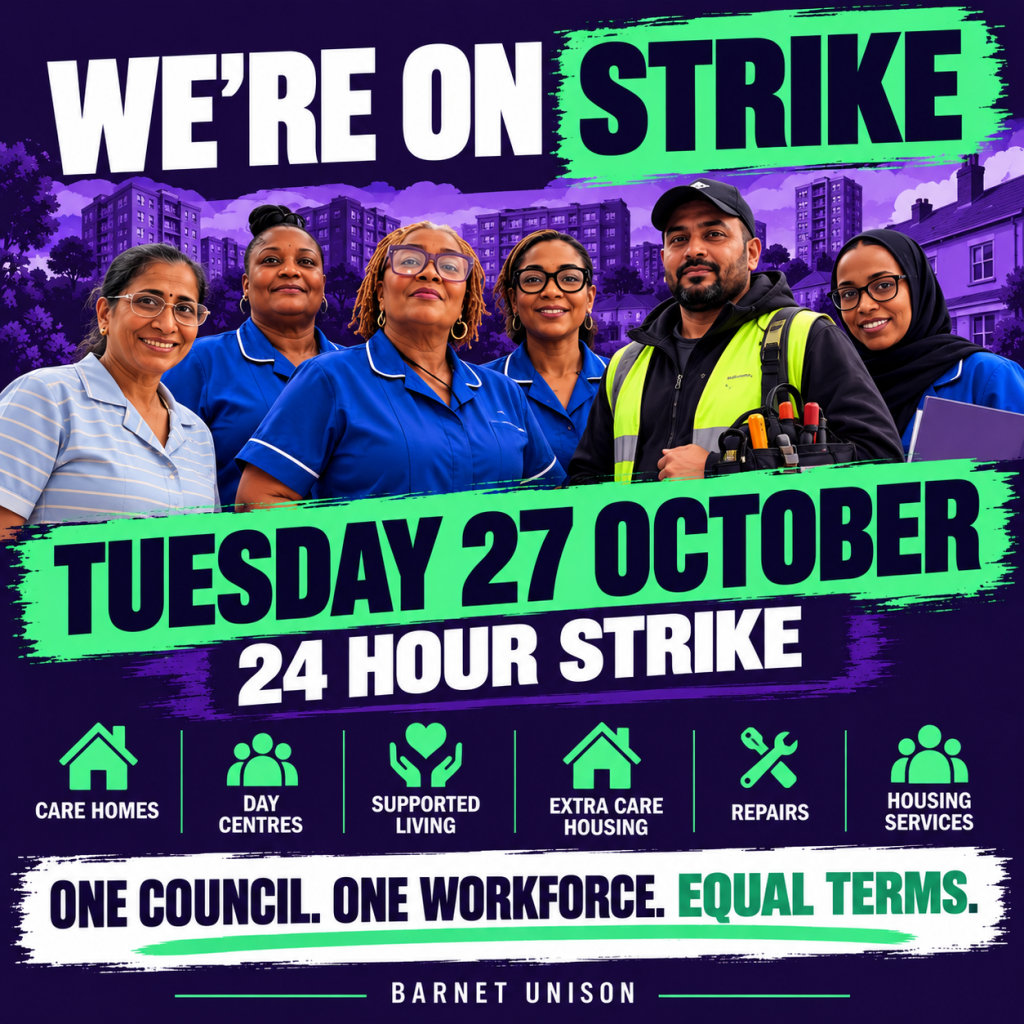
First day of strike action: Tuesday 27 October
15 October 2026
The first day of strike action for all UNISON members at The Barnet Group will be Tuesday 27 October. It will be a 24 hour strike.
Thank you to everyone who voted. A 55% turnout and 88% voting yes gives us a clear mandate.
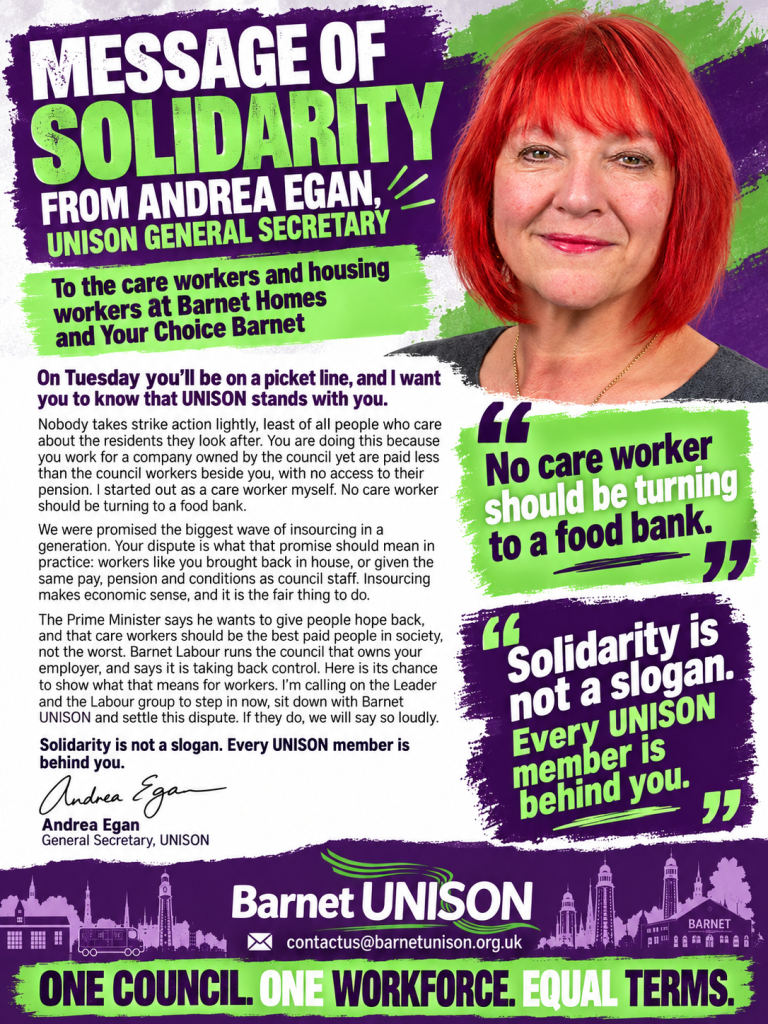
Message from UNISON General Secretary Andrea Egan to The Barnet Group workers
Dear colleagues,
Congratulations on a strong clear result. A 55% turnout and 88% voting yes is a strong, clear message, and everyone in UNISON is proud of you.
You care for vulnerable residents and look after people’s homes in one of the most expensive cities in the world. You do the same jobs as council staff, yet you are on worse pay and conditions, with many having no access to the council pension scheme. That is unfair, and you are right to say so.
UNISON is with you. You have the whole union behind you, from your branch and region to our national team. You voted because you want a fair deal, and I hope the employer will now sit down and negotiate one.
In solidarity,
Andrea Egan
General Secretary, UNISON
Talks have opened
Since the ballot, communication has opened up with the Group Chief Executive of TBG. He has agreed to review London Living Wage timing, annual leave and overtime. That is a step forward, but it does not go far enough.
We would much rather settle this dispute. On 15 October I wrote back to him with the points we want TBG to address:
- Working week. Parity with LBB colleagues on 36 hours, instead of the 37.5 hours TBG Flex staff work now.
- Annual leave. Movement towards 31 days.
- Sick pay. Sick pay on LBB terms, with an indicative cost.
- Overtime and night rates. A review that covers night, weekend and bank holiday rates, with a date for proposals.
- Pay structure. Talks to start now on one clear pay structure.
- Pensions. LGPS remains our aim. If TBG will not agree it, we have asked for a higher employer contribution to the Legal & General scheme, costed in stages, and for the joint meeting with the pension fund and LBB.
- NJC pay awards. Written into contracts.
- Policy review. A joint review of LBB and TBG policies.
- London Living Wage. A firm date to pay the new rate, rather than waiting until April.
I have asked him to instruct TBG’s negotiating team to meet UNISON with proposals. We will also be approaching the Labour Party about funding contributions from LBB.
Message from Andrea Egan to Barnet’s Labour administration
To Barnet’s Labour councillors,
Barnet UNISON members at The Barnet Group, a company owned by your council, have voted for strike action. They want what their council colleagues already have: fair pay, decent terms and access to the council pension scheme.
They deliver housing and care services for your residents, in London, where the cost of living has never been higher. Labour came into government promising to end the two tier workforce and to put an end to poverty pay in care. Your own Prime Minister told conference that care workers deserve better.
I am asking you to work with UNISON to settle this dispute. That means backing proper negotiations now and supporting the funding to make a fair offer possible. Barnet UNISON is ready to talk. Please make sure The Barnet Group is too.
Andrea Egan
General Secretary, UNISON
What happens next
We will publish details of the picket lines, and where members should report on the day, as soon as they are confirmed.
If you have questions about the strike, please ask your local rep or email the branch at contactus@barnetunison.org.uk.
Barnet UNISON.
FOR IMMEDIATE RELEASE Barnet Group workers vote for strike action over poverty pay
FOR IMMEDIATE RELEASE
Barnet Group workers vote for strike action over poverty pay
13 October 2026
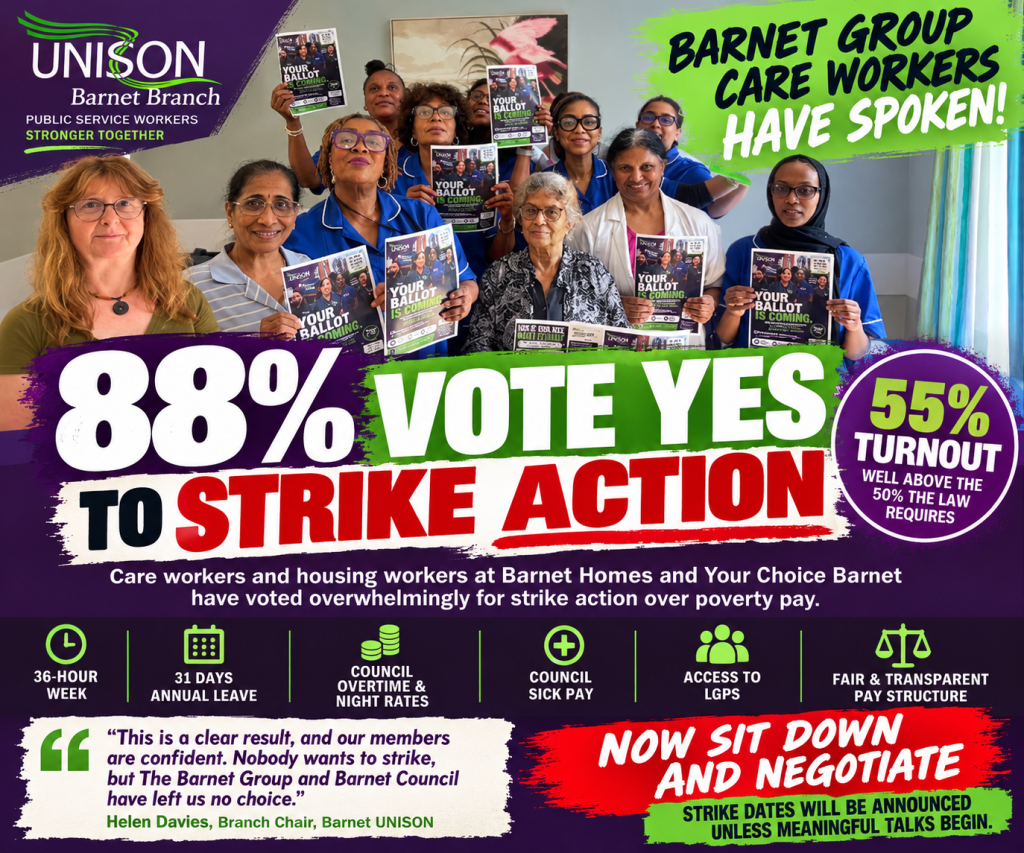
Care workers and housing workers at The Barnet Group have voted for strike action, with 88% voting yes on a 55% turnout, well above the 50% the law requires.
The workers are employed at Barnet Homes and Your Choice Barnet, both owned by Barnet Council. They provide housing and care services to Barnet residents. These services were once run in house by the council. They are now delivered by workers on inferior contracts, often alongside council staff doing similar jobs.
The ballot seeks to end that two tier workforce.
UNISON is asking for:
- a 36-hour week, down from 37.5 (40 for repairs staff)
- 31 days annual leave
- council overtime and night rates
- council sick pay
- talks on a single, transparent pay structure
- access to the Local Government Pension Scheme
- annual NJC pay awards written into contracts
- the new London Living Wage paid when announced in October, not the following April
- a joint review adopting council policies wherever they are better
The Barnet Group has refused every part of the claim and has been unwilling to enter proper negotiations. Staff are angry and morale is low. With food, energy and rent costs still rising, many say they are struggling to get by on what they earn.
At Labour conference on 29 September, Prime Minister Andy Burnham spoke of care workers “caring for other people’s parents on poverty pay”. He said he wants “care that is about people not profit”. Care workers employed by a council owned company are on exactly that poverty pay.
Care worker, Your Choice Barnet: “I look after people who can’t look after themselves, then worry about my own gas bill. Council staff doing the same job get better sick pay and a pension. We just want the same.”
Housing worker, Barnet Homes: “We help residents who are struggling, and many of us are struggling too. People voted because they’ve had enough of being treated as second class.”
Helen Davies, Branch Chair, Barnet UNISON: “This is a clear result, and our members are confident. Nobody wants to strike, but The Barnet Group and Barnet Council have left us no choice. We are asking them to sit down and negotiate properly, starting now.”
Strike dates will be announced unless meaningful talks begin.
End.
A National Care Service must start with the workforce
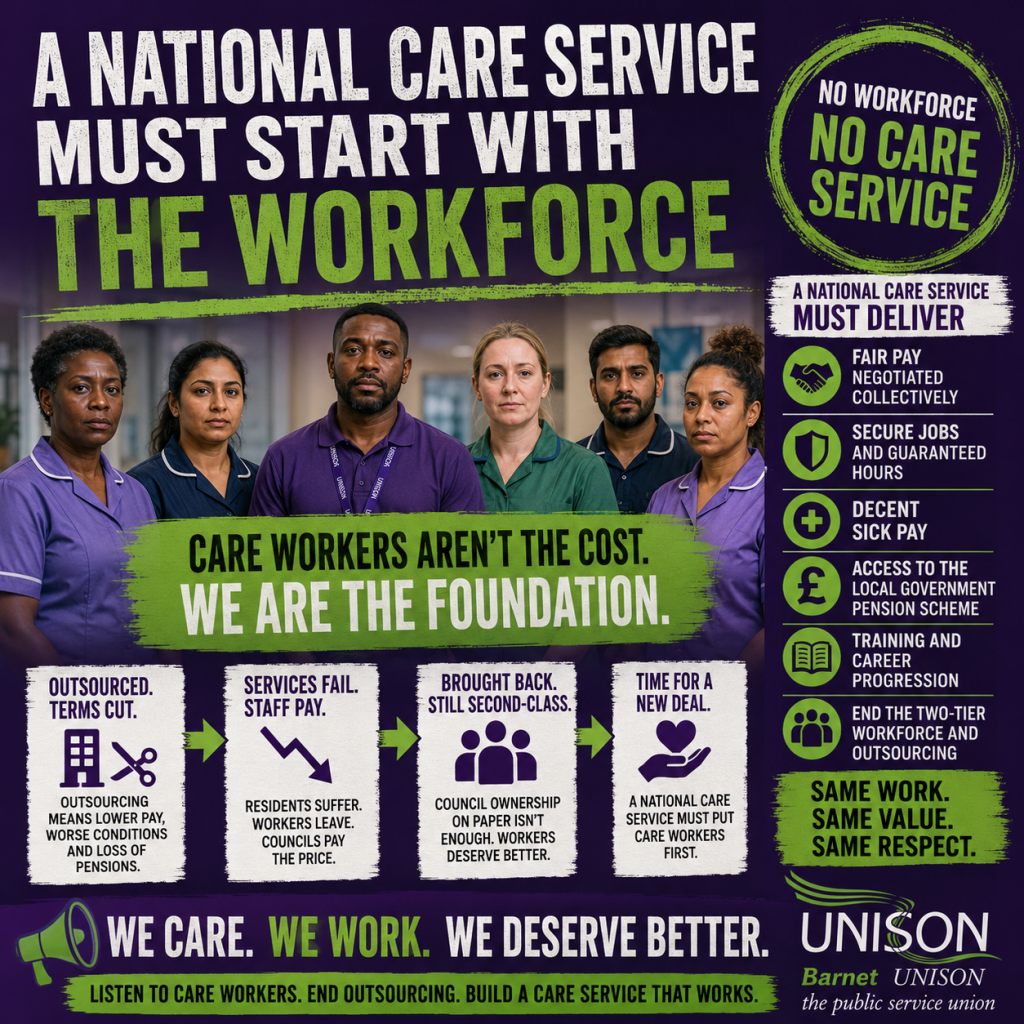
A National Care Service must start with the workforce
Rebecca Long-Bailey is right to argue that social care should become a universal public service, built on the same principle as the NHS: care according to need, not ability to pay.
But after 31 years as a UNISON representative, and decades organising and representing care workers in Barnet, I believe something fundamental is still missing from the national debate.
Politicians and the media repeatedly ask how much a National Care Service will cost and how it should be funded.
Those are important questions, but they are not the only questions.
We also need to ask who will provide the care, who will employ them, and on what pay, pensions and conditions.
There is no National Care Service without a national care workforce.
Three decades of outsourcing in Barnet
My first major involvement with care workers began in the late 1990s, when Barnet Council decided to outsource its residential care homes and day services.
The case put forward was that outsourcing was needed to secure investment in new and improved buildings.
Barnet UNISON opposed the proposal. We organised members and produced alternative reports challenging the argument that outsourcing was the only way to improve services.
At the same time, the council was implementing the national Single Status agreement. Care workers were moved from spot salaries onto a career-grade structure intended to provide fairer and more consistent pay.
The ink was barely dry on those new arrangements before the workers were told they were being outsourced.
The staff transferred to the Fremantle Trust. A few years later, the employer moved to impose significantly worse contracts.
Our members faced cuts to pay, sick pay and annual leave. Barnet UNISON members resisted through strike action, rallies, campaigning and meetings in Parliament.
We fought hard, but the cuts were imposed.
Much of the progress achieved through Single Status was undone. Skilled care workers delivering a public service were left with lower pay and weaker employment protections.
That experience taught us an important lesson.
Improvements negotiated through collective bargaining can be taken away when workers are transferred outside direct public employment.
The outsourcing model failed workers and services
The care-home contract later became the subject of a major financial dispute between Barnet Council and Catalyst Housing, which had partnered with Fremantle in the contract.
The dispute went to arbitration and resulted in substantial costs for the council.
Barnet Council eventually withdrew from the remaining contract. The services and staff transferred to Your Choice Barnet, part of the council-owned Barnet Group.
But the service did not return directly to the council.
The workers remained employed at arm’s length, outside council terms and conditions.
The history continued with the closure of Apthorp Care Home.
Residents had to leave their home and staff who had worked throughout the pandemic faced redundancy.
The building was reported to require millions of pounds of repairs despite being relatively new.
Once again, residents and workers carried the consequences of decisions made above them.
Home care followed the same pattern
Barnet UNISON also fought to retain the council’s in-house home-care service.
That service was outsourced.
Years later, part of the outsourced provision transferred to Aquaflo Care. The transfer ran into serious difficulties and the service was subsequently brought into The Barnet Group.
Several years later, The Barnet Group announced plans to close its Enablement Home Care Service.
The pattern has repeated itself throughout my time representing care workers:
A public service is outsourced.
The workforce is transferred.
Pay, pensions and conditions become fragmented.
The contract or provider runs into difficulty.
The service may eventually return to a council-owned organisation, but the workers do not necessarily regain council employment, council conditions or access to the Local Government Pension Scheme.
This is not history—our members are living it now
Today, Barnet UNISON is involved in a major dispute involving care workers employed by Your Choice Barnet.
These workers deliver essential adult social care services on behalf of Barnet Council.
They supported vulnerable residents throughout COVID. They carried on working when the risks to themselves and their families were very real.
Yet they remain part of a two-tier workforce.
They do not have the same core pay, terms and pension arrangements as directly employed council staff.
Our members are seeking fair pay, improved terms and conditions, a transparent pay structure and access to the Local Government Pension Scheme.
They should not have to consider strike action to secure basic fairness from an organisation wholly owned by the council.
This dispute exposes the gap between political promises about the future of social care and the reality experienced by the workforce.
The Prime Minister can speak about creating a National Care Service, but those words will mean little to care workers who remain underpaid, excluded from decent pensions and treated as second-class public-service workers.
A National Care Service cannot be credible if public bodies continue to deliver care through employment models that keep staff on inferior conditions.
The employment model matters
A National Care Service cannot simply be a new funding stream poured into the existing fragmented care market.
It cannot succeed while care remains dependent on outsourcing, low pay, insecure employment, inadequate sick pay and poor pension provision.
Nor is it enough to transfer services into council-owned companies while keeping the workforce outside council employment standards.
Public ownership must mean more than ownership on paper.
There must be no compromise about the employment model for care.
Care should be delivered as a public service through publicly accountable organisations.
Care workers should have:
- fair pay determined through collective bargaining;
- secure employment and guaranteed hours;
- decent occupational sick pay;
- nationally recognised training and genuine career progression;
- equal treatment across the workforce;
- and access to the Local Government Pension Scheme or an equivalent high-quality public-service pension.
There must also be a clear route for outsourced care services and their workers to return to direct public employment without losing existing contractual rights.
Listen to care workers
Any government serious about creating a National Care Service must speak directly to care workers and their trade unions before deciding how it will operate.
Care workers are not an afterthought.
They are not simply a cost in a funding model.
They are the people who make the service possible.
They understand what repeated outsourcing, fragmented commissioning and staff shortages mean in practice.
They know what happens when experienced workers leave because they cannot afford to remain in care.
They understand the impact that workforce instability has on older and disabled people who rely on consistent, trusted support.
For more than three decades, I have watched politicians praise care workers while supporting or tolerating employment models that hold down their pay, remove access to decent pensions and weaken collective bargaining.
Warm words are not enough.
Medals are not enough.
Calling workers heroes is not enough.
The care workforce is predominantly female, and many care workers are Black or Asian. They carry out skilled, physically demanding and emotionally demanding work.
They need justice at work, not another political promise that leaves their employment conditions untouched.
A National Care Service must be built around the people who provide the care.
It must end outsourcing and the two-tier workforce.
It must provide fair pay, decent conditions, collective bargaining and proper pensions.
The Prime Minister should start by looking at what is happening to care workers now, including those employed by council-owned companies such as The Barnet Group.
If the Government is serious about a National Care Service, it should support an employment model that treats care workers as public-service professionals—not as a source of savings.
Without a respected and properly rewarded workforce, there is no National Care Service.
Anything less is not good enough.
John Burgess
Branch Secretary, Barnet UNISON
UNISON representative for 31 years and lead representative for approximately 3,000 members
ARE YOU LISTENING, PRIME MINISTER BURNHAM?
Are you listening Prime Minister Burnham ?
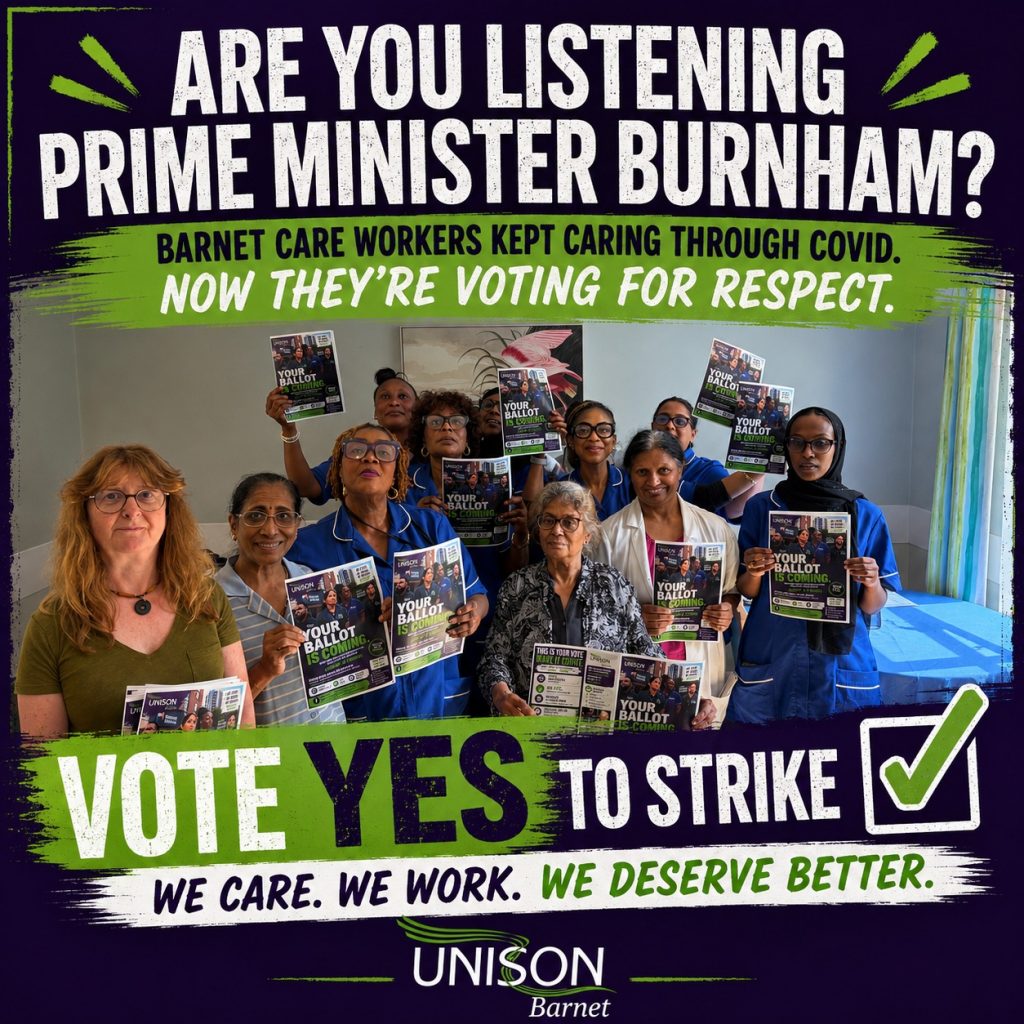
TBG UNISON members formal strike ballot looms
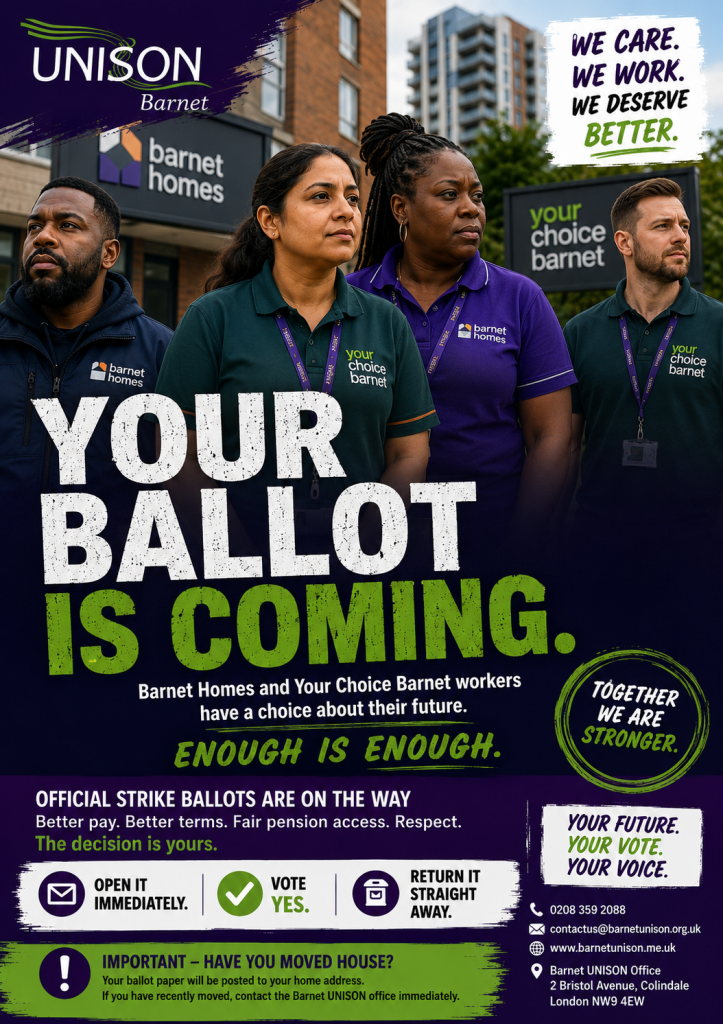
Barnet Voice TBG Ballot ready
read newsletter below
https://www.barnetunison.me.uk/wp/wp-content/uploads/2026/07/Barnet-Voice-TBG-Ballot-ready.pdf
School Meals Workers — UNISON Needs to Hear From You

June 2026
If you work for ISS Catering in a Barnet school, please read this.
The council’s contract with ISS is coming to an end in March 2027. That does not necessarily mean your job ends — it may mean a change of employer, or it may mean staying with ISS under a new arrangement — but there will be changes, and UNISON needs to be on top of this from the start to protect your rights.
I have already been into meetings with Barnet Council management about what this means for catering staff and I will be going back in. I am pushing hard on the things that matter most — your pay, your London Living Wage, your pension, and making sure any transfer is handled properly and fairly. I am also making the case directly to the council and to elected councillors that bringing this service back in-house — so that you become council employees again — is the right thing to do. That fight is ongoing.
But I need to hear from you.
Our membership records are not always up to date, and things may have changed since many of you moved from the council to ISS back in 2016. I cannot represent you properly without knowing your current situation.
Please get in touch and let me know:
- What job you are currently doing and which school you are based at
- Whether your terms and conditions have changed since you moved to ISS — for example your pay, your hours, your holiday entitlement
- Whether you are still in the Local Government Pension Scheme (LGPS) or whether your pension arrangements have changed
- Whether your contact details or home address have changed
- Whether you have any concerns or issues you want me to know about
Everything you tell me is treated in confidence. It comes to me directly and stays with me — I am not passing anything to ISS or to the council.
I know many of you will have questions I cannot fully answer yet. Things are still being worked out and I would rather be honest with you than give you information that turns out to be wrong. What I can tell you is that UNISON is in the room, I am attending every meeting, and your rights under TUPE mean your core terms and conditions are legally protected through any transfer.
Even if you have no concerns right now, please still get in touch with your current role and contact details. Every reply strengthens our position.
Contact Barnet UNISON directly: 📧 contactus@barnetunison.org.uk 📞 020 8359 2088
Not yet a UNISON member?
If a colleague has shared this with you and you are not yet in UNISON, now is exactly the right time to join. You can sign up at unison.org.uk/join or contact John directly and he will help you join over the phone.
End.
CAPITA CONTRACT ENDING — WHAT YOU NEED TO KNOW

CAPITA CONTRACT ENDING — WHAT YOU NEED TO KNOW
I want to let you know that the Capita contract with the London Borough of Barnet is coming to an end. New providers will be taking over a range of services from 1 October 2026.
I am currently in discussions with LBB management about what this means in practice — for services, for staffing, and for you as UNISON members. I will update you as things become clearer, but I didn’t want to wait until everything was finalised before making contact.
WHAT IS TUPE AND DOES IT APPLY TO ME?
The process that will apply to most of you is called TUPE — Transfer of Undertakings (Protection of Employment Regulations). In plain terms, this is the legal framework that is supposed to protect your job and your terms and conditions when a service changes hands. I will be involved in that process on your behalf.
But I can only do that job properly if I know who you are, what you’re doing, and what your current situation is.
I NEED TO HEAR FROM YOU DIRECTLY
Here’s the problem — our records may not be up to date. Some of you will have changed roles, moved to a different service area, or had changes to your terms and conditions since you left LBB. We may not have your current contact details.
If I’m going into bat for members in a TUPE process, I need accurate information, not outdated records.
Please email me directly at contactus@barnetunison.org.uk and let me know:
- What is your current job title?
• Which service area are you working in (e.g. Customer Services, Revenues and Benefits, IT, Payroll)?
• Have your terms and conditions changed since you were with LBB — pay, leave, sick pay, anything?
• Are you still in the Local Government Pension Scheme (LGPS)?
• Have you moved address, or have your personal contact details changed?
• Do you have any concerns or issues you want to flag to me now?
Please don’t assume someone else will pick this up. I need to hear from you individually.
IF YOU ARE WORRIED — CONTACT ME NOW
If there are things already worrying you — about your job, your pension, what happens next — tell me now. This is exactly the time to raise it, not after transfer letters have landed.
I will be in touch again as things develop. In the meantime, my door is open.
You can contact me at: Email: contactus@barnetunison.org.uk
In solidarity,
John
Branch Secretary, Barnet UNISON