
A National Care Service must start with the workforce

A National Care Service must start with the workforce

Rebecca Long-Bailey is right to argue that social care should become a universal public service, built on the same principle as the NHS: care according to need, not ability to pay.

But after 31 years as a UNISON representative, and decades organising and representing care workers in Barnet, I believe something fundamental is still missing from the national debate.

Politicians and the media repeatedly ask how much a National Care Service will cost and how it should be funded.

Those are important questions, but they are not the only questions.

We also need to ask who will provide the care, who will employ them, and on what pay, pensions and conditions.

There is no National Care Service without a national care workforce.

Three decades of outsourcing in Barnet

My first major involvement with care workers began in the late 1990s, when Barnet Council decided to outsource its residential care homes and day services.

The case put forward was that outsourcing was needed to secure investment in new and improved buildings.

Barnet UNISON opposed the proposal. We organised members and produced alternative reports challenging the argument that outsourcing was the only way to improve services.

At the same time, the council was implementing the national Single Status agreement. Care workers were moved from spot salaries onto a career-grade structure intended to provide fairer and more consistent pay.

The ink was barely dry on those new arrangements before the workers were told they were being outsourced.

The staff transferred to the Fremantle Trust. A few years later, the employer moved to impose significantly worse contracts.

Our members faced cuts to pay, sick pay and annual leave. Barnet UNISON members resisted through strike action, rallies, campaigning and meetings in Parliament.

We fought hard, but the cuts were imposed.

Much of the progress achieved through Single Status was undone. Skilled care workers delivering a public service were left with lower pay and weaker employment protections.

That experience taught us an important lesson.

Improvements negotiated through collective bargaining can be taken away when workers are transferred outside direct public employment.

The outsourcing model failed workers and services

The care-home contract later became the subject of a major financial dispute between Barnet Council and Catalyst Housing, which had partnered with Fremantle in the contract.

The dispute went to arbitration and resulted in substantial costs for the council.

Barnet Council eventually withdrew from the remaining contract. The services and staff transferred to Your Choice Barnet, part of the council-owned Barnet Group.

But the service did not return directly to the council.

The workers remained employed at arm’s length, outside council terms and conditions.

The history continued with the closure of Apthorp Care Home.

Residents had to leave their home and staff who had worked throughout the pandemic faced redundancy.

The building was reported to require millions of pounds of repairs despite being relatively new.

Once again, residents and workers carried the consequences of decisions made above them.

Home care followed the same pattern

Barnet UNISON also fought to retain the council’s in-house home-care service.

That service was outsourced.

Years later, part of the outsourced provision transferred to Aquaflo Care. The transfer ran into serious difficulties and the service was subsequently brought into The Barnet Group.

Several years later, The Barnet Group announced plans to close its Enablement Home Care Service.

The pattern has repeated itself throughout my time representing care workers:

A public service is outsourced.

The workforce is transferred.

Pay, pensions and conditions become fragmented.

The contract or provider runs into difficulty.

The service may eventually return to a council-owned organisation, but the workers do not necessarily regain council employment, council conditions or access to the Local Government Pension Scheme.

This is not history—our members are living it now

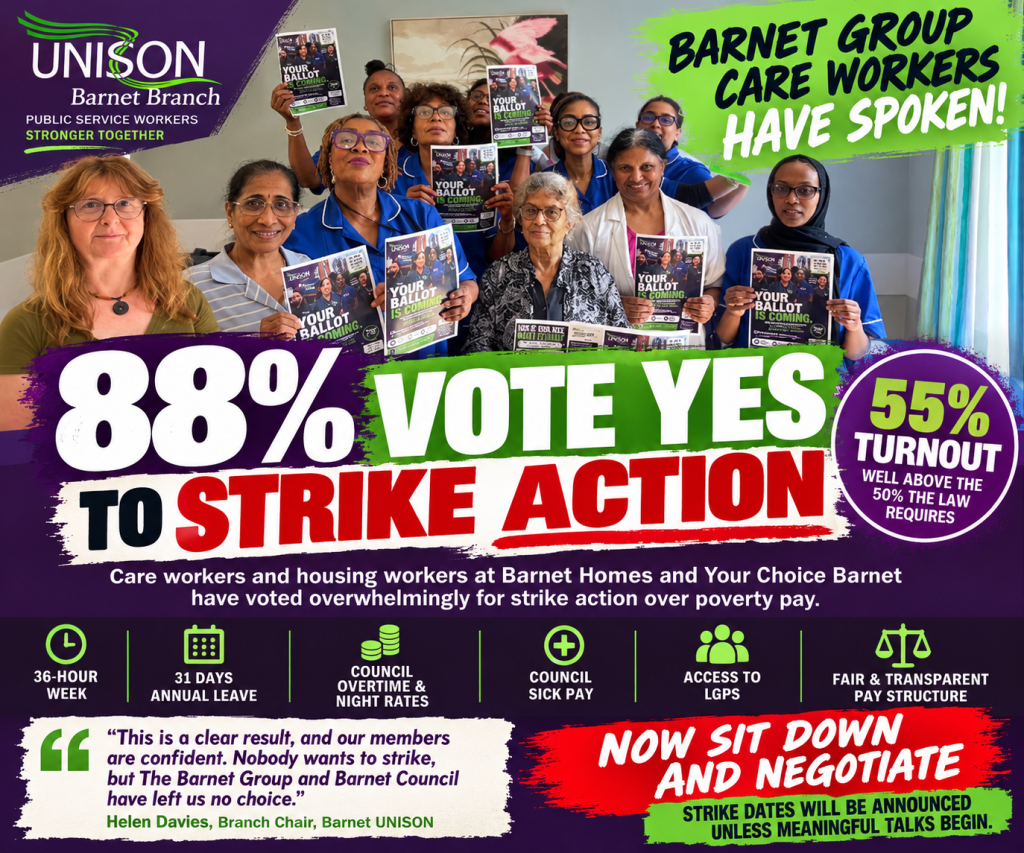
Today, Barnet UNISON is involved in a major dispute involving care workers employed by Your Choice Barnet.

These workers deliver essential adult social care services on behalf of Barnet Council.

They supported vulnerable residents throughout COVID. They carried on working when the risks to themselves and their families were very real.

Yet they remain part of a two-tier workforce.

They do not have the same core pay, terms and pension arrangements as directly employed council staff.

Our members are seeking fair pay, improved terms and conditions, a transparent pay structure and access to the Local Government Pension Scheme.

They should not have to consider strike action to secure basic fairness from an organisation wholly owned by the council.

This dispute exposes the gap between political promises about the future of social care and the reality experienced by the workforce.

The Prime Minister can speak about creating a National Care Service, but those words will mean little to care workers who remain underpaid, excluded from decent pensions and treated as second-class public-service workers.

A National Care Service cannot be credible if public bodies continue to deliver care through employment models that keep staff on inferior conditions.

The employment model matters

A National Care Service cannot simply be a new funding stream poured into the existing fragmented care market.

It cannot succeed while care remains dependent on outsourcing, low pay, insecure employment, inadequate sick pay and poor pension provision.

Nor is it enough to transfer services into council-owned companies while keeping the workforce outside council employment standards.

Public ownership must mean more than ownership on paper.

There must be no compromise about the employment model for care.

Care should be delivered as a public service through publicly accountable organisations.

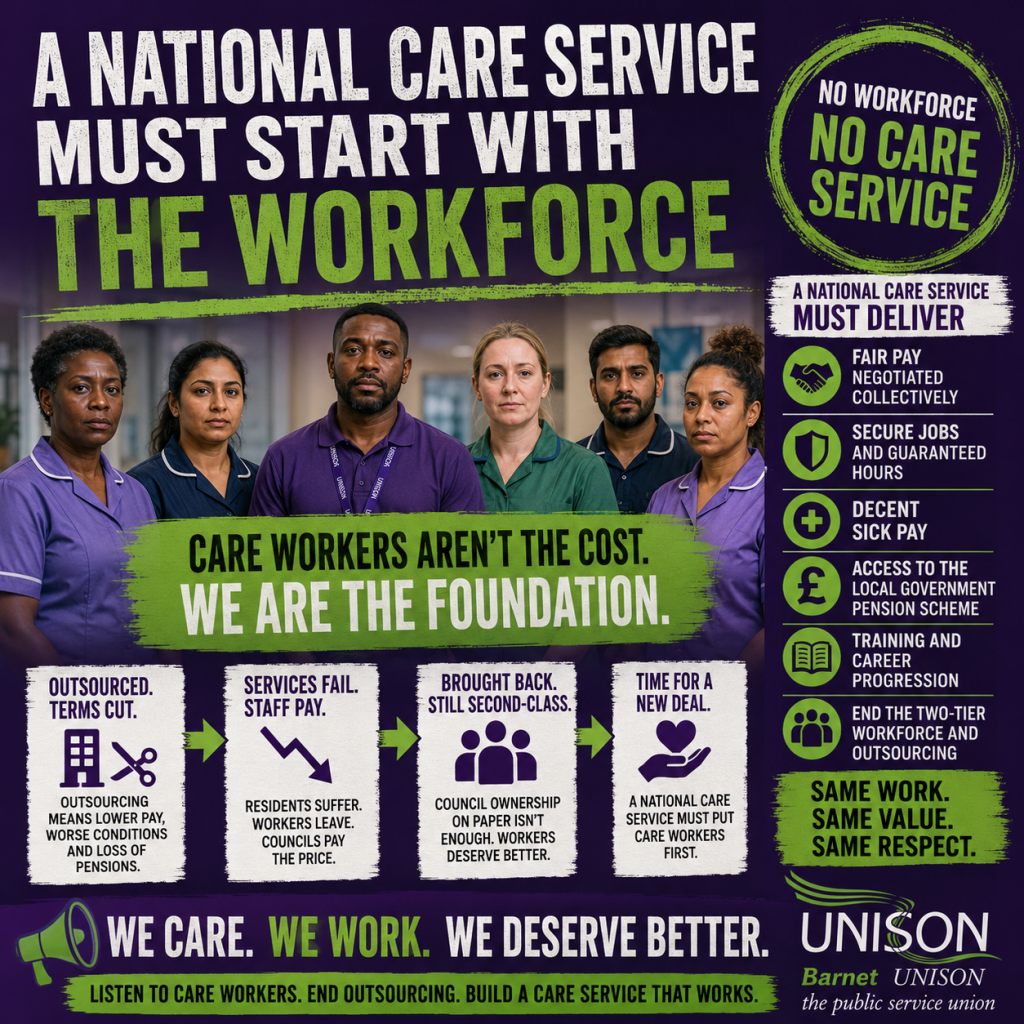
Care workers should have:

  • fair pay determined through collective bargaining;
  • secure employment and guaranteed hours;
  • decent occupational sick pay;
  • nationally recognised training and genuine career progression;
  • equal treatment across the workforce;
  • and access to the Local Government Pension Scheme or an equivalent high-quality public-service pension.

There must also be a clear route for outsourced care services and their workers to return to direct public employment without losing existing contractual rights.

Listen to care workers

Any government serious about creating a National Care Service must speak directly to care workers and their trade unions before deciding how it will operate.

Care workers are not an afterthought.

They are not simply a cost in a funding model.

They are the people who make the service possible.

They understand what repeated outsourcing, fragmented commissioning and staff shortages mean in practice.

They know what happens when experienced workers leave because they cannot afford to remain in care.

They understand the impact that workforce instability has on older and disabled people who rely on consistent, trusted support.

For more than three decades, I have watched politicians praise care workers while supporting or tolerating employment models that hold down their pay, remove access to decent pensions and weaken collective bargaining.

Warm words are not enough.

Medals are not enough.

Calling workers heroes is not enough.

The care workforce is predominantly female, and many care workers are Black or Asian. They carry out skilled, physically demanding and emotionally demanding work.

They need justice at work, not another political promise that leaves their employment conditions untouched.

A National Care Service must be built around the people who provide the care.

It must end outsourcing and the two-tier workforce.

It must provide fair pay, decent conditions, collective bargaining and proper pensions.

The Prime Minister should start by looking at what is happening to care workers now, including those employed by council-owned companies such as The Barnet Group.

If the Government is serious about a National Care Service, it should support an employment model that treats care workers as public-service professionals—not as a source of savings.

Without a respected and properly rewarded workforce, there is no National Care Service.

Anything less is not good enough.

John Burgess
Branch Secretary, Barnet UNISON
UNISON representative for 31 years and lead representative for approximately 3,000 members


FOR IMMEDIATE RELEASE — 17 JULY 2026 BARNET HOUSING AND CARE WORKERS MOVE TOWARDS STRIKE BALLOTS

FOR IMMEDIATE RELEASE — 17 JULY 2026

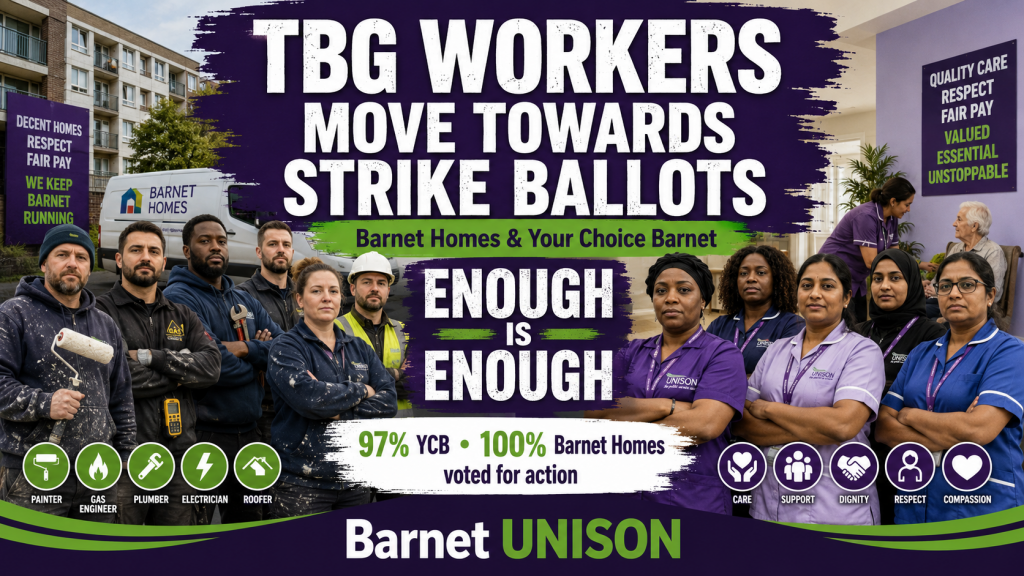
BARNET HOUSING AND CARE WORKERS MOVE TOWARDS STRIKE BALLOTS

Barnet Homes and Your Choice Barnet workers say “Enough is Enough” after TBG refuses to negotiate on pay, terms and pensions.

Barnet UNISON is preparing to request two separate formal industrial action ballots for members working in Barnet Homes and Your Choice Barnet, following a Special JNCC meeting with The Barnet Group today.

UNISON reported the results of two separate consultative ballots:

  • 97% of Your Choice Barnet members voted for industrial action
  • 100% of Barnet Homes members voted for industrial action

Despite these results, The Barnet Group confirmed at the meeting that it was not willing to negotiate on any part of UNISON’s claims.

The claims cover:

  • a proper pay increase, including a £15-an-hour minimum
  • improved terms and conditions
  • movement towards council-standard terms
  • access to the Local Government Pension Scheme

Barnet UNISON formally registered a failure to agree at the Special JNCC and advised TBG that the branch will now seek approval for separate statutory industrial action ballots for housing workers and care workers.

A Barnet Homes worker said:

“We deliver council housing services, but we are not treated like council workers. We work longer hours, receive worse terms and have no access to LGPS. Members have had enough of being told there is never any money for us.”

A Your Choice Barnet care worker said:

“We support vulnerable adults every day, often under huge physical and emotional pressure. Then we go home worrying about rent, food and bills. We are doing essential work in one of the most expensive cities in the world, but we are still treated as second-class.”

Helen Davies, Barnet UNISON Branch Chair and UNISON SGE representative for London, said:

“These ballot results send a powerful message. Housing and care workers are angry, organised and no longer prepared to accept second-class treatment. TBG has rejected every part of the claim and has now refused to negotiate, even after hearing that members are ready to take action. Enough is enough. Barnet Council owns The Barnet Group and cannot stand back while the workers delivering its services are treated this way.”

Barnet UNISON is calling on The Barnet Group and the London Borough of Barnet to return to negotiations with a serious proposal before the dispute escalates further.

Notes to editors

  • The Barnet Group is wholly owned by the London Borough of Barnet.
  • Barnet Homes provides housing services.
  • Your Choice Barnet provides adult social care services.
  • The consultative ballots were separate from the formal statutory industrial action ballots now being prepared.
  • Industrial action has not yet been authorised or called.

Media enquiries: contactus@barnetunison.org.uk

FOR IMMEDIATE RELEASE | June 2026 BARNET UNISON’S EQUAL PAY FIGHT: WE ARE NOT GOING AWAY

FOR IMMEDIATE RELEASE | June 2026

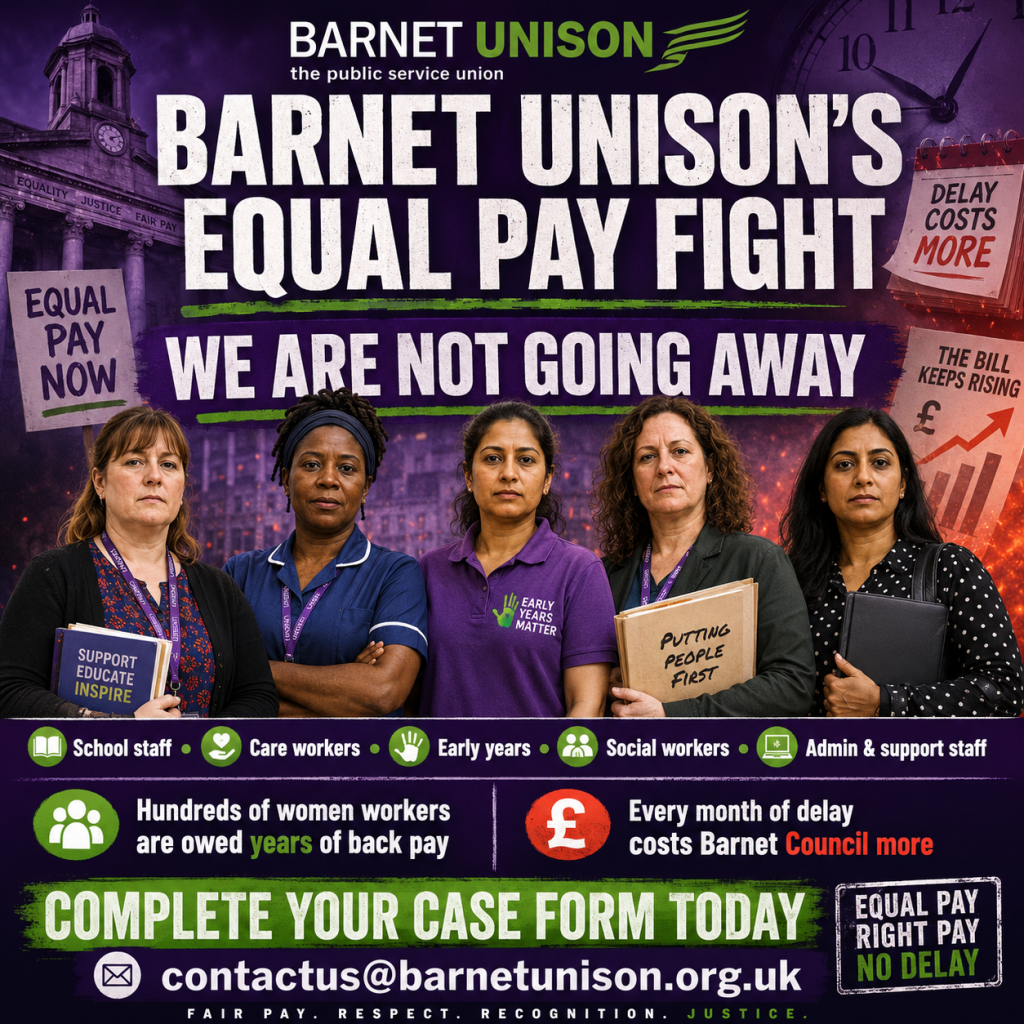
BARNET UNISON’S EQUAL PAY FIGHT: WE ARE NOT GOING AWAY

Hundreds of Barnet women workers are owed years of back pay. UNISON is fighting for every one of them and the bill for Barnet Council is growing every single day.

On 29 May 2026, Barnet UNISON took its equal pay claim to the Employment Tribunal. UNISON’s solicitors made the case for hundreds of women workers — school staff, care workers, early years workers, administrators and support staff — who have for years been paid less than their male counterparts in the council’s waste and recycling service.

Here is what we know. Male workers in the waste and recycling service are paid for a full working day but are allowed to go home when their rounds are done, sometimes by mid-morning. Women doing work of equal value have no such benefit. They work every contracted hour every day. That is not fair. That is unequal and illegal. And UNISON is determined to put it right.

WHAT HAPPENED AT THE TRIBUNAL

Our barrister succeeded in getting UNISON’s case heard, despite attempts by Barnet Council  to block our submissions. UNISON was fighting for women workers in that courtroom, making the case to get our members’ voices heard.

The judge has set a preliminary hearing for 9 September 2026 to consider UNISON’s application to have the procedural block on our claim removed.

That hearing is the next critical moment. We will be ready.

Separately, the tribunal confirmed that UNISON’s claims against The Barnet Group and Barnet Education and Learning Skills — the council’s own companies, employing many of our members — are not subject to any block and are being progressed. Those claims move forward now.

OUR CLAIM IS STRONG AND GROWING

Barnet UNISON’s case is not built on speculation. It is built on evidence — evidence that has been gathered carefully, systematically, and with the support of experienced legal specialists in equal pay law.

Here is what we know about the situation at Barnet:

  • Waste and recycling workers are regularly finishing their rounds hours before their contracted day ends and going home, paid in full.
  • Women working in schools, care, early years, social services and admin must complete every contracted hour. There is no equivalent benefit for them.
  • The council knows this practice exists. Rather than negotiating an end to this practice as other Councils have done, they are refusing to sit and meet with UNISON.
  • Other councils — including Southampton, Birmingham and Glasgow — have already settled equal pay claims on the same basis, paying out millions of pounds to women workers.
  • The longer Barnet Council refuses to come to the table, the bigger the bill becomes. Every single month of delay adds to the compensation owed.

“This claim is about basic fairness. Women working for Barnet Council and its companies have been short-changed for years while the council looked the other way. We have the evidence, we have the legal backing, and we have the determination to see this through. Barnet Council cannot run from this. The question is not whether they will have to pay — it is how much.”

Helen Davies, Branch Chair, Barnet UNISON and UNISON London Regional SGE Representative


EVERY MONTH OF DELAY COSTS BARNET COUNCIL MORE

Barnet Council’s legal strategy appears to be delay procedural hearings; blocking applications; running down the clock. What they do not seem to understand, or perhaps do not care about, is that delay does not reduce their liability; it increases it.

Equal pay back pay accrues from the date a claim is lodged. UNISON’s claims were lodged in November and December 2025. That clock is running. Every month the council refuses to negotiate, every month they hide behind procedural manoeuvres, the total compensation bill grows. By the time this case reaches settlement or judgment, Barnet Council will be paying for every single month they delayed.

That cost is ultimately borne by Barnet taxpayers. UNISON is not responsible for that. The council is.

THIS IS YOUR CLAIM. YOUR TIME IS NOW.

UNISON has lodged claims on behalf of our members. But the strength of this campaign depends on numbers and numbers depend on you.

Every eligible UNISON member who completes a case form adds to the pressure on Barnet Council to stop stalling and sit down at the negotiating table. A large, organised, well-evidenced claim is harder to ignore and harder to fight than a small one. Barnet Council is already watching these numbers. Help us make them impossible to ignore.

Here is what you must understand about timing: your back pay runs from the date you join the claim, not from the date UNISON first raised the issue. Every month you wait is a month of potential compensation you may never recover. Do not assume someone else has done it for you. Do not assume you will be included automatically.

COMPLETE YOUR CASE FORM TODAY

Contact Barnet UNISON at contactus@barnetunison.org.uk to get your case form. Fill it in. Return it. Do it now.

If you are a UNISON member working for the London Borough of Barnet, The Barnet Group or Barnet Education and Learning Skills, and you believe you may have been affected by unequal pay, you may be eligible to join this claim. Speak to your UNISON rep or contact the branch directly.

UNISON STANDS FULLY BEHIND YOU

UNISON knows what the cost-of-living crisis means for our members. We see it every day. Workers who give everything to their jobs — caring for children, supporting families, keeping this borough running — are struggling to pay their bills, heat their homes and put food on the table. Many of Barnet UNISON’s members are among the lowest paid workers in the borough. They cannot afford to wait years for justice that should have been delivered years ago.

That is why this claim matters beyond its legal significance. The back pay owed to these workers is not a windfall. It is money they earned and were denied. It is money that would make a real difference to real lives, right now, when it is needed most.


“Barnet UNISON’s equal pay claim is exactly the kind of fight that UNISON exists to lead. These are women who have worked hard, served their community, and been systematically short-changed. UNISON’s London region stands fully behind Barnet branch and every member in this claim. We will not rest until justice is delivered.”

Sara Gorton Regional Secretary UNISON Greater London Region


“Equal pay is not a negotiating position. It is a legal right. The women of Barnet have waited long enough. UNISON is unequivocally, unconditionally and completely behind Barnet UNISON’s members and their branch in this fight. Barnet Council must stop hiding behind legal delays and do the right thing: come to the table, negotiate a fair settlement, and end this inequality now.”

Andrea Egan, UNISON General Secretary


ENDS

For further information contact Barnet UNISON Branch: contactus@barnetunison.org.uk


NOTES TO EDITORS

  1. Barnet UNISON is the UNISON branch for workers employed by the London Borough of Barnet, The Barnet Group and Barnet Education and Learning Skills.
  2. Equal pay claims are brought under the Equality Act 2010. Back pay in Employment Tribunal equal pay claims in England and Wales runs for up to six years from the date the claim is lodged.
  3. UNISON’s equal pay claims were lodged with the Employment Tribunal in November and December 2025.
  4. A preliminary hearing is listed for 9 September 2026 to consider UNISON’s application to lift the procedural stay on claims against the London Borough of Barnet.
  5. Claims against The Barnet Group and Barnet Education and Learning Skills are not subject to the stay and are being actively progressed.
  6. Comparable equal pay settlements involving task and finish in waste and recycling services have been reached at Southampton City Council (July 2025), Birmingham City Council (2024–25) and Glasgow City Council (2022).

BARNET HOMES & YCB BALLOTS OPEN: TBG WORKERS VOTE ON NEXT STEPS IN PAY AND PENSION FIGHT

Housing and care workers employed by Barnet Council-owned TBG say “we can’t keep absorbing the cost of living crisis”

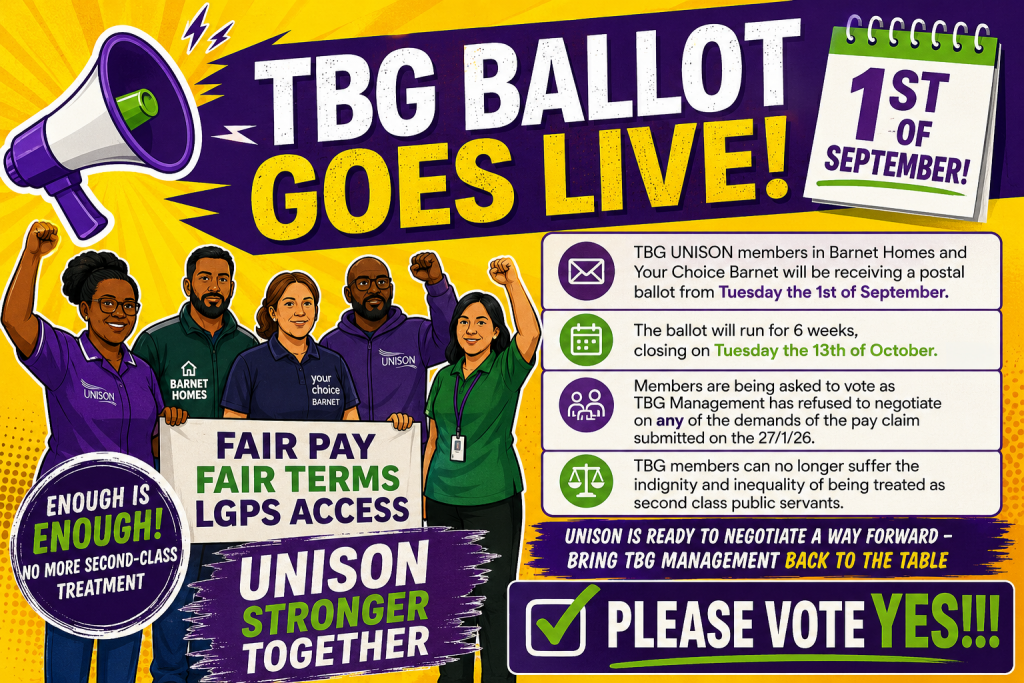
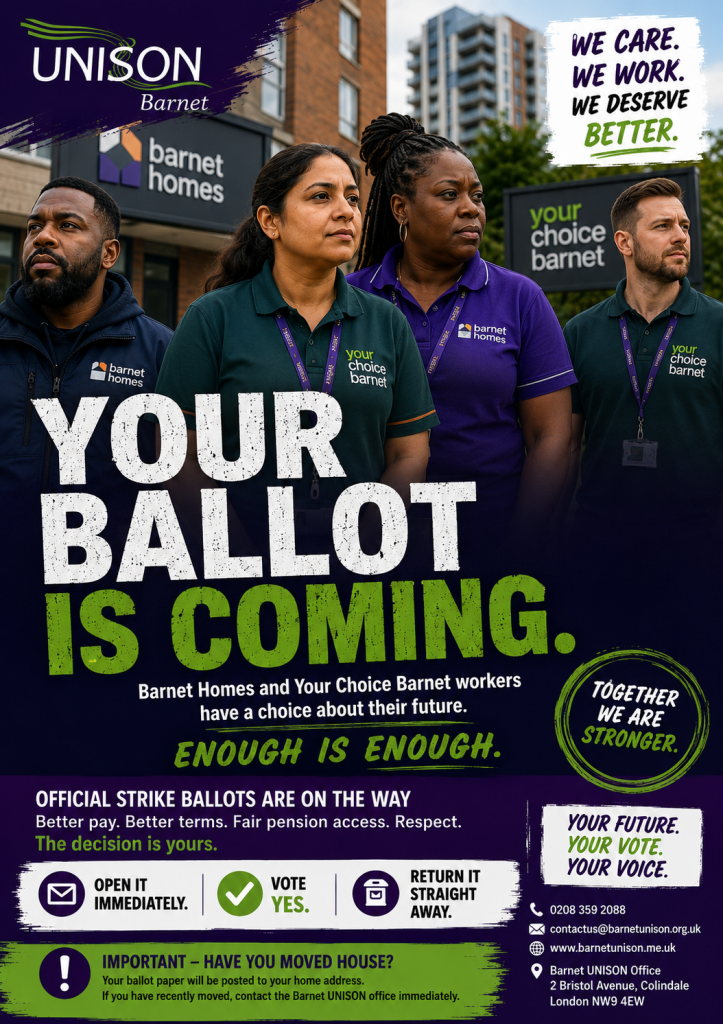
Barnet UNISON has opened two separate consultative ballots for members employed by The Barnet Group (TBG) — the council-owned company that delivers key services on behalf of the London Borough of Barnet.

The ballots cover:

  • Barnet Homes (Housing Services) workers, and
  • Your Choice Barnet (Adult Social Care) care and support workers.

The ballots follow TBG’s rejection of UNISON’s claims on pay, terms and conditions, and access to the Local Government Pension Scheme (LGPS). UNISON says the vote is needed to show management — and the council as owner and commissioner — that workers expect a serious response to the cost of living crisis.

A Barnet Homes housing worker said :

“People think housing is just admin. It isn’t. You’re dealing with residents in crisis, rising workload and constant pressure. Then you go home and you’re doing the same sums everyone else is doing — rent, bills, travel, food — and it doesn’t add up. The stress doesn’t switch off. It affects your head, your sleep, your family.”

A Your Choice Barnet care worker said :

“We support vulnerable adults every day. It’s physical work and it takes a toll mentally as well. But the hardest part is knowing you’re working flat out and still worrying about money — choosing between basics, falling behind, borrowing, trying to hold it together for your kids. This isn’t sustainable.”

Helen Davies, Barnet UNISON Branch Chair and UNISON SGE representative for London, said:

“These workers keep essential housing and care services running in one of the most expensive cities in the world. They are not asking for the moon — they are asking for fairness: decent pay, decent terms and access to LGPS. TBG is owned by Barnet Council, and Barnet Council cannot wash its hands of what happens to the workforce delivering its services. The ballots are open because members’ voices must be heard — and because the current situation is pushing too many working families towards hardship.”

Call to action:
Barnet UNISON is urging all eligible members in Barnet Homes and Your Choice Barnet to take part and return their ballot papers.

For media enquiries: contactus@barnetunison.org.uk

TBG rejects UNISON cost-of-living claims for housing and care workers

Employer admits financial pressure — but refuses pay, terms and LGPS improvements for Barnet Homes and Your Choice Barnet staff.

Barnet UNISON has received The Barnet Group’s formal response to our pay, terms and pension claims for workers in Barnet Homes (housing services) and Your Choice Barnet (adult social care). The headline is clear: TBG has rejected the claims.

These are frontline workers keeping essential services running in one of the most expensive cities in the world — supporting vulnerable adults, dealing with housing pressures, and carrying rising workloads. UNISON submitted the claims because members are being squeezed hard by the ongoing cost-of-living crisis and years of pay falling behind real living costs.

Key points from TBG’s response

  • TBG says Your Choice Barnet is forecasting a £824k loss this year and will have negative retained earnings rising to £2.048m.
  • TBG says Barnet Homes’ management fee will be cut by £2.763m (6%) from April 2026, and argues this limits what it can agree.
  • TBG has costed the key parts of the union claim and still concludes it is “not able to agree”.
  • Their own figures show a £15/hour minimum for Barnet Homes would cost £14,150 and affect 27 staff — yet they still refuse the claim overall.

Helen Davies, Barnet UNISON Branch Chair and UNISON SGE rep, said:

“Our members are not numbers on a spreadsheet. They are the housing workers and care staff holding services together every day. TBG’s response is basically ‘we can’t’ — while staff are being asked to cope with rising prices and worsening pressure at work. That’s not good enough. If these services matter, the workforce has to be treated with basic fairness: decent pay, decent terms, and a proper pension.”

What happens next

Barnet UNISON will now consult members on the employer’s response and the next steps in our campaign.

Read TBG full response here: https://www.barnetunison.me.uk/wp/wp-content/uploads/2026/03/2026.03.24-TBG-response-to-Barnet-UNISON-Cost-of-Living-Crisis-claims.pdf


End.

Update on Pay Negotiations with TBG

Barnet UNISON recently met with senior representatives from The Barnet Group (TBG) to discuss our 2024/25 pay and terms & conditions claim covering members in YCB and Barnet Homes.

At the meeting, TBG outlined what they describe as significant financial pressures across both organisations. They highlighted:

  • Very small projected operating surpluses for the coming year
  • Accumulated losses within YCB
  • Ongoing pressures linked to council funding and the Housing Revenue Account
  • Market challenges within residential care, including difficulties cross-subsidising council placements

They also referenced a recent external benchmarking review of extra care services, which they say shows TBG offering comparatively generous terms and conditions relative to parts of the wider care market.

UNISON’s Position

We made clear that our claim reflects the reality members are living through:

  • The cost of living crisis continues to hit housing and care workers hard.
  • Pay compression over many years has left many members feeling worse off in real terms.
  • In care services in particular, financial strain is severe, with some members telling us they are struggling to meet basic costs.

We emphasised that Barnet Homes and YCB do not function without their workforce. Any discussion about sustainability must include fair and sustainable pay for staff.

We also made clear that TBG is not bound by national NJC negotiations. That is why we have formally submitted our full claim locally and expect meaningful negotiation on all elements.

What Happens Next

TBG has committed to providing full costings for the outstanding elements of our claim, including pension implications. We expect that information before 24 March.

Once negotiations are exhausted, members will be consulted on the employer’s response. That would be a consultative ballot — not a strike ballot — allowing members to decide whether the offer is acceptable or whether further action is required.

This is a challenging negotiation. We recognise the financial arguments being made by the employer — but we also recognise the very real financial pressures our members are facing.

We will continue to press your case firmly and constructively.

Further updates will follow once we receive TBG’s full response.

End.


Cost of Living Crisis: What Barnet UNISON Is Doing — and Why Your Vote Matters

Every week Barnet UNISON speaks to members who are doing essential public service work — and struggling to make ends meet. That should never be normal. Yet in one of the most expensive cities in the world, too many Barnet workers are facing rising rents, higher food bills, increased energy costs, and transport fares that keep going up while pay falls behind.

We are seeing the reality on the ground: members skipping meals, taking second jobs, worrying about heating bills, and telling us they feel worse off now than at any time in their working lives.

Barnet UNISON has not stood back and watched this happen. We have built a coordinated Cost-of-Living response based on organising, bargaining and legal challenge. We are currently running ten separate cost-of-living campaigns across the employers where our members work.

Our 10 Cost of Living Campaigns

1. Equal Pay campaign across three employers

2. Pay claim for housing workers

3. Terms and conditions claim for housing workers

4. LGPS pension claim for housing workers

5. Pay claim for care workers

6. Terms and conditions claim for care workers

7. LGPS pension claim for care workers

8. Holiday payments claim for Barnet Council workers

9. Holiday payments claim for housing and care workers

10. Pay claim for outsourced cleaners

This is one of the most extensive cost-of-living responses our branch has ever mounted. It reflects what members have told us repeatedly: the problem is not one single issue — it is pay, pensions, insecure terms, unpaid entitlements, and historic inequality all combining to squeeze household incomes.

Low Pay in a High-Cost City: The Reality

Low pay is not accidental. It grows when employers hold down wages, delay reviews, outsource services, and maintain unequal pay structures.

Meanwhile, the cost of living in London continues to rise. Housing costs remain among the highest in the country. Inflation over recent years has pushed up the price of everyday essentials. When wages lag behind prices year after year, workers get poorer even while working just as hard — or harder — than before.

That is not sustainable for individuals, for families, or for the services we provide.

What the Union Is Doing — and What Happens Next

Our job as your union is to turn frustration into leverage. That means submitting claims, negotiating firmly, campaigning publicly, using legal routes where appropriate, and — when members support it — preparing for industrial action.

Across all ten campaigns, we are pressing employers to negotiate seriously and settle fairly. Some campaigns focus on immediate pay uplift. Others address structural unfairness that has cost members money over many years. All are about restoring value to your work.

The Most Important Message: Members Decide

There is one point we want to be absolutely clear about:

Members decide.

Ballots matter. Consultations matter. Voting matters. Whether a claim settles, escalates, or moves to the next stage depends on member participation and member votes.

The future of each of these campaigns will not be decided in a boardroom alone — it will be determined by how members vote.

When we organise and vote together, we are strongest.

End.

1 2 3 18