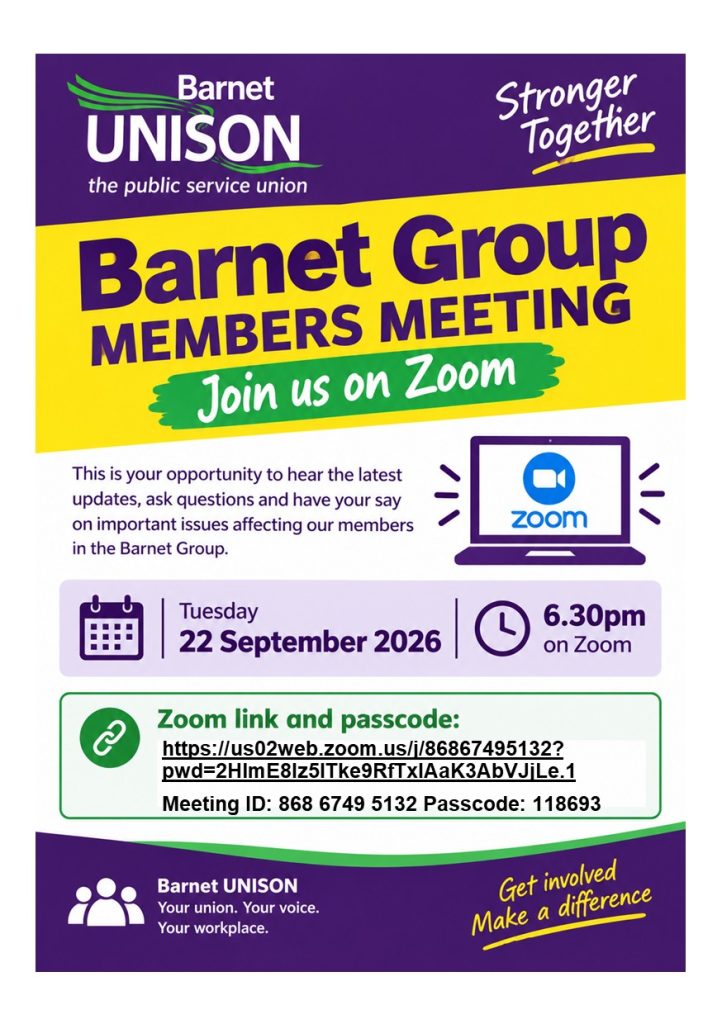

TBG members meeting

Click this link to join the meeting
https://us02web.zoom.us/j/86867495132?pwd=2HlmE8Iz5ITke9RfTxIAaK3AbVJjLe.1
Meeting ID: 868 6749 5132
Passcode: 118693

Click this link to join the meeting
https://us02web.zoom.us/j/86867495132?pwd=2HlmE8Iz5ITke9RfTxIAaK3AbVJjLe.1
Meeting ID: 868 6749 5132
Passcode: 118693

Monday 7th September 2026
Weekly Blog — speaking truth to power – Restructures what are your rights.
Restructures are happening across this council all the time, in some corner of the organisation or another. Most members never think about the process until the day it lands on their own desk. By then it’s too late to learn the rules from scratch. So, this week I want to set out plainly what happens when your service is restructured, what rights you actually have, and why the moment to get in touch with us is the day you hear the word “restructure,” not the day you get a letter about redundancy.
What actually happens
When management propose a restructure, they’re supposed to consult you formally before anything is decided. That means at least ten days’ notice of the meeting where consultation starts, and a proper written pack explaining what’s changing and why. Before that meeting even happens, we as your union should be briefed by management so we know what’s coming.
Once consultation opens, anyone whose post might go gets told individually that they’re “at risk.” That’s not the same as being made redundant. It means your post is on the list for job matching, where your current role gets compared against roles in the new structure. If there’s a close enough match, you slot straight in. If there are fewer posts than people, you go into a ring-fenced selection process instead.
Only after all of that is exhausted, if there’s genuinely no role for you, does redundancy notice get issued. And even then, you stay eligible for redeployment right up to your last day.
Where it can go wrong for you
On paper this all sounds fair. In practice, it depends entirely on management doing it properly, and on you knowing your rights well enough to hold them to it. You’re entitled to bring a union rep into every meeting, formal or informal. If you move to a lower graded post through this process, pay protection should apply. If you disagree with a job match, you’ve got fourteen calendar days to appeal it. If you’re made redundant, you’ve got fourteen calendar days to appeal that too. Calendar days, not working days, so a letter that lands on a Friday eats into your weekend as well.
Fourteen days sounds like plenty until you’re the one staring at a letter you don’t fully understand, trying to work out if the process was followed correctly. Most of the mistakes I see aren’t made deliberately. They happen because nobody was checking the detail at the time it mattered, and by the time someone does check, the clock has already run down.
That’s the whole point of getting us involved early. We can’t fix a flawed process after the decision’s been rubber-stamped nearly as easily as we can shape it while it’s still open.
So if your service is facing change, or you’ve had any hint that it might, don’t wait for a formal letter. Contact your steward or the branch office as soon as you hear anything, even if it’s only rumour at this stage. We’d rather talk you through ten false alarms than find out about a genuine one after the appeal deadline’s gone.
Take care of yourselves and each other.
Best wishes John Burgess Branch Secretary, Barnet UNISON

Monday 24 August 2026
Weekly Blog — speaking truth to power – A warning for every council worker
Something has been happening quietly in the Passenger Transport Service that every Barnet council worker needs to know about. It does not just affect Passenger Assistants. It sets a precedent that could affect any of us.
What has been going on
In 2017 a decision was taken — without any consultation with UNISON or GMB — that when Passenger Assistant posts became vacant through retirement or resignation, they would not be refilled with directly employed LBB staff. Instead, the work would be picked up by external providers.
Nobody announced this. Nobody brought it to a JNCC. No business case was published. No equality assessment was carried out. It just happened, post by post, year by year.
In January 2021 there were approximately 85 directly employed LBB Passenger Assistants. There are now 42. The work has not reduced. The service still runs over 100 routes that need Passenger Assistant support. The workers have simply been replaced.
We have now had this confirmed in writing by management. When we asked who is doing the work that LBB Passenger Assistants used to do, the answer came back: 61 workers employed by external private providers contracted by the Council.
That is not gap-filling. That is not flexible provision. That is outsourcing — and it has been done without any of the process that outsourcing requires.
Why this should worry you, wherever you work
This is not just a Passenger Transport story. The method matters.
Management found a way to run down an in-house workforce without ever formally proposing to outsource it. No Cabinet report saying we want to contract this service out. No consultation with the unions. No equality impact assessment on what it means for a low-paid, predominantly female workforce. Just a quiet decision to stop recruiting, and wait.
By the time anyone noticed, 60% of the Passenger Assistant function was being delivered by workers employed by private companies rather than by the Council.
Ask yourself this. What stops the same approach being used in your service? If management decided tomorrow to stop filling vacancies in your team and use contractors instead, this is now the precedent they would point to. UNISON is not prepared to let that stand unchallenged.
What UNISON has done and where we are
We have submitted a formal report to the highest level of joint negotiation with the Council — the JNCG, chaired by the Chief Executive. That report sets out the full picture: the workforce figures, the governance failures, the health and safety concerns, the breach of the Trade Union Engagement Framework the Council signed just last December.
We submitted that report in June. We are now in August. We have still not received a substantive response.
We have also formally asked management a question they have not answered: when did LBB last directly recruit a Passenger Assistant? The answer to that question will tell us exactly when the decision was made that this workforce would be wound down. We intend to find out.
This matter is going to JNCC as a formal agenda item. We are not dropping it.
What members can do
If you are a Passenger Assistant or Passenger Escort, or you know someone who is, please get in touch with the branch. Your experience of what has changed in this service matters and we want to hear it.
If you work in any other part of the Council and you have noticed posts in your team sitting vacant for long periods without being advertised, let us know. We want to understand whether what has happened in Passenger Transport is happening anywhere else.
The council workforce is strongest when we look out for each other. What happens to one group of workers today can happen to another group tomorrow.
Best wishes John Burgess Branch Secretary, Barnet UNISON

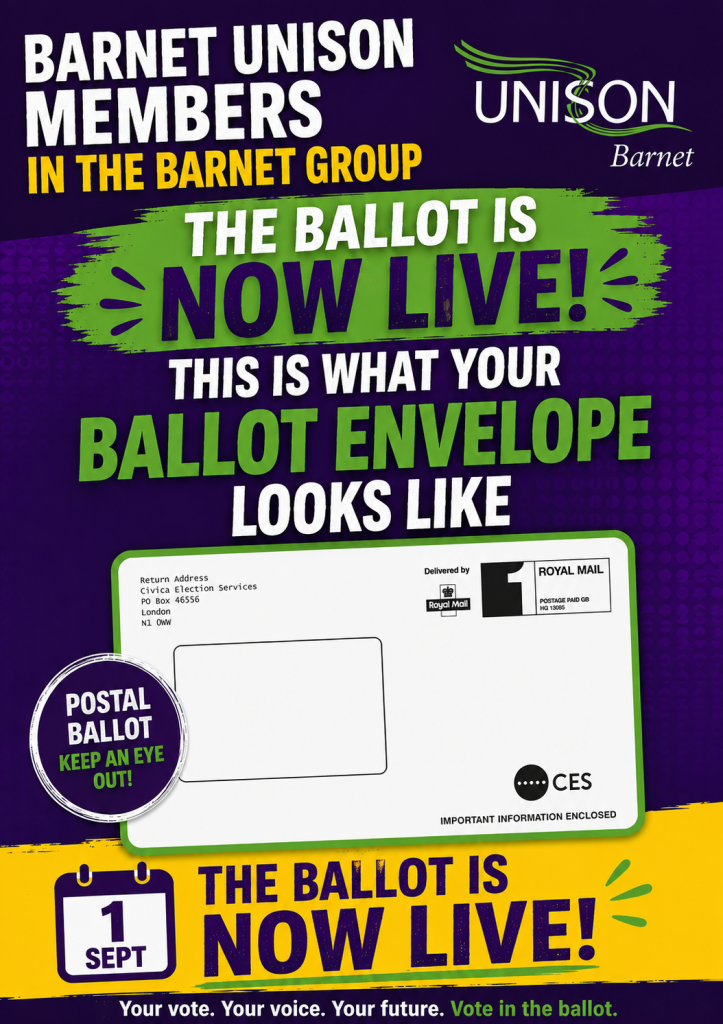
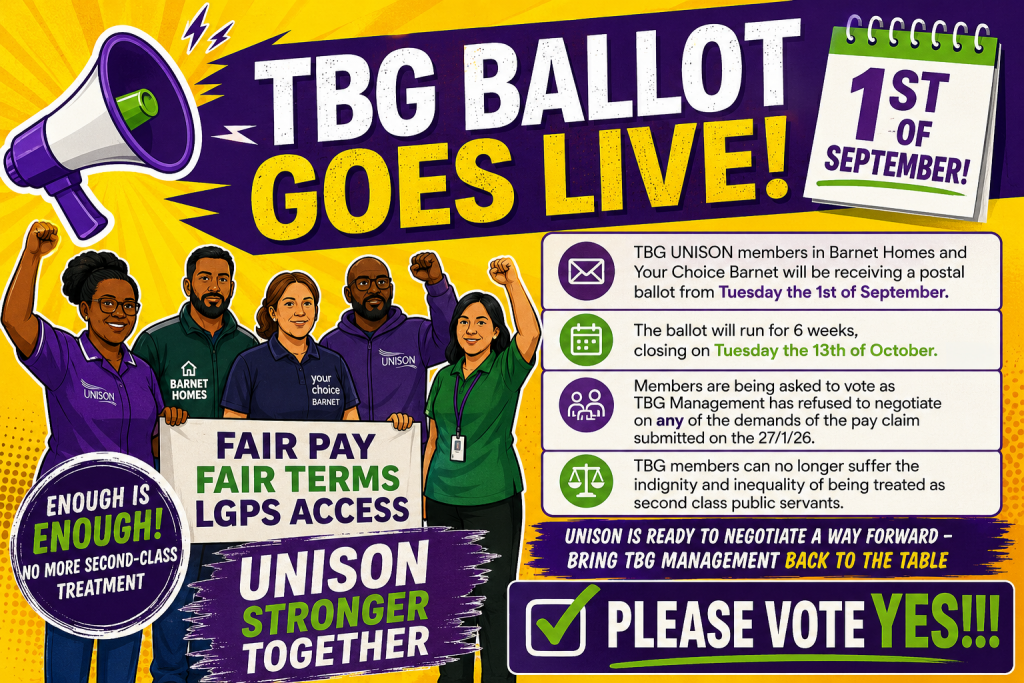
The Barnet Group (TBG) UNISON members in Barnet Homes and Your Choice Barnet will be receiving a postal ballot from Tuesday the 1st of September.
The ballot will run for 6 weeks, closing on Tuesday the 13th of October.
Members are being asked to vote as TBG Management has refused to negotiate on any of the demands of the pay claim submitted on the 27/1/26.
TBG members can no longer suffer the indignity and inequality of being treated as second class public servants.
UNISON is ready to negotiate a way forward – Bring TBG Management back to the table
Please vote YES!!!

Monday 10th August
Weekly Blog – Speaking Truth too Power – Sickness Absence
Sickness absence can become complicated very quickly. A few days off, a return-to-work meeting, then suddenly a manager is talking about review stages and attendance targets.
My message this week is simple. Contact UNISON early. Do not wait until you are worried that your job may be at risk.
Tell us when your health is affecting your work
You do not need to wait until you are signed off sick before contacting UNISON.
Speak to us if your health is affecting your attendance, your performance or your ability to carry out parts of your job. This includes physical health, mental health, stress, a disability or a long-term health condition.
The Council’s own policy says managers should support staff, discuss health problems sensitively and consider appropriate adjustments. That might include changes to duties, hours, equipment, workload or working arrangements.
The earlier these issues are raised, the better the chance of support being put in place before matters become more serious.
This guide relates to Barnet Council employees. Staff employed by schools may be covered by a separate policy adopted by their governing body, so school members should contact us for advice about the procedure that applies to them.
Know the basic sickness reporting rules
Employees are expected to notify their manager on the first day of sickness, normally within one hour of their usual start time or earlier where possible.
You should agree how you will keep in contact during your absence. If you are off for more than seven calendar days, including weekends and bank holidays, you must provide a fit note covering the absence.
A return-to-work meeting should normally take place after every period of sickness absence. The discussion should be private. Your manager should make a written note, place it on your personnel file and give you a copy.
Read that note. Check that it is accurate. Challenge anything which is wrong or misleading.
The Council’s review point is three periods of sickness absence or eight days of cumulative absence within a rolling twelve-month period, adjusted for part-time staff. Reaching that point does not automatically mean formal action. The manager should consider the circumstances and what support may be needed.
Occupational Health should be used properly
Occupational Health can be useful, but the referral needs to ask the right questions.
The Council normally seeks an employee’s consent before making a referral. Occupational Health advice is advisory. It does not make the management decision.
Before agreeing to a referral, ask to see the questions being sent. They should focus on matters such as whether you are fit to work, whether your condition may be work-related, what adjustments may help and whether a phased return is appropriate.
A poor referral can produce a poor report. A report based on incomplete or inaccurate information can then be used in meetings about your employment.
The procedure also says managers should have an up-to-date Occupational Health report before arranging a formal meeting or hearing. Contact UNISON before the referral is submitted, particularly if your health problems involve workplace stress, bullying, an accident at work or an ongoing grievance.
Do not attend formal meetings alone
The procedure has three review stages.
Stage 1 is described as an informal review. It may include an attendance target and a further review period.
Stage 2 is a formal review meeting. Medical evidence, Occupational Health advice, adjustments, phased returns and possible redeployment should be considered.
Stage 3 is the final formal review. At that stage, the Council may say that continued employment is at risk. Possible outcomes can include medical redeployment, ill-health retirement or dismissal.
Members have the right to be represented by UNISON at formal meetings. You may also ask to be accompanied at an informal review meeting, although the policy does not give the same automatic right.
Do not wait until Stage 3 before asking for help. By then, decisions may already have been made and opportunities to challenge poor management or secure adjustments may have been missed.
If you receive a letter inviting you to an absence review meeting, contact the Barnet UNISON office straight away. Send us the invitation, the absence record, any Occupational Health reports and any correspondence from your manager.
Sickness absence procedures are supposed to support employees. They should not become a conveyor belt towards dismissal.
Keep records. Ask questions. Get advice early.
best wishes
John Burgess
Branch Secretary
Barnet UNISON

Monday 27th July 2026
Weekly Blog – Employment Rights Act 2025 – What does it mean for workers?
The Employment Rights Act 2025 is now law, but it is not one big switch that has suddenly improved every workplace. Some rights are already in force. Others will arrive later, and some still depend on regulations and consultation.
The useful question for members is simple: what has changed, what is still coming, and will employers actually obey it?
What has changed already
Since April, Statutory Sick Pay has been payable from the first day of sickness rather than the fourth. The old minimum earnings threshold has also been removed. This matters most to low-paid workers, including many people in outsourced services, agency work and jobs with short or irregular hours.
Many Barnet Council employees have contractual sick pay which is better than Statutory Sick Pay. The new law does not give employers an excuse to cut better contractual arrangements. It sets a legal minimum, not a target.
Paternity leave and unpaid parental leave have also become rights from the first day of employment. The maximum protective award where an employer fails to consult properly over collective redundancies has doubled from 90 to 180 days’ pay.
Employers must now keep adequate records of annual leave and holiday pay for six years. That is especially relevant in Barnet, where UNISON is still challenging the Council over years of holiday pay which failed to include regular overtime. Employers have spent far too long acting as though poor records are the worker’s problem. They are not.
The Fair Work Agency has also been established, with powers covering areas including holiday pay and Statutory Sick Pay. We will judge it by what it delivers, not by the name on the door.
What is still to come
More changes are due later this year. These include electronic or workplace voting in statutory trade union ballots, stronger union access rights, better protection for union representatives and a new duty on employers to tell workers about their right to join a trade union.
There are also stronger duties planned to prevent sexual harassment, including harassment by third parties such as customers, clients or service users.
From January 2027, the qualifying period for ordinary unfair dismissal is due to fall from two years to six months. That is an improvement, but it is not the day-one protection that was originally promised. Fire and rehire protections are also due in January 2027.
Other changes, including rights to guaranteed hours, reasonable notice of shifts, payment when shifts are cancelled, stronger flexible working rights and wider bereavement leave, are expected during 2027. Much of the detail is still being worked through.
Rights on paper are not enough
The Act contains important gains. Trade unions campaigned for them, and workers will benefit. But no law enforces itself.
Some employers will update their policies properly. Others will drag their feet, misunderstand the law or quietly hope workers do not know what has changed. We have seen that before with holiday pay, equal pay, maternity rights and reasonable adjustments.
That is why union organisation still matters. A legal right is stronger when workers know about it, keep records and act together when an employer gets it wrong.
Over the coming months, Barnet UNISON will continue checking employer policies and challenging anything which falls short. If you believe your sick pay, family leave, holiday pay or other rights are not being applied correctly, speak to your workplace rep or contact the branch.
The Employment Rights Act is progress. Our job is to make sure the words become real rights at work.
best wishes
John Burgess
Branch Secretary
Barnet UNISON

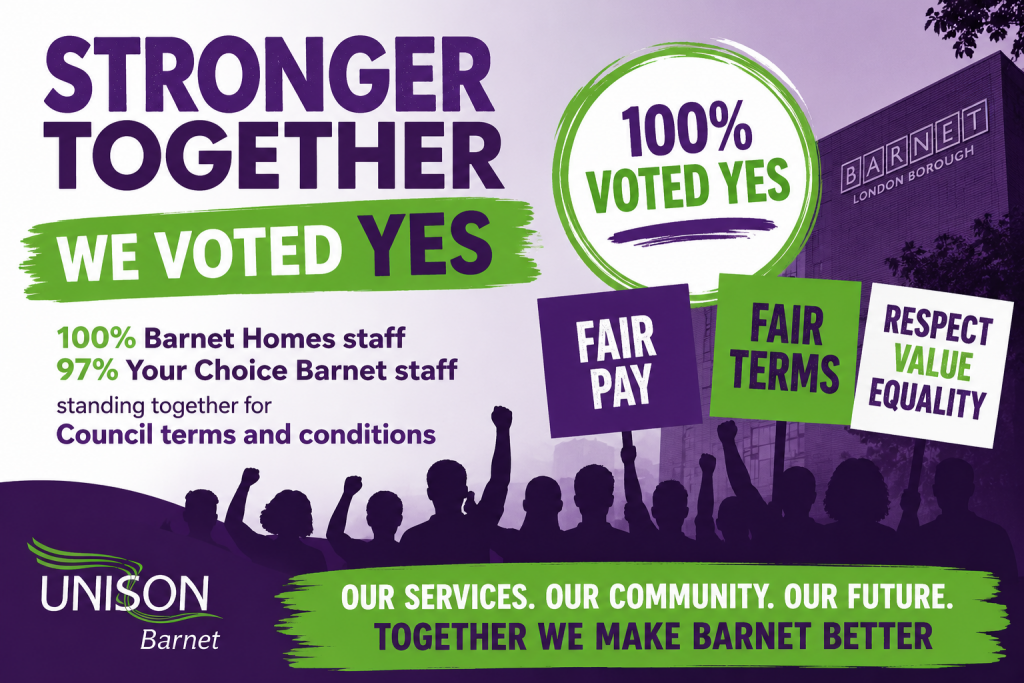
Barnet Homes staff voted 100% and Your Choice Barnet staff voted 97% to move towards an industrial ballot to achieve their aim of having Council terms and conditions restored.
The turnouts mean that they would have confidently beaten the thresholds required by the anti-trade union laws. No longer are these workers prepared to carry out 1st class Council services on 2nd class pay.
The only reason for the existence of Local Authority Trading Companies is for Councils to sidestep Council terms and conditions. They often cite the cost of the pension scheme to the employer. Yet it is senior managers who cost the most in the pension scheme and so we wonder “if it is such a good idea and so good for the Council then instead of forcing the lowest paid into even more inferior terms and conditions, why don’t senior managers lead by example and create one for themselves?”
Barnet UNISON has requested a Special JNCC to impress on The Barnet Group the need to negotiate movement on the demands from the workforce.
This news comes at a time when the Tribunal has ruled that the Equal Pay Claim against The Barnet Group and BELS can proceed to be heard.
We will feedback when we have more developments.
If you have any questions or need any support please contact the Branch Office
Or you can call 020 8359 2088, if we are unable to answer the telephone please leave a message speaking slowly and clearly please include your name, telephone number, membership number and a brief message about the assistance you require. We will respond as soon as we can.
Alternatively you can contact UNISON Direct Call Centre by telephone
08000 857 857 Monday – Friday 6am – Midnight, Saturday 9am – 4pm
or make an online enquiry by clicking the following link
https://www.unison.org.uk/get-help/online-enquiries/
To Join UNISON click the following link