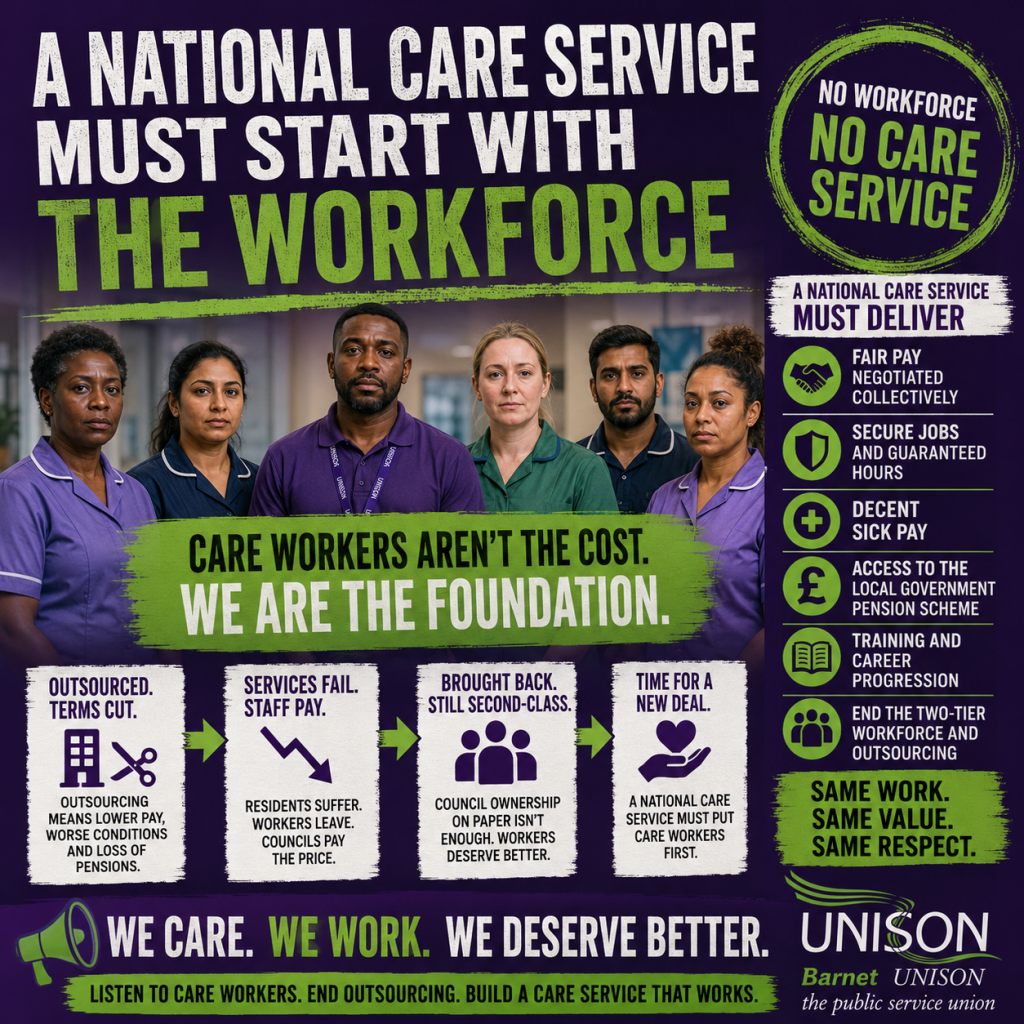

A National Care Service must start with the workforce

A National Care Service must start with the workforce

Rebecca Long-Bailey is right to argue that social care should become a universal public service, built on the same principle as the NHS: care according to need, not ability to pay.

But after 31 years as a UNISON representative, and decades organising and representing care workers in Barnet, I believe something fundamental is still missing from the national debate.

Politicians and the media repeatedly ask how much a National Care Service will cost and how it should be funded.

Those are important questions, but they are not the only questions.

We also need to ask who will provide the care, who will employ them, and on what pay, pensions and conditions.

There is no National Care Service without a national care workforce.

Three decades of outsourcing in Barnet

My first major involvement with care workers began in the late 1990s, when Barnet Council decided to outsource its residential care homes and day services.

The case put forward was that outsourcing was needed to secure investment in new and improved buildings.

Barnet UNISON opposed the proposal. We organised members and produced alternative reports challenging the argument that outsourcing was the only way to improve services.

At the same time, the council was implementing the national Single Status agreement. Care workers were moved from spot salaries onto a career-grade structure intended to provide fairer and more consistent pay.

The ink was barely dry on those new arrangements before the workers were told they were being outsourced.

The staff transferred to the Fremantle Trust. A few years later, the employer moved to impose significantly worse contracts.

Our members faced cuts to pay, sick pay and annual leave. Barnet UNISON members resisted through strike action, rallies, campaigning and meetings in Parliament.

We fought hard, but the cuts were imposed.

Much of the progress achieved through Single Status was undone. Skilled care workers delivering a public service were left with lower pay and weaker employment protections.

That experience taught us an important lesson.

Improvements negotiated through collective bargaining can be taken away when workers are transferred outside direct public employment.

The outsourcing model failed workers and services

The care-home contract later became the subject of a major financial dispute between Barnet Council and Catalyst Housing, which had partnered with Fremantle in the contract.

The dispute went to arbitration and resulted in substantial costs for the council.

Barnet Council eventually withdrew from the remaining contract. The services and staff transferred to Your Choice Barnet, part of the council-owned Barnet Group.

But the service did not return directly to the council.

The workers remained employed at arm’s length, outside council terms and conditions.

The history continued with the closure of Apthorp Care Home.

Residents had to leave their home and staff who had worked throughout the pandemic faced redundancy.

The building was reported to require millions of pounds of repairs despite being relatively new.

Once again, residents and workers carried the consequences of decisions made above them.

Home care followed the same pattern

Barnet UNISON also fought to retain the council’s in-house home-care service.

That service was outsourced.

Years later, part of the outsourced provision transferred to Aquaflo Care. The transfer ran into serious difficulties and the service was subsequently brought into The Barnet Group.

Several years later, The Barnet Group announced plans to close its Enablement Home Care Service.

The pattern has repeated itself throughout my time representing care workers:

A public service is outsourced.

The workforce is transferred.

Pay, pensions and conditions become fragmented.

The contract or provider runs into difficulty.

The service may eventually return to a council-owned organisation, but the workers do not necessarily regain council employment, council conditions or access to the Local Government Pension Scheme.

This is not history—our members are living it now

Today, Barnet UNISON is involved in a major dispute involving care workers employed by Your Choice Barnet.

These workers deliver essential adult social care services on behalf of Barnet Council.

They supported vulnerable residents throughout COVID. They carried on working when the risks to themselves and their families were very real.

Yet they remain part of a two-tier workforce.

They do not have the same core pay, terms and pension arrangements as directly employed council staff.

Our members are seeking fair pay, improved terms and conditions, a transparent pay structure and access to the Local Government Pension Scheme.

They should not have to consider strike action to secure basic fairness from an organisation wholly owned by the council.

This dispute exposes the gap between political promises about the future of social care and the reality experienced by the workforce.

The Prime Minister can speak about creating a National Care Service, but those words will mean little to care workers who remain underpaid, excluded from decent pensions and treated as second-class public-service workers.

A National Care Service cannot be credible if public bodies continue to deliver care through employment models that keep staff on inferior conditions.

The employment model matters

A National Care Service cannot simply be a new funding stream poured into the existing fragmented care market.

It cannot succeed while care remains dependent on outsourcing, low pay, insecure employment, inadequate sick pay and poor pension provision.

Nor is it enough to transfer services into council-owned companies while keeping the workforce outside council employment standards.

Public ownership must mean more than ownership on paper.

There must be no compromise about the employment model for care.

Care should be delivered as a public service through publicly accountable organisations.

Care workers should have:

  • fair pay determined through collective bargaining;
  • secure employment and guaranteed hours;
  • decent occupational sick pay;
  • nationally recognised training and genuine career progression;
  • equal treatment across the workforce;
  • and access to the Local Government Pension Scheme or an equivalent high-quality public-service pension.

There must also be a clear route for outsourced care services and their workers to return to direct public employment without losing existing contractual rights.

Listen to care workers

Any government serious about creating a National Care Service must speak directly to care workers and their trade unions before deciding how it will operate.

Care workers are not an afterthought.

They are not simply a cost in a funding model.

They are the people who make the service possible.

They understand what repeated outsourcing, fragmented commissioning and staff shortages mean in practice.

They know what happens when experienced workers leave because they cannot afford to remain in care.

They understand the impact that workforce instability has on older and disabled people who rely on consistent, trusted support.

For more than three decades, I have watched politicians praise care workers while supporting or tolerating employment models that hold down their pay, remove access to decent pensions and weaken collective bargaining.

Warm words are not enough.

Medals are not enough.

Calling workers heroes is not enough.

The care workforce is predominantly female, and many care workers are Black or Asian. They carry out skilled, physically demanding and emotionally demanding work.

They need justice at work, not another political promise that leaves their employment conditions untouched.

A National Care Service must be built around the people who provide the care.

It must end outsourcing and the two-tier workforce.

It must provide fair pay, decent conditions, collective bargaining and proper pensions.

The Prime Minister should start by looking at what is happening to care workers now, including those employed by council-owned companies such as The Barnet Group.

If the Government is serious about a National Care Service, it should support an employment model that treats care workers as public-service professionals—not as a source of savings.

Without a respected and properly rewarded workforce, there is no National Care Service.

Anything less is not good enough.

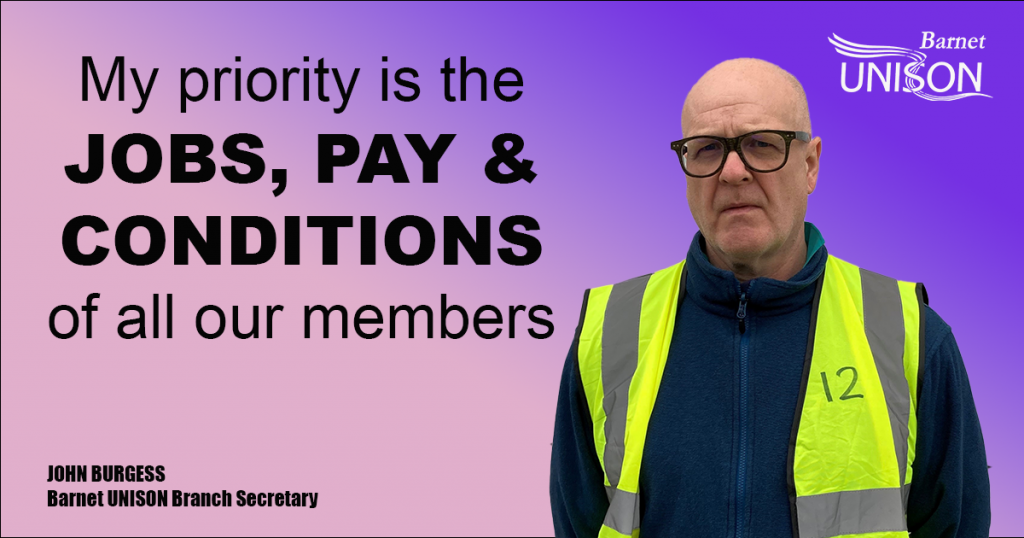
John Burgess
Branch Secretary, Barnet UNISON
UNISON representative for 31 years and lead representative for approximately 3,000 members


“No stone left unturned” What is The Barnet Group (TBG)? Number 7: Part Three

Ever since we published our article called Three Chief Executives and a Plumber, we have been inundated with questions about The Barnet Group (TBG).

Barnet UNISON published three animations which were put together with the help of our Barnet UNISON reps in TBG

Here is Animation Number Three which we noticed someone was watching it on a bus.


After watching this animation we strongly recommend you reading our article Three Chief Executives and a Plumber, here https://www.barnetunison.me.uk/wp/2024/10/18/barnet-council-the-tale-of-three-chief-executives-and-one-plumber/

End.


“No stone left unturned” What is The Barnet Group (TBG)? Number 6: Part Two

Ever since we published our article called Three Chief Executives and a Plumber, we have been inundated with questions about The Barnet Group (TBG).

Barnet UNISON published three animations which were put together with the help of our Barnet UNISON reps in TBG

Here is Animation Number Two which appears to have been screened in London Docklands.


After watching this animation we strongly recommend you reading our article Three Chief Executives and a Plumber, here https://www.barnetunison.me.uk/wp/2024/10/18/barnet-council-the-tale-of-three-chief-executives-and-one-plumber/

End.

Barnet UNISON consultative ballot for care workers


13 February 2024

Dear colleague,

We want you to participate in this consultative ballot to make it clear to senior managers just how strongly you feel about your pay.

We will be letting senior managers know the results of the ballot, so this is your chance to make a difference. If enough people vote yes, then it will not be your last chance and we may progress to balloting our members officially about your willingness to take strike action.

During the COVID pandemic you put your lives and the lives of your families/ loved ones on the line to keep members of the public safe. It took a long time for you to then receive an uplift in your pay, terms and conditions….and it was not enough.

In any case the small gains you made in pay were smashed away by the cost-of-living crisis.

What can The Barnet Group afford? Perhaps we should ask the question differently – You have been identified as essential workers; can any employer afford the cost of you not doing your job?

What you must do now?

If your workplace setting has a UNISON rep, you should ask them for your ballot paper. Your rep should be checking with you that the address on the envelope matches your current home address. If we did go on to carry out an official ballot, the letter would go to your home address. We need to know we have your correct details. Complete the ballot paper and hand it back to your UNISON rep.

If your workplace has no UNISON rep, the ballot paper will be posted to you directly. Please complete the ballot paper and put it back in the pre-paid envelope and post it back to us.

Your ballot paper needs to reach us by 5pm 23rd February 2024


Yours Sincerely


John Burgess                                  Patrick Hunter                           Helen Davies

Barnet UNISON                               Barnet UNISON                         Barnet UNISON

Branch Secretary              TBG Assistant Branch Secretary                Branch Chair


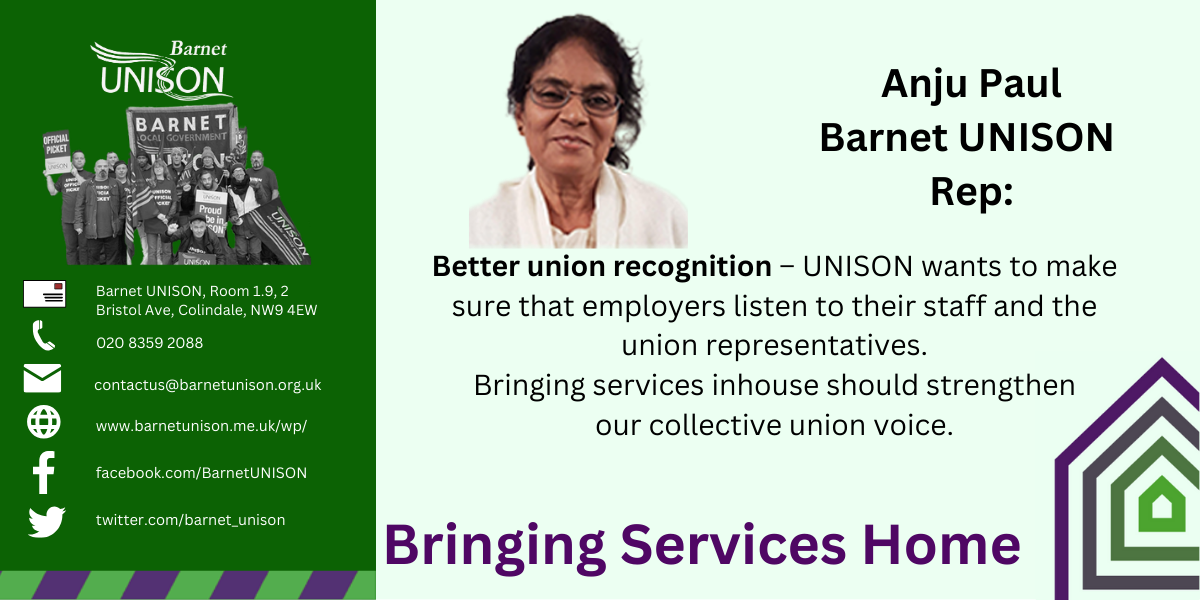
Bringing Services Home – Barnet UNISON campaign


Barnet UNISON is proud to announce that we are promoting UNISON Bringing Services Home campaign.

As a branch we have had more than our share of outsourcing. The easy Council experiment was a spectacular failure. It cost more money (yes, we told them it would!) and it did not lead to better services.

In May 2022, Barnet Labour Party won the election with a massive majority and one of their priorities was “Review of contracted out services, in the context of the new administration’s aspiration to bring privatised services back in-house.”

Last year Barnet Labour Party brought back one of the big contracts with Capita and other services on the other Capita contract have been coming back in-house.

The Council is going through a period of healing from the badly advised outsourcing ideology which dominated our Council for over a decade.

Today Barnet UNISON has written to all senior council officers responsible for outsourced contracts seeking a meeting to discuss how and when they are going to review the outsourced service.

Barnet UNISON also want to deal with the Ethnicity Pay Gap which the outsourcing easy Council ideology promoted by always securing the outsourcing option for services which are largely provided by Black workers e.g.

  1. NSL: Parking Services
  2. ISS: Catering Services
  3. Your Choice Barnet: Social Care services
  4. Norse: Cleaning services
  5. Blue 9: Security Services.

All the above services were outsourced under the Tories.

Barnet UNISON positively supports the statement of UNISON general secretary Christina McAnea said:

“Black workers make a vital contribution to the health and care sector but are all too often at the bottom of the pay scale as care workers, porters, healthcare assistants and catering staff. They frequently face shocking discrimination, threatening their health, job security and life chances.”

This why Barnet UNISON is determined to work with the Labour Administration to bring back these services into the Council thus enabling real life meaningful changes for a workforce that is often invisible and often low paid and without occupational sick pay.

End.


Breaking News: Covid Heroes face the sack by Barnet Council

The Barnet Group is an arm’s length company 100% owned by Barnet Council.

On Friday 9 February 2024, Enablement Home Care workers were told that they were no longer needed.

“We are the best at what we do, that is why we look after people discharged from hospital for 8 weeks till other carers takeover.”

Care worker

“They should be expanding our service, not shutting it, what we do is vital and we do it well”

Care worker

Staff and Barnet UNISON left the meeting with the following questions:

  1. Enablement is a well-run and valued service – why isn’t TBG expanding rather than closing the service?
  2. What engagement has taken place with stakeholders – our tenants and clients?
  3. When will we know if this is a TUPE or a Closure?
  4. What are they consulting staff and UNISON on? UNISON is clear that TBG need to provide more details before commencing with 121’s?
  5. When will ‘consultation’ begin and how long will it last?

 Background:

This service was handed to TBG after senior officers working for Barnet Council spectacularly failed over the procurement of Aquaflo a private contractor who had been given the contract by Barnet Council to deliver home care for Barnet residents.

‘Disaster’ – Aquaflo Care company’s takeover from Housing 21 goes badly wrong.” 15th September 2016.

https://www.borehamwoodtimes.co.uk/news/14745911.disaster-aquaflo-care-companys-takeover-from-housing-21-goes-badly-wrong/

Covid: How quickly senior officers and councillors forget

It is only a few years ago that these workers were called heroes as they went into Barnet residents’ homes to provide care and support whilst many of the senior managers and councillors issued instructions from the safety of their homes.Barnet UNISON will be providing support to all of our members.

Barnet UNISON will be providing support to all of our members and in the meantime, we are calling on Barnet Council to reverse this decision and bring it back in-house to the Adult Social Care directorate where it belongs. The decision by senior officers is at odds with the Labour Party position on creating a National Care Service which is something UNISON supports. “Unison’s general secretary, Christina McAnea, told the Observer: “Care is in crisis and the need for a national service has never been greater.”

More news later.

End.


Barnet Tories 2023/24 Council Budget Plan to cut hundreds of jobs……

Barnet Tories 2023/24 Council Budget Plan to cut hundreds of jobs and the right to representation by a trade union.

Read details here on the Council website https://barnet.moderngov.co.uk/documents/s76600/Conservative%20Alternative%20Budget%20Final%20Publish.pdf

In the biggest Cost of Living Crisis in over 75 years Barnet Tories have proposed an alternative budget that according to the Councils Chief Finance officer has this to say:

“Notionally this would be taking approximately 100 posts out of the services not mentioned above. This would have a significant impact on the delivery of those services and the S151 would advise caution in the delivery of this saving and the impact it could have on services.”

https://barnet.moderngov.co.uk/documents/s76601/S151%20and%20Monitoring%20Officer%20Comments%20on%20Alternative%20Budget.pdf


This anti worker rhetoric sums up where we are politically. The only response the Tories have is to frighten workers with redundancies and at the same time take away the right of workers to organise and be represented by trade unions.

If they want to look at waste, Barnet UNISON warned the Tories of the dangers of their mass outsourcing ideology back in 2008. We warned it would lead to poorer services, mass redundancies and of course we warned that Barnet would become a cash cow to the contractors.

Take a look at Barnet Blogger Mr Reasonable and read in horror the latest figures of Council spend on the two Capita contracts read below

http://reasonablenewbarnet.blogspot.com/2023/02/capita-continuing-to-disappoint-in.html


To date Barnet Council has given Capita an eye watering £634 million of which £273 million more than the contracted value.

Back in 2012 Barnet UNISON was assured that Capita would be held to account, but the reality is that they have been treated differently to in-house services who have had to try to deliver services through austerity whereas Capita keep holding their hands out asking for more.

What was worrying at the last Audit Committee on 16 January 2023 is that the Council were not seeking compensation for poor performance and even more worrying that the Council is not monitoring Capita in the last few months of contract take a listen below:

https://aisapps.sonicfoundry.com/AuditelScheduler/Player/Index/?id=2329a97b-5ee9-40b6-ad39-aef3cce9a3b6&presID=b142792e21954335a5579e2a62fb46ef1d


The Tories spent £13 million to consultants to help develop and manage the mass outsourcing of services.

What about the decision to set the Council depot based in the centre of the borough ideally located to deliver frontline services to the residents of Barnet. A decision that saw services split between Barnet and Harrow. This model did not work, and the costs associated with moving services back to one location have cost millions with more still to be spent.

Barnet UNISON is proud of the hard work and commitment of all our members working across all parts of the Council including schools. They were quite rightly lauded as key workers, most of whom went into work when others worked from the safety of their homes.

We will continue to organise and mobilise our members wherever they are.

End.

Emergency HGV drivers depot meeting 1 February 5.45 am

Barnet UNISON carried out an informal ballot of our members on the offer of 10 % Recruitment/Retention for our HGV driver members.

97% of members rejected this offer.

Barnet Council has been paying social workers in Family Services Recruitment/Retention payments up to 20% for the past 5 years.

In the worst Cost of Living Crisis our members believe they are worth more than 10%.

We are calling a meeting of all drivers to discuss what happens to our claim. It is important that all drivers turn up to the meeting

Wednesday 1 February, 5.45 a.m.

End.

1 2 3 12