
They Were Heroes During Covid. Now They Are Fighting for Fair Pay. We Must Stand With Them.

They Were Heroes During Covid. Now They Are Fighting for Fair Pay. We Must Stand With Them.
 Branch Secretary Blog — John Burgess, Barnet UNISON

On Tuesday 13 October, Barnet UNISON announced that our members working for The Barnet Group had voted overwhelmingly for strike action.

 88% voted YES on a 55% turnout.

That is a powerful result, and I want to explain why this dispute matters to every Barnet UNISON member, not just those working for The Barnet Group.

 Who are The Barnet Group workers?

The Barnet Group (TBG) is a company wholly owned by Barnet Council. It includes Barnet Homes, which provides housing services, and Your Choice Barnet, which provides social care and support services.

These are not optional services. Housing and social care are essential public services which councils have statutory responsibilities to provide or arrange.

Our members include care and support workers looking after vulnerable adults, and housing workers helping residents with their homes, repairs and housing needs.

They are public service workers. They work for organisations owned by Barnet Council. But they are not treated the same as Barnet Council employees.

Many members reading this may be surprised to learn that TBG workers do not automatically receive the same pay, annual leave, sick pay, overtime rates or other terms and conditions as Council staff.

They also do not have the same access to the Local Government Pension Scheme (LGPS).

How can that be right?

Remember when care workers were called heroes?

I want members to think back to Covid.

When much of the country was told to stay at home, our care workers continued going to work.

They supported vulnerable residents who depended on them. They worried about catching Covid, about passing it on to the people they cared for, and about bringing it home to their own families.

They went to work because people needed them.

Remember the weekly applause? Remember people standing outside their homes banging saucepans to show their appreciation for NHS and care workers?

They were called heroes then. So why are they still fighting for fair pay, decent conditions and pension rights now?

You cannot pay the rent with applause. You cannot pay your energy bills with praise.

And you certainly cannot build a decent retirement on warm words.

One Council. Two Workforces. That Must End.

Barnet UNISON has been campaigning for years against outsourcing and the creation of a two-tier workforce.

Barnet Homes and Your Choice Barnet were once Council services. Moving them outside direct Council employment has left workers doing essential public service jobs without the same contractual protections and benefits as their Council colleagues.

Our members are demanding better pay and conditions, including improved annual leave, sick pay, working hours, overtime rates, a fair pay structure and access to the LGPS.

The Barnet Group has rejected the claim.

Our members have responded by voting for strike action.

Nobody takes a decision to strike lightly, especially workers who care for vulnerable people and support residents.

But when employers refuse to negotiate seriously, what choice are workers left with?

This is why Barnet UNISON is calling on The Barnet Group and Barnet Council to sit down with us and negotiate a fair settlement.

My Message to Every Barnet UNISON Member

I have spent 31 years representing workers in Barnet, including 23 years as Branch Secretary.

I have seen what outsourcing does to workers. I have seen the divisions it creates, the inequalities it produces and the damage it can do to morale.

I have also seen what happens when workers stand together.

Our TBG members have shown courage. They have voted to challenge their employer because they believe they deserve better.

Now I am asking every Barnet UNISON member reading this blog to do something simple.

Take a few minutes to send a message of solidarity to our housing and care workers.

It doesn’t have to be long. Just a few words to let them know they are not alone.

You might work in a school, a library, a depot, an office or another Council service. You might never have met a TBG worker.

That doesn’t matter.

We are all UNISON members, and when one group of workers is fighting for fair treatment, they deserve the support of the rest of us.

Please email your message of support to contactus@barnetunison.org.uk.

I will make sure our TBG members get to read your messages.

I want them to know that thousands of fellow UNISON members across Barnet recognise their fight and stand alongside them.

 They were there for our community during Covid.

 Now it’s our turn to be there for them.

Solidarity.

John Burgess
Branch Secretary
Barnet UNISON
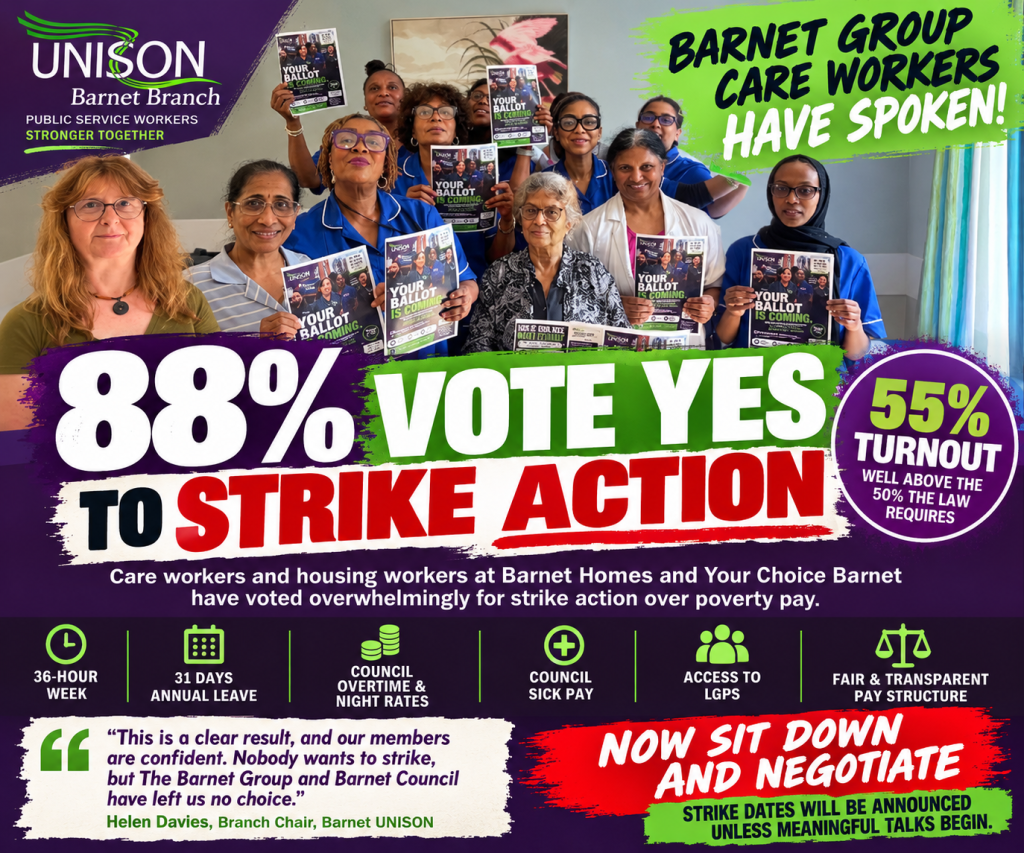
FOR IMMEDIATE RELEASE Barnet Group workers vote for strike action over poverty pay

FOR IMMEDIATE RELEASE

Barnet Group workers vote for strike action over poverty pay

13 October 2026

Care workers and housing workers at The Barnet Group have voted for strike action, with 88% voting yes on a 55% turnout, well above the 50% the law requires.

The workers are employed at Barnet Homes and Your Choice Barnet, both owned by Barnet Council. They provide housing and care services to Barnet residents. These services were once run in house by the council. They are now delivered by workers on inferior contracts, often alongside council staff doing similar jobs.

The ballot seeks to end that two tier workforce.

UNISON is asking for:

  • a 36-hour week, down from 37.5 (40 for repairs staff)
  • 31 days annual leave
  • council overtime and night rates
  • council sick pay
  • talks on a single, transparent pay structure
  • access to the Local Government Pension Scheme
  • annual NJC pay awards written into contracts
  • the new London Living Wage paid when announced in October, not the following April
  • a joint review adopting council policies wherever they are better

The Barnet Group has refused every part of the claim and has been unwilling to enter proper negotiations. Staff are angry and morale is low. With food, energy and rent costs still rising, many say they are struggling to get by on what they earn.

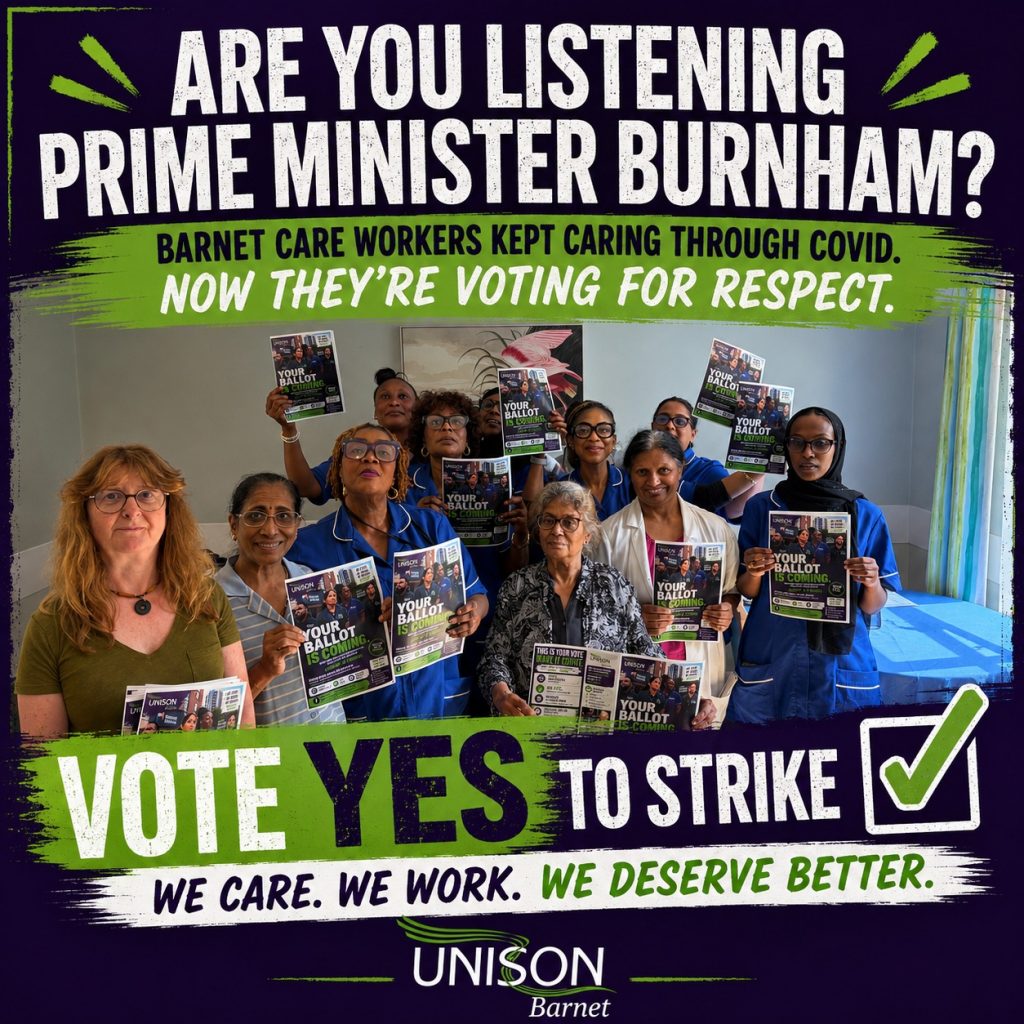
At Labour conference on 29 September, Prime Minister Andy Burnham spoke of care workers “caring for other people’s parents on poverty pay”. He said he wants “care that is about people not profit”. Care workers employed by a council owned company are on exactly that poverty pay.

Care worker, Your Choice Barnet: “I look after people who can’t look after themselves, then worry about my own gas bill. Council staff doing the same job get better sick pay and a pension. We just want the same.”

Housing worker, Barnet Homes: “We help residents who are struggling, and many of us are struggling too. People voted because they’ve had enough of being treated as second class.”

Helen Davies, Branch Chair, Barnet UNISON: “This is a clear result, and our members are confident. Nobody wants to strike, but The Barnet Group and Barnet Council have left us no choice. We are asking them to sit down and negotiate properly, starting now.”

Strike dates will be announced unless meaningful talks begin.

End.


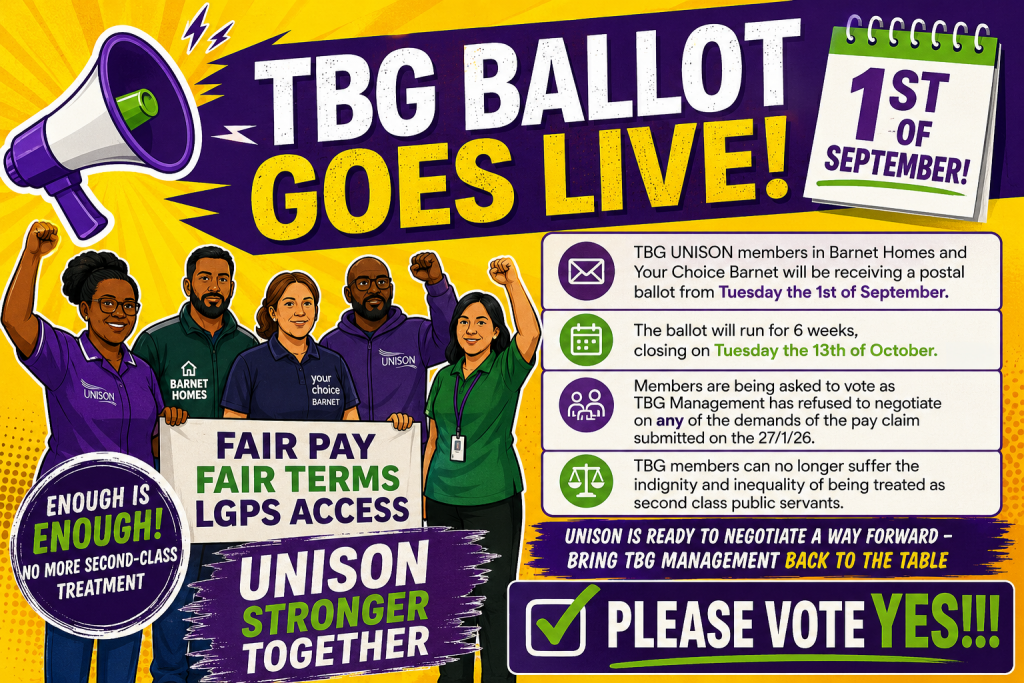
TBG Ballot Goes Live on the 1st of September!

The Barnet Group (TBG) UNISON members in Barnet Homes and Your Choice Barnet will be receiving a postal ballot from Tuesday the 1st of September.

The ballot will run for 6 weeks, closing on Tuesday the 13th of October.

Members are being asked to vote as TBG Management has refused to negotiate on any of the demands of the pay claim submitted on the 27/1/26.

FOR IMMEDIATE RELEASE 27 January 2026 Your Choice Barnet care workers demand fair pay, fair terms and access to LGPS — “time to end this injustice” – Barnet UNISON

TBG members can no longer suffer the indignity and inequality of being  treated as second class public servants.

UNISON is ready to negotiate a way forward – Bring TBG Management back to the table

Please vote YES!!!

Weekly Blog — speaking truth to power – National Care Service


This week I published a piece on the branch website about the National Care Service debate. I want to use this blog to explain why I wrote it, what it means for our members right now, and where the dispute with The Barnet Group stands.

Why I wrote about a National Care Service

Politicians talk about creating a National Care Service the way they talk about most things — as a funding question. How much will it cost? How will it be paid for? Those are fair questions. But they are not the only ones.

After 31 years as a UNISON rep, I have watched care workers praised in speeches and shortchanged in their pay packets. I have watched outsourcing strip away decent terms. I have watched workers transferred out of council employment, away from the Local Government Pension Scheme, onto weaker sick pay, weaker holiday entitlement, weaker everything — and I have watched management call it an efficiency.

A National Care Service built on that foundation is not a National Care Service. It is the same fragmented mess with a new name on the door.

If the Government is serious, it starts with the workforce. Fair pay, secure contracts, collective bargaining, and access to a proper pension. You can read the full piece here: https://www.barnetunison.me.uk/wp/2026/07/30/a-national-care-service-must-start-with-the-workforce/

The dispute on our doorstep

While politicians debate the future, our members in Your Choice Barnet and Barnet Homes are living the present. And the present is not acceptable.

Earlier this month, 97% of Your Choice Barnet members and 100% of Barnet Homes members voted for industrial action in consultative ballots. Those turnouts would have comfortably beaten the statutory thresholds needed for a formal ballot. The message could not have been clearer.

The Barnet Group’s response? They refused to negotiate. They rejected the claim in full and said they would not move. That is not a negotiating position. That is a refusal to engage with people who deliver first-class public services on second-class pay.

We have now requested formal statutory industrial action ballots. That process is underway. The Barnet Group is wholly owned by Barnet Council. The council cannot stand to one side and say this has nothing to do with them. It has everything to do with them.

The pension question

One of the central demands in this dispute is access to the Local Government Pension Scheme. This matters and it is worth explaining why.

LGPS is not a gold-plated luxury. It is a defined benefit scheme that gives workers a degree of certainty about their retirement — the kind of certainty that has been taken for granted by council employees for decades. Workers transferred into TBG and Your Choice Barnet were moved away from it. That means lower retirement income for some of the lowest-paid workers in the borough.

We often hear that LGPS employer contributions make it unaffordable. The employer contribution rate is currently 20.4%. That is not a secret. But it is worth pointing out that the people who find LGPS “unaffordable” for frontline care workers tend to be the same senior managers who are themselves in the scheme and drawing from it. If it is good enough for them, it is good enough for the people doing the actual care.

What happens next

The formal ballot process has begun. If members vote yes — and I expect they will — strike action becomes a real possibility. That is not where anyone wants to be. But it is where The Barnet Group has taken us by refusing to negotiate.

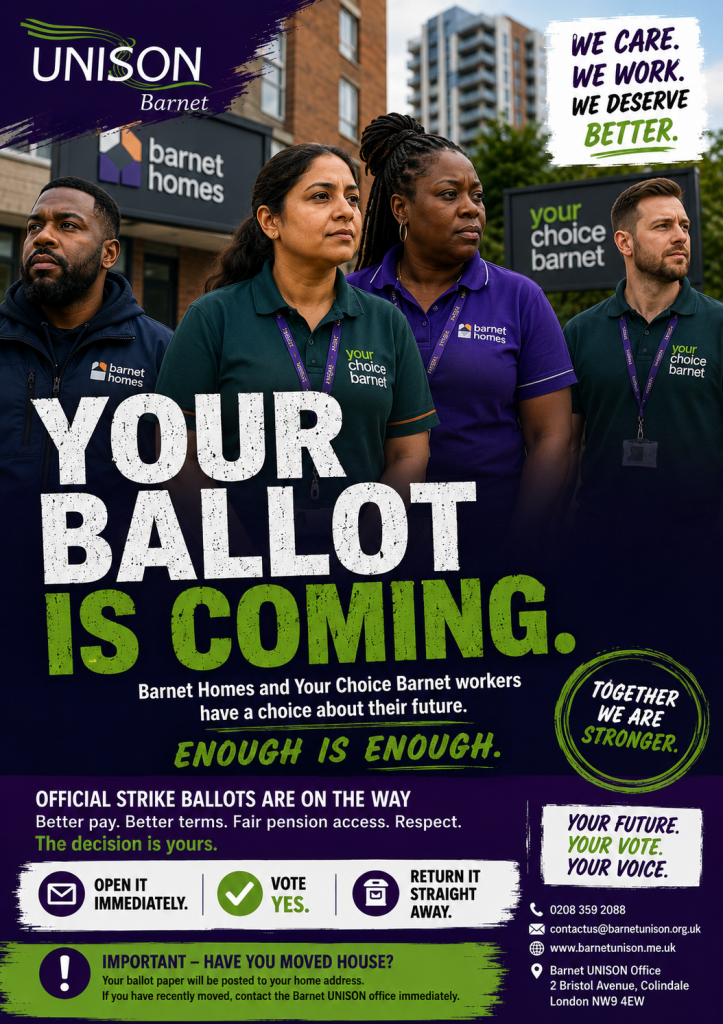
If you work in Your Choice Barnet or Barnet Homes, make sure your contact details are up to date with the branch. Watch for your ballot when it arrives. And vote.

Best wishes John Burgess Branch Secretary, Barnet UNISON


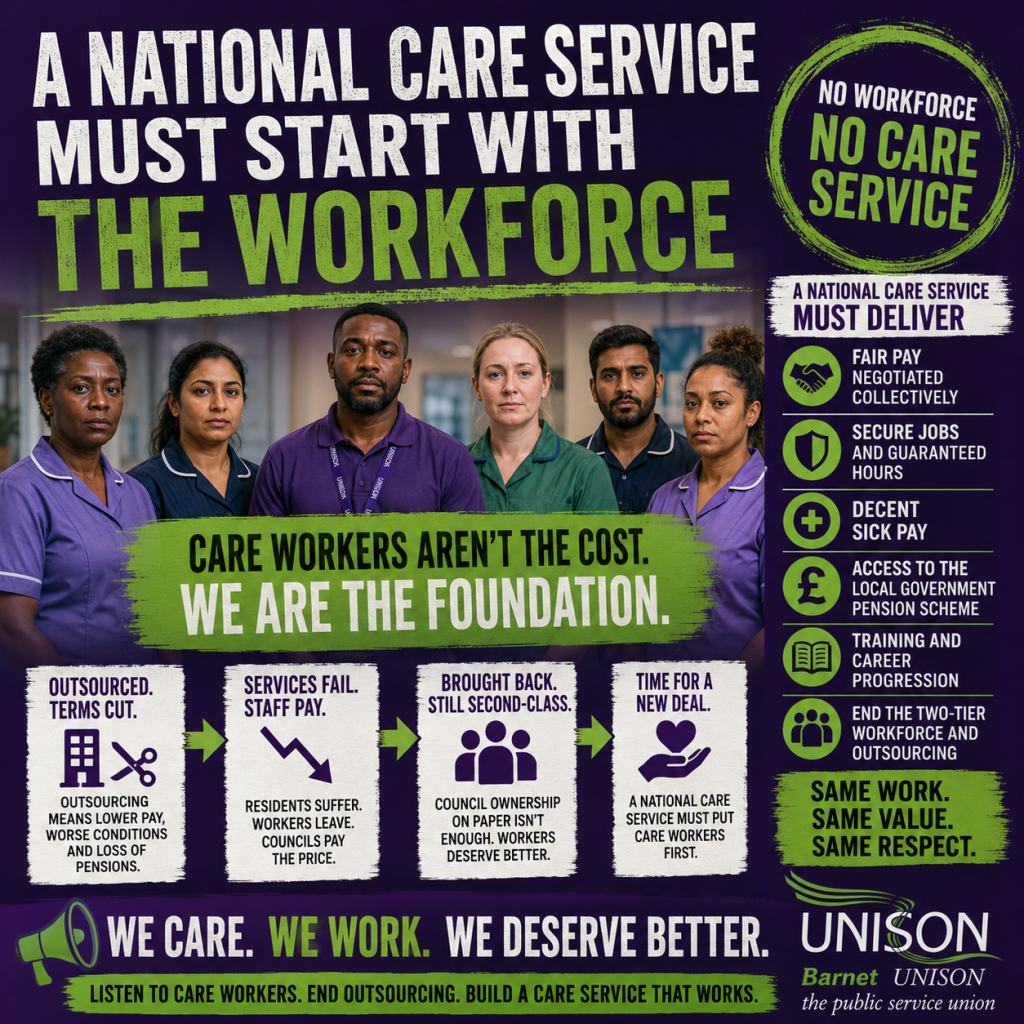
A National Care Service must start with the workforce

A National Care Service must start with the workforce

Rebecca Long-Bailey is right to argue that social care should become a universal public service, built on the same principle as the NHS: care according to need, not ability to pay.

But after 31 years as a UNISON representative, and decades organising and representing care workers in Barnet, I believe something fundamental is still missing from the national debate.

Politicians and the media repeatedly ask how much a National Care Service will cost and how it should be funded.

Those are important questions, but they are not the only questions.

We also need to ask who will provide the care, who will employ them, and on what pay, pensions and conditions.

There is no National Care Service without a national care workforce.

Three decades of outsourcing in Barnet

My first major involvement with care workers began in the late 1990s, when Barnet Council decided to outsource its residential care homes and day services.

The case put forward was that outsourcing was needed to secure investment in new and improved buildings.

Barnet UNISON opposed the proposal. We organised members and produced alternative reports challenging the argument that outsourcing was the only way to improve services.

At the same time, the council was implementing the national Single Status agreement. Care workers were moved from spot salaries onto a career-grade structure intended to provide fairer and more consistent pay.

The ink was barely dry on those new arrangements before the workers were told they were being outsourced.

The staff transferred to the Fremantle Trust. A few years later, the employer moved to impose significantly worse contracts.

Our members faced cuts to pay, sick pay and annual leave. Barnet UNISON members resisted through strike action, rallies, campaigning and meetings in Parliament.

We fought hard, but the cuts were imposed.

Much of the progress achieved through Single Status was undone. Skilled care workers delivering a public service were left with lower pay and weaker employment protections.

That experience taught us an important lesson.

Improvements negotiated through collective bargaining can be taken away when workers are transferred outside direct public employment.

The outsourcing model failed workers and services

The care-home contract later became the subject of a major financial dispute between Barnet Council and Catalyst Housing, which had partnered with Fremantle in the contract.

The dispute went to arbitration and resulted in substantial costs for the council.

Barnet Council eventually withdrew from the remaining contract. The services and staff transferred to Your Choice Barnet, part of the council-owned Barnet Group.

But the service did not return directly to the council.

The workers remained employed at arm’s length, outside council terms and conditions.

The history continued with the closure of Apthorp Care Home.

Residents had to leave their home and staff who had worked throughout the pandemic faced redundancy.

The building was reported to require millions of pounds of repairs despite being relatively new.

Once again, residents and workers carried the consequences of decisions made above them.

Home care followed the same pattern

Barnet UNISON also fought to retain the council’s in-house home-care service.

That service was outsourced.

Years later, part of the outsourced provision transferred to Aquaflo Care. The transfer ran into serious difficulties and the service was subsequently brought into The Barnet Group.

Several years later, The Barnet Group announced plans to close its Enablement Home Care Service.

The pattern has repeated itself throughout my time representing care workers:

A public service is outsourced.

The workforce is transferred.

Pay, pensions and conditions become fragmented.

The contract or provider runs into difficulty.

The service may eventually return to a council-owned organisation, but the workers do not necessarily regain council employment, council conditions or access to the Local Government Pension Scheme.

This is not history—our members are living it now

Today, Barnet UNISON is involved in a major dispute involving care workers employed by Your Choice Barnet.

These workers deliver essential adult social care services on behalf of Barnet Council.

They supported vulnerable residents throughout COVID. They carried on working when the risks to themselves and their families were very real.

Yet they remain part of a two-tier workforce.

They do not have the same core pay, terms and pension arrangements as directly employed council staff.

Our members are seeking fair pay, improved terms and conditions, a transparent pay structure and access to the Local Government Pension Scheme.

They should not have to consider strike action to secure basic fairness from an organisation wholly owned by the council.

This dispute exposes the gap between political promises about the future of social care and the reality experienced by the workforce.

The Prime Minister can speak about creating a National Care Service, but those words will mean little to care workers who remain underpaid, excluded from decent pensions and treated as second-class public-service workers.

A National Care Service cannot be credible if public bodies continue to deliver care through employment models that keep staff on inferior conditions.

The employment model matters

A National Care Service cannot simply be a new funding stream poured into the existing fragmented care market.

It cannot succeed while care remains dependent on outsourcing, low pay, insecure employment, inadequate sick pay and poor pension provision.

Nor is it enough to transfer services into council-owned companies while keeping the workforce outside council employment standards.

Public ownership must mean more than ownership on paper.

There must be no compromise about the employment model for care.

Care should be delivered as a public service through publicly accountable organisations.

Care workers should have:

  • fair pay determined through collective bargaining;
  • secure employment and guaranteed hours;
  • decent occupational sick pay;
  • nationally recognised training and genuine career progression;
  • equal treatment across the workforce;
  • and access to the Local Government Pension Scheme or an equivalent high-quality public-service pension.

There must also be a clear route for outsourced care services and their workers to return to direct public employment without losing existing contractual rights.

Listen to care workers

Any government serious about creating a National Care Service must speak directly to care workers and their trade unions before deciding how it will operate.

Care workers are not an afterthought.

They are not simply a cost in a funding model.

They are the people who make the service possible.

They understand what repeated outsourcing, fragmented commissioning and staff shortages mean in practice.

They know what happens when experienced workers leave because they cannot afford to remain in care.

They understand the impact that workforce instability has on older and disabled people who rely on consistent, trusted support.

For more than three decades, I have watched politicians praise care workers while supporting or tolerating employment models that hold down their pay, remove access to decent pensions and weaken collective bargaining.

Warm words are not enough.

Medals are not enough.

Calling workers heroes is not enough.

The care workforce is predominantly female, and many care workers are Black or Asian. They carry out skilled, physically demanding and emotionally demanding work.

They need justice at work, not another political promise that leaves their employment conditions untouched.

A National Care Service must be built around the people who provide the care.

It must end outsourcing and the two-tier workforce.

It must provide fair pay, decent conditions, collective bargaining and proper pensions.

The Prime Minister should start by looking at what is happening to care workers now, including those employed by council-owned companies such as The Barnet Group.

If the Government is serious about a National Care Service, it should support an employment model that treats care workers as public-service professionals—not as a source of savings.

Without a respected and properly rewarded workforce, there is no National Care Service.

Anything less is not good enough.

John Burgess
Branch Secretary, Barnet UNISON
UNISON representative for 31 years and lead representative for approximately 3,000 members


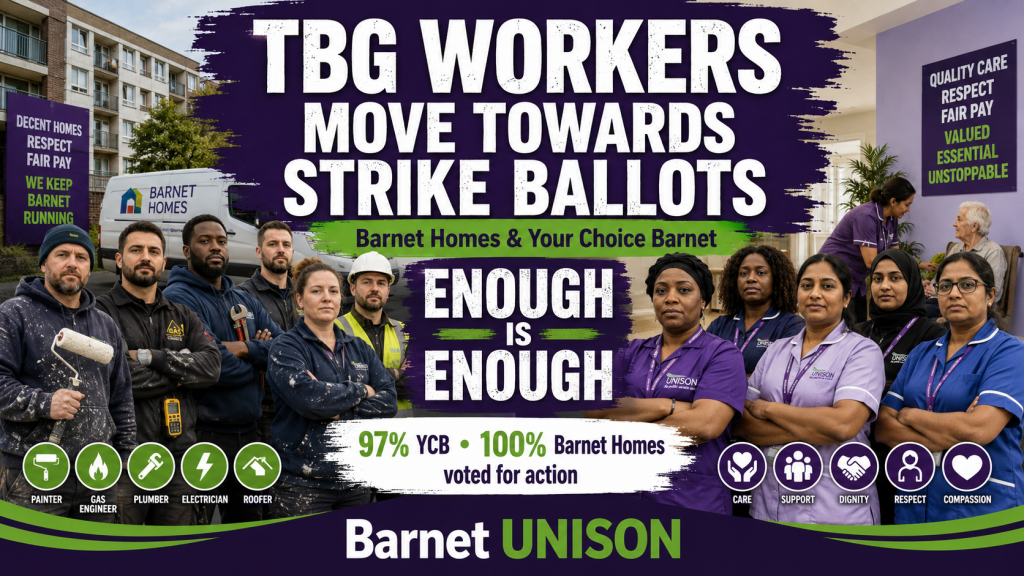
FOR IMMEDIATE RELEASE — 17 JULY 2026 BARNET HOUSING AND CARE WORKERS MOVE TOWARDS STRIKE BALLOTS

FOR IMMEDIATE RELEASE — 17 JULY 2026

BARNET HOUSING AND CARE WORKERS MOVE TOWARDS STRIKE BALLOTS

Barnet Homes and Your Choice Barnet workers say “Enough is Enough” after TBG refuses to negotiate on pay, terms and pensions.

Barnet UNISON is preparing to request two separate formal industrial action ballots for members working in Barnet Homes and Your Choice Barnet, following a Special JNCC meeting with The Barnet Group today.

UNISON reported the results of two separate consultative ballots:

  • 97% of Your Choice Barnet members voted for industrial action
  • 100% of Barnet Homes members voted for industrial action

Despite these results, The Barnet Group confirmed at the meeting that it was not willing to negotiate on any part of UNISON’s claims.

The claims cover:

  • a proper pay increase, including a £15-an-hour minimum
  • improved terms and conditions
  • movement towards council-standard terms
  • access to the Local Government Pension Scheme

Barnet UNISON formally registered a failure to agree at the Special JNCC and advised TBG that the branch will now seek approval for separate statutory industrial action ballots for housing workers and care workers.

A Barnet Homes worker said:

“We deliver council housing services, but we are not treated like council workers. We work longer hours, receive worse terms and have no access to LGPS. Members have had enough of being told there is never any money for us.”

A Your Choice Barnet care worker said:

“We support vulnerable adults every day, often under huge physical and emotional pressure. Then we go home worrying about rent, food and bills. We are doing essential work in one of the most expensive cities in the world, but we are still treated as second-class.”

Helen Davies, Barnet UNISON Branch Chair and UNISON SGE representative for London, said:

“These ballot results send a powerful message. Housing and care workers are angry, organised and no longer prepared to accept second-class treatment. TBG has rejected every part of the claim and has now refused to negotiate, even after hearing that members are ready to take action. Enough is enough. Barnet Council owns The Barnet Group and cannot stand back while the workers delivering its services are treated this way.”

Barnet UNISON is calling on The Barnet Group and the London Borough of Barnet to return to negotiations with a serious proposal before the dispute escalates further.

Notes to editors

  • The Barnet Group is wholly owned by the London Borough of Barnet.
  • Barnet Homes provides housing services.
  • Your Choice Barnet provides adult social care services.
  • The consultative ballots were separate from the formal statutory industrial action ballots now being prepared.
  • Industrial action has not yet been authorised or called.

Media enquiries: contactus@barnetunison.org.uk

FOR IMMEDIATE RELEASE | June 2026 BARNET UNISON’S EQUAL PAY FIGHT: WE ARE NOT GOING AWAY

FOR IMMEDIATE RELEASE | June 2026

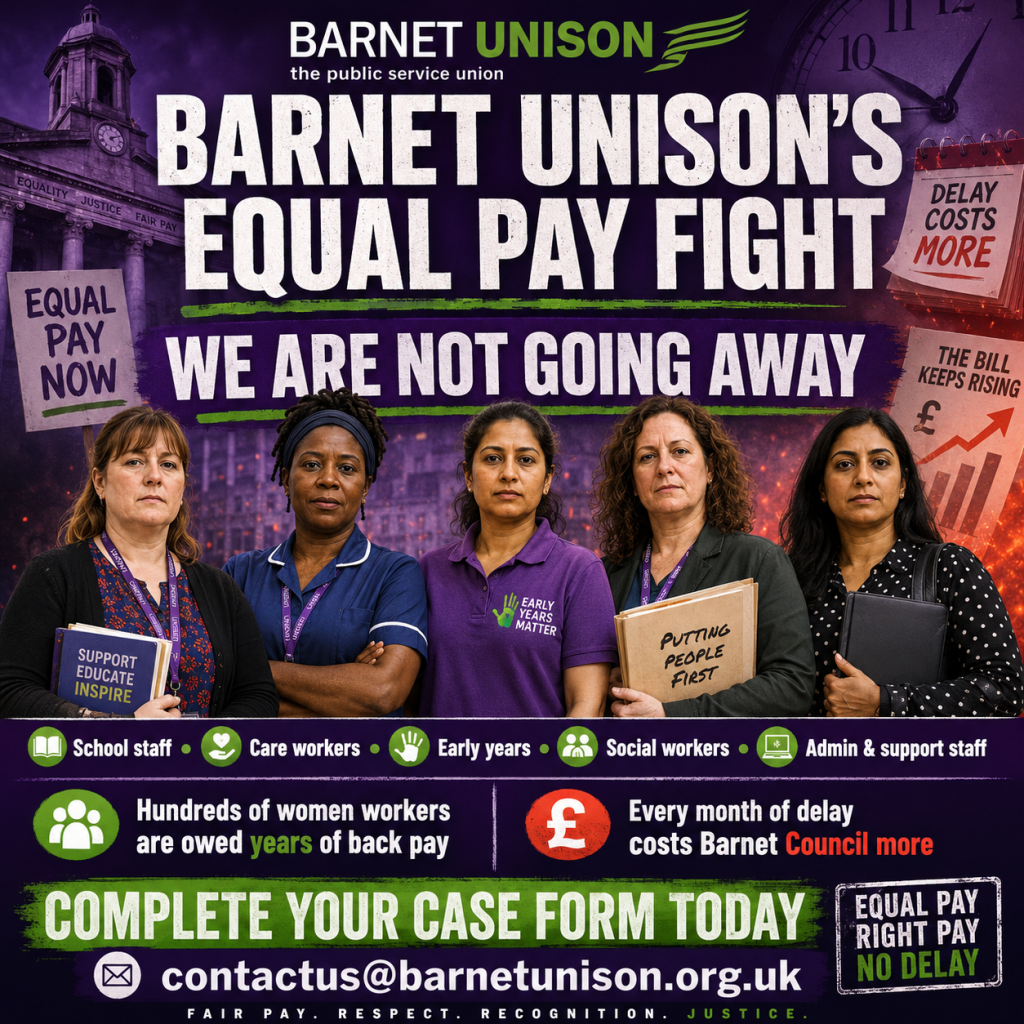
BARNET UNISON’S EQUAL PAY FIGHT: WE ARE NOT GOING AWAY

Hundreds of Barnet women workers are owed years of back pay. UNISON is fighting for every one of them and the bill for Barnet Council is growing every single day.

On 29 May 2026, Barnet UNISON took its equal pay claim to the Employment Tribunal. UNISON’s solicitors made the case for hundreds of women workers — school staff, care workers, early years workers, administrators and support staff — who have for years been paid less than their male counterparts in the council’s waste and recycling service.

Here is what we know. Male workers in the waste and recycling service are paid for a full working day but are allowed to go home when their rounds are done, sometimes by mid-morning. Women doing work of equal value have no such benefit. They work every contracted hour every day. That is not fair. That is unequal and illegal. And UNISON is determined to put it right.

WHAT HAPPENED AT THE TRIBUNAL

Our barrister succeeded in getting UNISON’s case heard, despite attempts by Barnet Council  to block our submissions. UNISON was fighting for women workers in that courtroom, making the case to get our members’ voices heard.

The judge has set a preliminary hearing for 9 September 2026 to consider UNISON’s application to have the procedural block on our claim removed.

That hearing is the next critical moment. We will be ready.

Separately, the tribunal confirmed that UNISON’s claims against The Barnet Group and Barnet Education and Learning Skills — the council’s own companies, employing many of our members — are not subject to any block and are being progressed. Those claims move forward now.

OUR CLAIM IS STRONG AND GROWING

Barnet UNISON’s case is not built on speculation. It is built on evidence — evidence that has been gathered carefully, systematically, and with the support of experienced legal specialists in equal pay law.

Here is what we know about the situation at Barnet:

  • Waste and recycling workers are regularly finishing their rounds hours before their contracted day ends and going home, paid in full.
  • Women working in schools, care, early years, social services and admin must complete every contracted hour. There is no equivalent benefit for them.
  • The council knows this practice exists. Rather than negotiating an end to this practice as other Councils have done, they are refusing to sit and meet with UNISON.
  • Other councils — including Southampton, Birmingham and Glasgow — have already settled equal pay claims on the same basis, paying out millions of pounds to women workers.
  • The longer Barnet Council refuses to come to the table, the bigger the bill becomes. Every single month of delay adds to the compensation owed.

“This claim is about basic fairness. Women working for Barnet Council and its companies have been short-changed for years while the council looked the other way. We have the evidence, we have the legal backing, and we have the determination to see this through. Barnet Council cannot run from this. The question is not whether they will have to pay — it is how much.”

Helen Davies, Branch Chair, Barnet UNISON and UNISON London Regional SGE Representative


EVERY MONTH OF DELAY COSTS BARNET COUNCIL MORE

Barnet Council’s legal strategy appears to be delay procedural hearings; blocking applications; running down the clock. What they do not seem to understand, or perhaps do not care about, is that delay does not reduce their liability; it increases it.

Equal pay back pay accrues from the date a claim is lodged. UNISON’s claims were lodged in November and December 2025. That clock is running. Every month the council refuses to negotiate, every month they hide behind procedural manoeuvres, the total compensation bill grows. By the time this case reaches settlement or judgment, Barnet Council will be paying for every single month they delayed.

That cost is ultimately borne by Barnet taxpayers. UNISON is not responsible for that. The council is.

THIS IS YOUR CLAIM. YOUR TIME IS NOW.

UNISON has lodged claims on behalf of our members. But the strength of this campaign depends on numbers and numbers depend on you.

Every eligible UNISON member who completes a case form adds to the pressure on Barnet Council to stop stalling and sit down at the negotiating table. A large, organised, well-evidenced claim is harder to ignore and harder to fight than a small one. Barnet Council is already watching these numbers. Help us make them impossible to ignore.

Here is what you must understand about timing: your back pay runs from the date you join the claim, not from the date UNISON first raised the issue. Every month you wait is a month of potential compensation you may never recover. Do not assume someone else has done it for you. Do not assume you will be included automatically.

COMPLETE YOUR CASE FORM TODAY

Contact Barnet UNISON at contactus@barnetunison.org.uk to get your case form. Fill it in. Return it. Do it now.

If you are a UNISON member working for the London Borough of Barnet, The Barnet Group or Barnet Education and Learning Skills, and you believe you may have been affected by unequal pay, you may be eligible to join this claim. Speak to your UNISON rep or contact the branch directly.

UNISON STANDS FULLY BEHIND YOU

UNISON knows what the cost-of-living crisis means for our members. We see it every day. Workers who give everything to their jobs — caring for children, supporting families, keeping this borough running — are struggling to pay their bills, heat their homes and put food on the table. Many of Barnet UNISON’s members are among the lowest paid workers in the borough. They cannot afford to wait years for justice that should have been delivered years ago.

That is why this claim matters beyond its legal significance. The back pay owed to these workers is not a windfall. It is money they earned and were denied. It is money that would make a real difference to real lives, right now, when it is needed most.


“Barnet UNISON’s equal pay claim is exactly the kind of fight that UNISON exists to lead. These are women who have worked hard, served their community, and been systematically short-changed. UNISON’s London region stands fully behind Barnet branch and every member in this claim. We will not rest until justice is delivered.”

Sara Gorton Regional Secretary UNISON Greater London Region


“Equal pay is not a negotiating position. It is a legal right. The women of Barnet have waited long enough. UNISON is unequivocally, unconditionally and completely behind Barnet UNISON’s members and their branch in this fight. Barnet Council must stop hiding behind legal delays and do the right thing: come to the table, negotiate a fair settlement, and end this inequality now.”

Andrea Egan, UNISON General Secretary


ENDS

For further information contact Barnet UNISON Branch: contactus@barnetunison.org.uk


NOTES TO EDITORS

  1. Barnet UNISON is the UNISON branch for workers employed by the London Borough of Barnet, The Barnet Group and Barnet Education and Learning Skills.
  2. Equal pay claims are brought under the Equality Act 2010. Back pay in Employment Tribunal equal pay claims in England and Wales runs for up to six years from the date the claim is lodged.
  3. UNISON’s equal pay claims were lodged with the Employment Tribunal in November and December 2025.
  4. A preliminary hearing is listed for 9 September 2026 to consider UNISON’s application to lift the procedural stay on claims against the London Borough of Barnet.
  5. Claims against The Barnet Group and Barnet Education and Learning Skills are not subject to the stay and are being actively progressed.
  6. Comparable equal pay settlements involving task and finish in waste and recycling services have been reached at Southampton City Council (July 2025), Birmingham City Council (2024–25) and Glasgow City Council (2022).
1 2 3 … 19