
Barnet Depot Workers Reject Holiday Pay Offer, Escalation Looms

Barnet Council workers in Waste & Recycling and Street Cleansing have voted overwhelmingly against the council’s offer to settle twelve years of unpaid holiday pay, and UNISON has now requested an urgent meeting with the council’s Chief Executive to try to resolve the dispute before it escalates.

For over a decade, holiday pay on overtime worked by staff in these services was miscalculated under a payroll contract run by Capita on behalf of the council. Since the council changed payroll provider in 2025, the calculation has been done correctly — proof the problem was always fixable, and that workers were shortchanged for years while nothing was done.

In a consultative ballot that closed this week, turnout was above 90% in both services, and rejection of the council’s offer was close to unanimous — 100% in Waste & Recycling and 96% in Street Cleansing. UNISON has asked the council to substantially improve its offer, and has written to the Chief Executive requesting an urgent meeting by 9 October 2026. If a fair offer isn’t forthcoming, the union will move to a formal ballot for industrial action.

“These workers have waited twelve years to be paid properly, in the middle of a cost of living crisis that makes every missing pound count. The council’s answer so far has been a fraction of what’s owed. Our members have rejected that fraction, and rightly so — the council needs to come back with a serious offer, or this will escalate.”
— John Burgess, Branch Secretary, Barnet UNISON

“We’re writing in good faith, wanting a negotiated settlement. But the council’s offer has already been decisively rejected — 100% of those balloted said no. Members have been affected for years, some for over a decade, through no fault of their own. We’re asking the council for an offer that properly reflects the length of this underpayment and the loss members have suffered. That’s not too much to ask — the decision now rests with the council.”
— Dennis Moses, Street Scene Convenor, Barnet UNISON

Barnet UNISON represents over 3,000 members working for the London Borough of Barnet, The Barnet Group, Barnet Education and Learning Skills, and contracted services across the borough, including waste, cleansing, care, schools and council offices.

[Press contact 0208 359 2088 or email contactus@barnetunison.org.uk ]
 

DEPOT WORKERS – Holiday Pay: One-Week Consultative Ballot Opens Friday

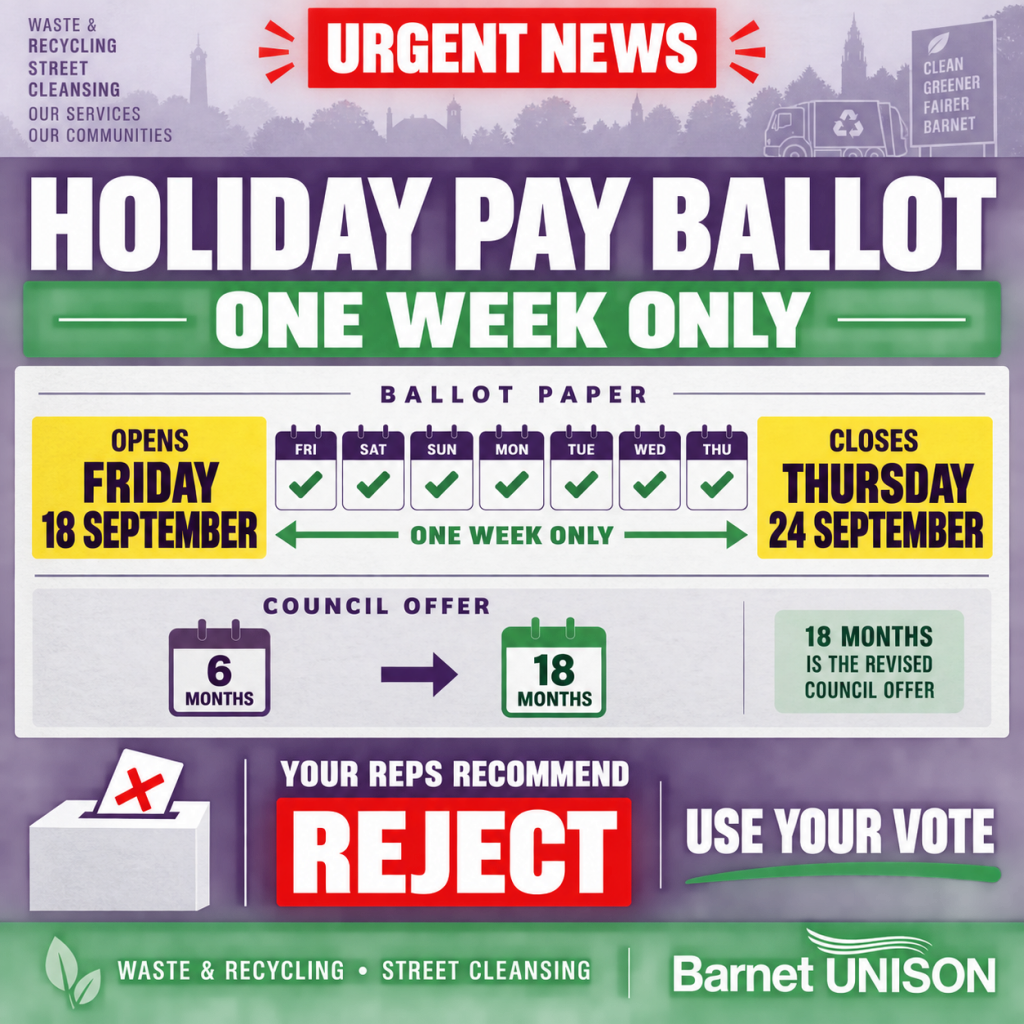
Barnet UNISON is holding a one-week consultative ballot on the council’s revised holiday pay offer. The ballot opens Friday 18 September and closes Thursday 24 September.

The council has increased its offer from six months’ backdated pay to 18 months. UNISON reps for  will be contacting all members directly this week to collect ballot papers and get your vote in straight away.

This is not a pay claim. Members are not asking for more money — this is about being paid for work you have already done. That overtime was worked, it was relied on, and the law says it should have counted towards your holiday pay. The council has withheld that money from the workforce, and this offer still doesn’t cover the full period.

Your reps are recommending REJECT. Eighteen months is an improvement on the original offer, but it is not good enough.

Questions? Contact the branch: 0208 359 2088 / contactus@barnetunison.org.uk

End.

Weekly Blog Special: “Setting the Record Straight: Our Reply to TBG’s CEO”

Hi everyone,

I am responding to the TBGs CEO (Elliott Sweetman) email to all staff sent on Thursday 10 September 2026.

The CEO’s message this week talks about one thing: the 3.3% NJC pay uplift, applied at his discretion. What it doesn’t mention is what we actually asked for.

In January 2026, Barnet UNISON submitted a full pay and terms claim to TBG on behalf of Barnet Homes and Your Choice Barnet members. It covered:

  • A £15/hour floor for the lowest-paid staff — costed by TBG itself at a fraction of one percent of budget
  • Proper overtime and night-shift rates, instead of a flat rate regardless of when you work
  • A shorter working week — cut from 37.5 to 36 hours, the same as Barnet Council staff
  • The same occupational sick pay scheme as Barnet Council staff
  • More annual leave, moving toward full parity with LBB’s 31 days
  • A single, transparent pay and grading structure, instead of the opaque TBG Flex model
  • No loss of existing rights as a condition of any settlement
  • And access to the LGPS for everyone — not just staff on legacy contracts.

TBG rejected the claim outright in March, refusing even a zero-cost request for a joint meeting to talk it through. In July, after the consultative ballot returned 97% (YCB) and 100% (Barnet Homes) in favour of action, we met TBG again — and they refused to negotiate on any single demand.

Every one of the demands above is covered by the same NJC/Green Book framework Sweetman quotes so selectively. TBG was set up specifically so its workers don’t get these basic terms — that’s not an accident, it’s the whole point of the model. TBG is a leftover from the Tories’ “easy council” playbook: strip terms out of the council, hand the work to an arm’s-length company, call it efficiency.

It also sits directly against the government’s own Employment Rights Act, passed this year, which is meant to strengthen workers’ rights — not give councils a way to dodge them through corporate structures.

And notice what the CEO’s own letter admits. At no point in any negotiation has TBG committed to automatically honouring the NJC pay decision for its staff, whatever it is, every year. His letter confirms it in black and white: this increase was applied “at our discretion,” not because TBG is bound to it. Council staff get the NJC settlement as a matter of contractual right. TBG staff get it only if and when management decides to be generous. That’s not a technicality — it’s about who holds the power. It’s another reason this vote matters: a “yes” is the only way to turn a discretionary favour into something you can actually rely on. 

Pensions are the biggest issue here, by far. TBG Flex was set up so that every new starter goes onto a contract with no LGPS access at all — just a private scheme with a fraction of the employer contribution. Only around a quarter of the combined workforce still has LGPS, and that share falls every year, because every new hire goes straight onto Flex. Giving everyone LGPS access would cost TBG in the region of £5 million a year — real money, but this is a company wholly owned by the council, and the council decides how much it funds TBG in the first place.

That’s the heart of it. You work in the same services as council staff, often in the same buildings, doing work the council could not run without you — but on a worse pension, worse sick pay, less leave, and a working week set up specifically to keep you off council terms.

Barnet Group workers should not be treated as second-class council workers. That’s not a slogan — it’s the deliberate design of the TBG Flex model, and TBG’s own board has said so in writing.

The CEO’s letter offers to sit down and discuss this with anyone, one-to-one or in a team meeting. But he won’t negotiate even the most basic improvements for our members — in the worst cost of living crisis in living memory. An offer to talk is not the same as an offer to move.

The CEO’s letter, landing in week two of the statutory ballot and talking only about pay, is timed to make you think this is a smaller fight than it is. It isn’t.

Vote. Whichever way you decide, make sure it’s an informed decision — not one shaped by a letter that leaves out almost everything we actually asked for.

Questions about the ballot or anything in this message — contact the branch: contactus@barnetunison.org.uk

 You will be receiving text messages asking if you have voted please respond.

Solidarity 

End.

Branch Secretary Weekly Message Monday 7th September 2026

Monday 7th September 2026

Weekly Blog — speaking truth to power – Restructures what are your rights.


Restructures are happening across this council all the time, in some corner of the organisation or another. Most members never think about the process until the day it lands on their own desk. By then it’s too late to learn the rules from scratch. So, this week I want to set out plainly what happens when your service is restructured, what rights you actually have, and why the moment to get in touch with us is the day you hear the word “restructure,” not the day you get a letter about redundancy.


What actually happens

When management propose a restructure, they’re supposed to consult you formally before anything is decided. That means at least ten days’ notice of the meeting where consultation starts, and a proper written pack explaining what’s changing and why. Before that meeting even happens, we as your union should be briefed by management so we know what’s coming.


Once consultation opens, anyone whose post might go gets told individually that they’re “at risk.” That’s not the same as being made redundant. It means your post is on the list for job matching, where your current role gets compared against roles in the new structure. If there’s a close enough match, you slot straight in. If there are fewer posts than people, you go into a ring-fenced selection process instead.


Only after all of that is exhausted, if there’s genuinely no role for you, does redundancy notice get issued. And even then, you stay eligible for redeployment right up to your last day.


Where it can go wrong for you

On paper this all sounds fair. In practice, it depends entirely on management doing it properly, and on you knowing your rights well enough to hold them to it. You’re entitled to bring a union rep into every meeting, formal or informal. If you move to a lower graded post through this process, pay protection should apply. If you disagree with a job match, you’ve got fourteen calendar days to appeal it. If you’re made redundant, you’ve got fourteen calendar days to appeal that too. Calendar days, not working days, so a letter that lands on a Friday eats into your weekend as well.


Fourteen days sounds like plenty until you’re the one staring at a letter you don’t fully understand, trying to work out if the process was followed correctly. Most of the mistakes I see aren’t made deliberately. They happen because nobody was checking the detail at the time it mattered, and by the time someone does check, the clock has already run down.


That’s the whole point of getting us involved early. We can’t fix a flawed process after the decision’s been rubber-stamped nearly as easily as we can shape it while it’s still open.


So if your service is facing change, or you’ve had any hint that it might, don’t wait for a formal letter. Contact your steward or the branch office as soon as you hear anything, even if it’s only rumour at this stage. We’d rather talk you through ten false alarms than find out about a genuine one after the appeal deadline’s gone.


Take care of yourselves and each other.


Best wishes John Burgess Branch Secretary, Barnet UNISON