Contacting the Branch

If you have any questions or need any support please contact the Branch Office

 contactus@barnetunison.org.uk

Or you can call 020 8359 2088, if we are unable to answer the telephone please leave a message speaking slowly and clearly please include your name, telephone number, membership number and a brief message about the assistance you require. We will respond as soon as we can.

Alternatively you can contact UNISON Direct Call Centre by telephone 

08000 857 857 Monday – Friday 6am – Midnight, Saturday 9am – 4pm

or make an online enquiry by clicking the following link

https://www.unison.org.uk/get-help/online-enquiries/

To Join UNISON click the following link 

https://join.unison.org.uk/

Weekly Bog Special: “Setting the Record Straight: Our Reply to TBG’s CEO”

Hi everyone,

I am responding to the TBGs CEO (Elliott Sweetman) email to all staff sent on Thursday 10 September 2026.

The CEO’s message this week talks about one thing: the 3.3% NJC pay uplift, applied at his discretion. What it doesn’t mention is what we actually asked for.

In January 2026, Barnet UNISON submitted a full pay and terms claim to TBG on behalf of Barnet Homes and Your Choice Barnet members. It covered:

  • A £15/hour floor for the lowest-paid staff — costed by TBG itself at a fraction of one percent of budget
  • Proper overtime and night-shift rates, instead of a flat rate regardless of when you work
  • A shorter working week — cut from 37.5 to 36 hours, the same as Barnet Council staff
  • The same occupational sick pay scheme as Barnet Council staff
  • More annual leave, moving toward full parity with LBB’s 31 days
  • A single, transparent pay and grading structure, instead of the opaque TBG Flex model
  • No loss of existing rights as a condition of any settlement
  • And access to the LGPS for everyone — not just staff on legacy contracts.

TBG rejected the claim outright in March, refusing even a zero-cost request for a joint meeting to talk it through. In July, after the consultative ballot returned 97% (YCB) and 100% (Barnet Homes) in favour of action, we met TBG again — and they refused to negotiate on any single demand.

Every one of the demands above is covered by the same NJC/Green Book framework Sweetman quotes so selectively. TBG was set up specifically so its workers don’t get these basic terms — that’s not an accident, it’s the whole point of the model. TBG is a leftover from the Tories’ “easy council” playbook: strip terms out of the council, hand the work to an arm’s-length company, call it efficiency.

It also sits directly against the government’s own Employment Rights Act, passed this year, which is meant to strengthen workers’ rights — not give councils a way to dodge them through corporate structures.

And notice what the CEO’s own letter admits. At no point in any negotiation has TBG committed to automatically honouring the NJC pay decision for its staff, whatever it is, every year. His letter confirms it in black and white: this increase was applied “at our discretion,” not because TBG is bound to it. Council staff get the NJC settlement as a matter of contractual right. TBG staff get it only if and when management decides to be generous. That’s not a technicality — it’s about who holds the power. It’s another reason this vote matters: a “yes” is the only way to turn a discretionary favour into something you can actually rely on. 

Pensions are the biggest issue here, by far. TBG Flex was set up so that every new starter goes onto a contract with no LGPS access at all — just a private scheme with a fraction of the employer contribution. Only around a quarter of the combined workforce still has LGPS, and that share falls every year, because every new hire goes straight onto Flex. Giving everyone LGPS access would cost TBG in the region of £5 million a year — real money, but this is a company wholly owned by the council, and the council decides how much it funds TBG in the first place.

That’s the heart of it. You work in the same services as council staff, often in the same buildings, doing work the council could not run without you — but on a worse pension, worse sick pay, less leave, and a working week set up specifically to keep you off council terms.

Barnet Group workers should not be treated as second-class council workers. That’s not a slogan — it’s the deliberate design of the TBG Flex model, and TBG’s own board has said so in writing.

The CEO’s letter offers to sit down and discuss this with anyone, one-to-one or in a team meeting. But he won’t negotiate even the most basic improvements for our members — in the worst cost of living crisis in living memory. An offer to talk is not the same as an offer to move.

The CEO’s letter, landing in week two of the statutory ballot and talking only about pay, is timed to make you think this is a smaller fight than it is. It isn’t.

Vote. Whichever way you decide, make sure it’s an informed decision — not one shaped by a letter that leaves out almost everything we actually asked for.

Questions about the ballot or anything in this message — contact the branch: contactus@barnetunison.org.uk

 You will be receiving text messages asking if you have voted please respond.

Solidarity 

End.

Branch Secretary Weekly Message Monday 7th September 2026

Monday 7th September 2026

Weekly Blog — speaking truth to power – Restructures what are your rights.


Restructures are happening across this council all the time, in some corner of the organisation or another. Most members never think about the process until the day it lands on their own desk. By then it’s too late to learn the rules from scratch. So, this week I want to set out plainly what happens when your service is restructured, what rights you actually have, and why the moment to get in touch with us is the day you hear the word “restructure,” not the day you get a letter about redundancy.


What actually happens

When management propose a restructure, they’re supposed to consult you formally before anything is decided. That means at least ten days’ notice of the meeting where consultation starts, and a proper written pack explaining what’s changing and why. Before that meeting even happens, we as your union should be briefed by management so we know what’s coming.


Once consultation opens, anyone whose post might go gets told individually that they’re “at risk.” That’s not the same as being made redundant. It means your post is on the list for job matching, where your current role gets compared against roles in the new structure. If there’s a close enough match, you slot straight in. If there are fewer posts than people, you go into a ring-fenced selection process instead.


Only after all of that is exhausted, if there’s genuinely no role for you, does redundancy notice get issued. And even then, you stay eligible for redeployment right up to your last day.


Where it can go wrong for you

On paper this all sounds fair. In practice, it depends entirely on management doing it properly, and on you knowing your rights well enough to hold them to it. You’re entitled to bring a union rep into every meeting, formal or informal. If you move to a lower graded post through this process, pay protection should apply. If you disagree with a job match, you’ve got fourteen calendar days to appeal it. If you’re made redundant, you’ve got fourteen calendar days to appeal that too. Calendar days, not working days, so a letter that lands on a Friday eats into your weekend as well.


Fourteen days sounds like plenty until you’re the one staring at a letter you don’t fully understand, trying to work out if the process was followed correctly. Most of the mistakes I see aren’t made deliberately. They happen because nobody was checking the detail at the time it mattered, and by the time someone does check, the clock has already run down.


That’s the whole point of getting us involved early. We can’t fix a flawed process after the decision’s been rubber-stamped nearly as easily as we can shape it while it’s still open.


So if your service is facing change, or you’ve had any hint that it might, don’t wait for a formal letter. Contact your steward or the branch office as soon as you hear anything, even if it’s only rumour at this stage. We’d rather talk you through ten false alarms than find out about a genuine one after the appeal deadline’s gone.


Take care of yourselves and each other.


Best wishes John Burgess Branch Secretary, Barnet UNISON

Branch Secretary Weekly Message Monday 24th August 2026

Monday 24 August 2026

Weekly Blog — speaking truth to power – A warning for every council worker

Something has been happening quietly in the Passenger Transport Service that every Barnet council worker needs to know about. It does not just affect Passenger Assistants. It sets a precedent that could affect any of us.


What has been going on

In 2017 a decision was taken — without any consultation with UNISON or GMB — that when Passenger Assistant posts became vacant through retirement or resignation, they would not be refilled with directly employed LBB staff. Instead, the work would be picked up by external providers.


Nobody announced this. Nobody brought it to a JNCC. No business case was published. No equality assessment was carried out. It just happened, post by post, year by year.

In January 2021 there were approximately 85 directly employed LBB Passenger Assistants. There are now 42. The work has not reduced. The service still runs over 100 routes that need Passenger Assistant support. The workers have simply been replaced.


We have now had this confirmed in writing by management. When we asked who is doing the work that LBB Passenger Assistants used to do, the answer came back: 61 workers employed by external private providers contracted by the Council.


That is not gap-filling. That is not flexible provision. That is outsourcing — and it has been done without any of the process that outsourcing requires.


Why this should worry you, wherever you work

This is not just a Passenger Transport story. The method matters.

Management found a way to run down an in-house workforce without ever formally proposing to outsource it. No Cabinet report saying we want to contract this service out. No consultation with the unions. No equality impact assessment on what it means for a low-paid, predominantly female workforce. Just a quiet decision to stop recruiting, and wait.


By the time anyone noticed, 60% of the Passenger Assistant function was being delivered by workers employed by private companies rather than by the Council.


Ask yourself this. What stops the same approach being used in your service? If management decided tomorrow to stop filling vacancies in your team and use contractors instead, this is now the precedent they would point to. UNISON is not prepared to let that stand unchallenged.


What UNISON has done and where we are

We have submitted a formal report to the highest level of joint negotiation with the Council — the JNCG, chaired by the Chief Executive. That report sets out the full picture: the workforce figures, the governance failures, the health and safety concerns, the breach of the Trade Union Engagement Framework the Council signed just last December.


We submitted that report in June. We are now in August. We have still not received a substantive response.


We have also formally asked management a question they have not answered: when did LBB last directly recruit a Passenger Assistant? The answer to that question will tell us exactly when the decision was made that this workforce would be wound down. We intend to find out.

This matter is going to JNCC as a formal agenda item. We are not dropping it.


What members can do

If you are a Passenger Assistant or Passenger Escort, or you know someone who is, please get in touch with the branch. Your experience of what has changed in this service matters and we want to hear it.

If you work in any other part of the Council and you have noticed posts in your team sitting vacant for long periods without being advertised, let us know. We want to understand whether what has happened in Passenger Transport is happening anywhere else.


The council workforce is strongest when we look out for each other. What happens to one group of workers today can happen to another group tomorrow.


Best wishes John Burgess Branch Secretary, Barnet UNISON

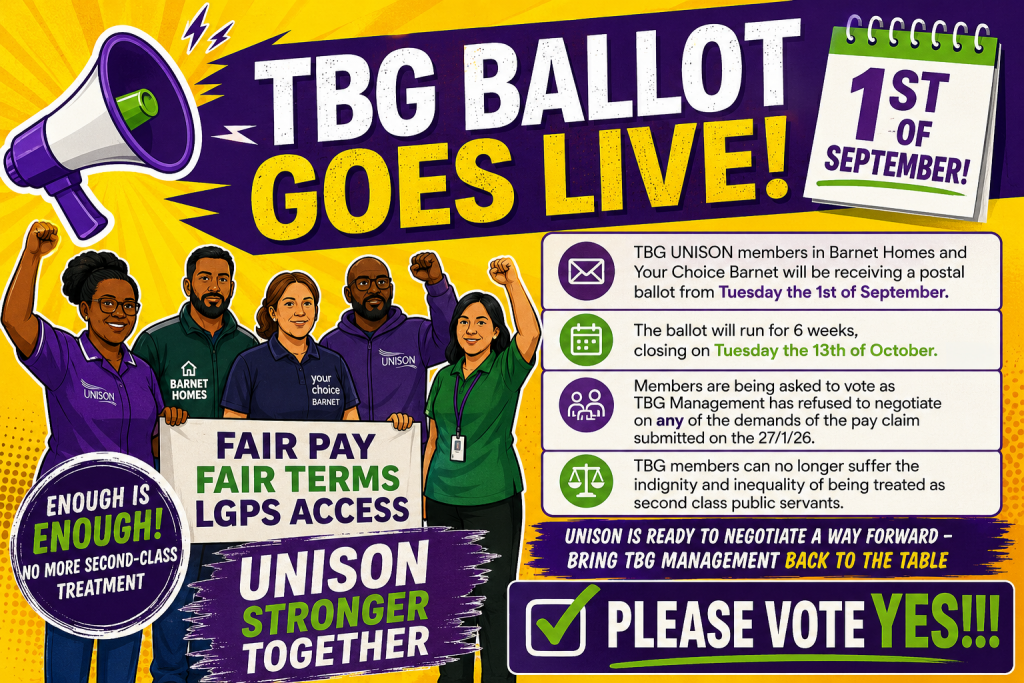
TBG Ballot Goes Live on the 1st of September!

The Barnet Group (TBG) UNISON members in Barnet Homes and Your Choice Barnet will be receiving a postal ballot from Tuesday the 1st of September.

The ballot will run for 6 weeks, closing on Tuesday the 13th of October.

Members are being asked to vote as TBG Management has refused to negotiate on any of the demands of the pay claim submitted on the 27/1/26.

FOR IMMEDIATE RELEASE 27 January 2026 Your Choice Barnet care workers demand fair pay, fair terms and access to LGPS — “time to end this injustice” – Barnet UNISON

TBG members can no longer suffer the indignity and inequality of being  treated as second class public servants.

UNISON is ready to negotiate a way forward – Bring TBG Management back to the table

Please vote YES!!!

FOR IMMEDIATE RELEASE — 100% of Barnet bin and street cleansing workers reject holiday pay offer

18 August 2026

Barnet bin and street cleansing workers vote 100% to reject holiday pay offer, seek formal strike ballot

Council workers affected by Barnet Council’s 12-year holiday pay underpayment have unanimously rejected the council’s current offer, Barnet UNISON has announced and are now seeking a formal industrial action ballot.

In a consultative ballot, bin workers returned a 96% turnout with 100% voting to reject the council’s offer of six months’ backdated pay. Street Cleansing workers returned a 66% turnout, also with 100% voting to reject it — against underpayment that in many cases goes back to 2014.

The union has already written to the council’s Chief Executive and separately to Council Leader Barry Rawlings following the result, calling for urgent talks and asking the Leader to personally intervene.

A Joint Negotiating and Consultative Group meeting has since been confirmed for Monday 14 September, where the union will press the council on the questions it has raised.

UNISON has put a series of questions to the council that it says the public would reasonably expect answered, including why correct payment only began once a new payroll contractor took over in 2025, whether the council knew about the failure before then, whether a full investigation has taken place, whether Capita has been asked to account for the failure, whether the council has considered recovering the loss from Capita, and what evidence supports six months as an appropriate settlement.

The union is calling on the council to return to meaningful negotiation, provide full transparency on the payroll history, explain the basis of its offer, and come back with a significantly improved settlement that reflects the real duration and scale of the underpayment.

UNISON says that isn’t the outcome anyone wants — but with members having already signalled they’re ready to move to a formal industrial action ballot, continued council inaction risks strike action in Barnet as early as this autumn, which would mean bin collections and street cleansing grinding to a halt and the real prospect of fly-tipping building up across the borough.

“This result couldn’t be clearer. Not a single member who voted backed the council’s offer. We’ve asked the council for urgent talks — we’d much rather resolve this at the table than take it further. But if the council keeps standing behind Capita instead of doing right by the workers who kept this borough running, residents need to understand where that leads: a strike this autumn, bins left uncollected, and fly-tipping piling up across Barnet. That’s entirely avoidable, and it’s in the council’s hands to avoid it.”

The dispute follows a payroll error under former contractor Capita, which left overtime out of holiday pay calculations for staff who regularly worked it, including depot workers in waste, recycling, green waste and street cleaning.

ENDS

Notes to editors:

Barnet UNISON represents around 3,000 members working for the London Borough of Barnet and associated employers.

Contact: contactus@barnetunison.org.uk


Bus strikes – what you need to do now

Barnet UNISON depot members please read the advice below.

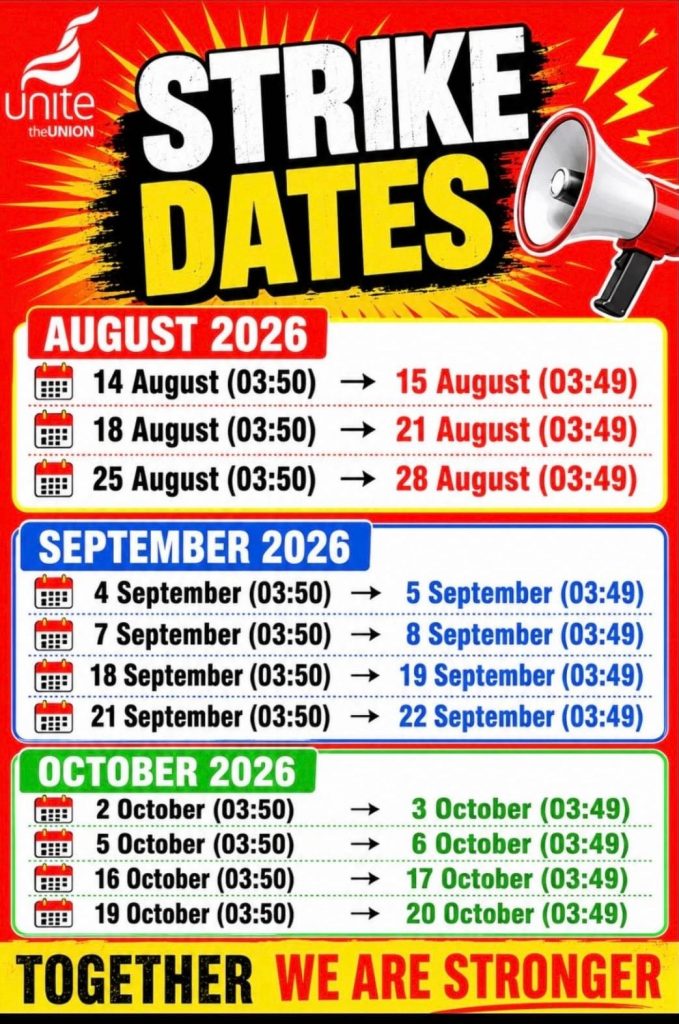
The Unite bus strikes affecting Arriva North London services start this Friday, 14 August, and continue on further dates through to October. If your journey to work depends on one of the affected routes, please read this and act now.

When the strikes are happening

Strike periods are: 14–15 August, 18–21 August, 25–28 August, 4–5 September, 7–8 September, 18–19 September, 21–22 September, 2–3 October, 5–6 October, and 16–17 and 19–20 October. Each period runs from just before 4am on the first date through to just before 4am on the day after the last date shown.

What to do now

If you think you’ll have trouble getting to work this Friday because your bus route is affected, speak to your supervisor today – don’t wait until the morning of the strike. The same applies ahead of every other date listed above. The earlier you flag it, the more time there is to sort something out.

What the Council is looking into

We’ve met with the Assistant Director, who is looking at practical ways to help affected staff get in on strike days. This includes putting on alternative transport, arranging car sharing, and asking supervisors to pick up staff who are struggling to get in. Nothing is confirmed yet, which is exactly why speaking to your supervisor now matters – it’s how you get included in whatever gets arranged.

If you’re not getting help

If you raise this with your supervisor and you’re not offered any practical support, or you’re told you’ll be marked late or absent through no fault of your own because of strike disruption, contact us straight away. Don’t just stay off work without speaking to your supervisor and to UNISON first.

Contact your workplace UNISON rep, or the branch office directly at contactus@barnetunison.org.uk , if you need help.

End.


Branch Secretary Weekly Message Monday 10th August 2026

Monday 10th August

Weekly Blog – Speaking Truth too Power – Sickness Absence

Sickness absence can become complicated very quickly. A few days off, a return-to-work meeting, then suddenly a manager is talking about review stages and attendance targets.


My message this week is simple. Contact UNISON early. Do not wait until you are worried that your job may be at risk.


Tell us when your health is affecting your work

You do not need to wait until you are signed off sick before contacting UNISON.


Speak to us if your health is affecting your attendance, your performance or your ability to carry out parts of your job. This includes physical health, mental health, stress, a disability or a long-term health condition.


The Council’s own policy says managers should support staff, discuss health problems sensitively and consider appropriate adjustments. That might include changes to duties, hours, equipment, workload or working arrangements.


The earlier these issues are raised, the better the chance of support being put in place before matters become more serious.


This guide relates to Barnet Council employees. Staff employed by schools may be covered by a separate policy adopted by their governing body, so school members should contact us for advice about the procedure that applies to them.


Know the basic sickness reporting rules

Employees are expected to notify their manager on the first day of sickness, normally within one hour of their usual start time or earlier where possible.


You should agree how you will keep in contact during your absence. If you are off for more than seven calendar days, including weekends and bank holidays, you must provide a fit note covering the absence.

A return-to-work meeting should normally take place after every period of sickness absence. The discussion should be private. Your manager should make a written note, place it on your personnel file and give you a copy.

Read that note. Check that it is accurate. Challenge anything which is wrong or misleading.


The Council’s review point is three periods of sickness absence or eight days of cumulative absence within a rolling twelve-month period, adjusted for part-time staff. Reaching that point does not automatically mean formal action. The manager should consider the circumstances and what support may be needed.


Occupational Health should be used properly

Occupational Health can be useful, but the referral needs to ask the right questions.


The Council normally seeks an employee’s consent before making a referral. Occupational Health advice is advisory. It does not make the management decision.

Before agreeing to a referral, ask to see the questions being sent. They should focus on matters such as whether you are fit to work, whether your condition may be work-related, what adjustments may help and whether a phased return is appropriate.


A poor referral can produce a poor report. A report based on incomplete or inaccurate information can then be used in meetings about your employment.

The procedure also says managers should have an up-to-date Occupational Health report before arranging a formal meeting or hearing. Contact UNISON before the referral is submitted, particularly if your health problems involve workplace stress, bullying, an accident at work or an ongoing grievance.


Do not attend formal meetings alone

The procedure has three review stages.

Stage 1 is described as an informal review. It may include an attendance target and a further review period.

Stage 2 is a formal review meeting. Medical evidence, Occupational Health advice, adjustments, phased returns and possible redeployment should be considered.

Stage 3 is the final formal review. At that stage, the Council may say that continued employment is at risk. Possible outcomes can include medical redeployment, ill-health retirement or dismissal.


Members have the right to be represented by UNISON at formal meetings. You may also ask to be accompanied at an informal review meeting, although the policy does not give the same automatic right.


Do not wait until Stage 3 before asking for help. By then, decisions may already have been made and opportunities to challenge poor management or secure adjustments may have been missed.

If you receive a letter inviting you to an absence review meeting, contact the Barnet UNISON office straight away. Send us the invitation, the absence record, any Occupational Health reports and any correspondence from your manager.


Sickness absence procedures are supposed to support employees. They should not become a conveyor belt towards dismissal.


Keep records. Ask questions. Get advice early.

best wishes
John Burgess
Branch Secretary
Barnet UNISON

 

Weekly Blog — speaking truth to power – National Care Service


This week I published a piece on the branch website about the National Care Service debate. I want to use this blog to explain why I wrote it, what it means for our members right now, and where the dispute with The Barnet Group stands.

Why I wrote about a National Care Service

Politicians talk about creating a National Care Service the way they talk about most things — as a funding question. How much will it cost? How will it be paid for? Those are fair questions. But they are not the only ones.

After 31 years as a UNISON rep, I have watched care workers praised in speeches and shortchanged in their pay packets. I have watched outsourcing strip away decent terms. I have watched workers transferred out of council employment, away from the Local Government Pension Scheme, onto weaker sick pay, weaker holiday entitlement, weaker everything — and I have watched management call it an efficiency.

A National Care Service built on that foundation is not a National Care Service. It is the same fragmented mess with a new name on the door.

If the Government is serious, it starts with the workforce. Fair pay, secure contracts, collective bargaining, and access to a proper pension. You can read the full piece here: https://www.barnetunison.me.uk/wp/2026/07/30/a-national-care-service-must-start-with-the-workforce/

The dispute on our doorstep

While politicians debate the future, our members in Your Choice Barnet and Barnet Homes are living the present. And the present is not acceptable.

Earlier this month, 97% of Your Choice Barnet members and 100% of Barnet Homes members voted for industrial action in consultative ballots. Those turnouts would have comfortably beaten the statutory thresholds needed for a formal ballot. The message could not have been clearer.

The Barnet Group’s response? They refused to negotiate. They rejected the claim in full and said they would not move. That is not a negotiating position. That is a refusal to engage with people who deliver first-class public services on second-class pay.

We have now requested formal statutory industrial action ballots. That process is underway. The Barnet Group is wholly owned by Barnet Council. The council cannot stand to one side and say this has nothing to do with them. It has everything to do with them.

The pension question

One of the central demands in this dispute is access to the Local Government Pension Scheme. This matters and it is worth explaining why.

LGPS is not a gold-plated luxury. It is a defined benefit scheme that gives workers a degree of certainty about their retirement — the kind of certainty that has been taken for granted by council employees for decades. Workers transferred into TBG and Your Choice Barnet were moved away from it. That means lower retirement income for some of the lowest-paid workers in the borough.

We often hear that LGPS employer contributions make it unaffordable. The employer contribution rate is currently 20.4%. That is not a secret. But it is worth pointing out that the people who find LGPS “unaffordable” for frontline care workers tend to be the same senior managers who are themselves in the scheme and drawing from it. If it is good enough for them, it is good enough for the people doing the actual care.

What happens next

The formal ballot process has begun. If members vote yes — and I expect they will — strike action becomes a real possibility. That is not where anyone wants to be. But it is where The Barnet Group has taken us by refusing to negotiate.

If you work in Your Choice Barnet or Barnet Homes, make sure your contact details are up to date with the branch. Watch for your ballot when it arrives. And vote.

Best wishes John Burgess Branch Secretary, Barnet UNISON


1 2 3 255