
Barnet UNISON: Branch Secretary Weekly Message 16 November 2026

Monday 16 November 2026

Weekly Blog — speaking truth to power – Pension Poverty 


This week I want to put some numbers on pensions for workers on the London Living Wage in TBG, and set them beside what the same workers would get in the Council’s scheme, the LGPS. All the figures are ballpark estimates in today’s money, built on the examples I set out below. The gap between the two is what matters, and it is big.


A worker on the London Living Wage


Take a full-time worker on £14.80 an hour and a 37.5-hour week. That is about £29,000 a year.


In the LGPS you earn a pension of 1/49th of your pay for every year you work. It is guaranteed for life and rises with inflation. You pay about 6% and the employer pays about a fifth of your pay.


A scheme like TBG’s is a pot of money invested on the stock market. Nothing is guaranteed. What you retire on depends on how the market does. For my example I have said you pay in 5% and your employer matches it.


That is about £1,450 a year from each of you. Check your own payslip and tell us what you see. If less goes in, the gap is wider.


You put in about the same either way. The difference is the employer. In the LGPS the employer pays in about four times as much as the 5% in my example.


What you retire on


After 30 years, the LGPS worker has a pension of about £17,700 a year. In my example the TBG worker has about £5,900. That is a third. Every year you spend in the TBG scheme instead of the LGPS costs you about £400 a year of retirement income, for life. Pay in 2% with a matching 2% and the pension is about £2,300. Pay in nothing and there is no pension.


Add the full State Pension, about £12,500 a year. The LGPS worker has about £30,000. The TBG worker has about £18,400, or £14,900 on 2%. Pay in nothing and you have the State Pension alone. And the State Pension age is rising to 68 for younger workers.


The pensions industry’s own figure for a bare minimum retirement for a single person is £13,900 a year. Pay in nothing and you fall below it. Pay in 2% and you are only just above it. That is pension poverty, and many will never be able to afford to retire.


I have assumed pay rises with inflation and the pot grows 2% a year above inflation after charges. These are estimates, not financial advice.


The hole in the pot


To buy a pension of £17,700 a year that rises with inflation, you need a pot of about £354,000. After 30 years the pot in my example would be about £117,000. That leaves a hole of about £237,000. To fill it yourself you would have to save another £110 a week, a fifth of your pay. On £555 a week before tax, that is not realistic.


The LGPS also pays a pension to your partner if you die, a lump sum of three times your pay if you die in service, and protection if ill health forces you to retire. A pot on the stock market does none of that.


Some of these workers care for Barnet’s elderly and vulnerable residents. Who will care for them? That is why UNISON is supporting our TBG members and why we will continue to fight and lobby for these services to have the same terms and conditions as their fellow Council workers.


Best wishes

John Burgess

Branch Secretary, Barnet UNISON
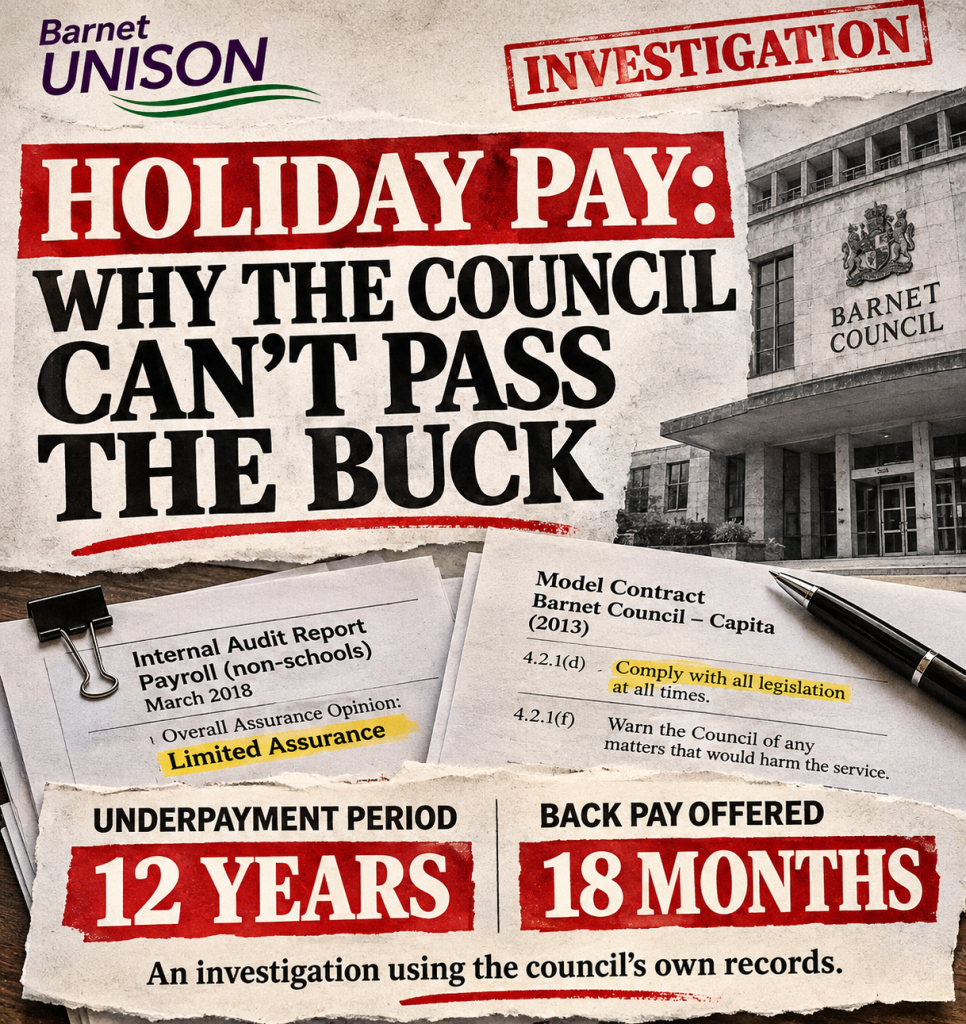
HOLIDAY PAY: WHY THE COUNCIL CAN’T PASS THE BUCK

HOLIDAY PAY: WHY THE COUNCIL CAN’T PASS THE BUCK

For more than ten years, Barnet Council staff who regularly worked overtime were underpaid when they took holiday. While Capita ran the council’s payroll, from 2013 to March 2025, regular overtime was left out of holiday pay. When Liberata took over running payroll in April 2025, on the council’s new Oracle system, it was put right straight away (https://barnet.moderngov.co.uk/ieDecisionDetails.aspx?ID=9343.

Capita says it “delivered the service as instructed by Barnet Council” (https://barnetpost.co.uk/2026/08/12/council-leader-to-underpaid-workers-youll-only-get-your-money-by-taking-it-from-disabled-children/). The council has offered staff 18 months of back pay for a 12-year underpayment. Here is why we say the responsibility sits with the council, using its own committee papers.

THE LAW HAS BEEN CLEAR SINCE 2014

In November 2014, in Bear Scotland v Fulton, the Employment Appeal Tribunal ruled that regular overtime must count towards holiday pay. In 2017, Dudley Council v Willetts confirmed this includes regular voluntary overtime. In 2024 the government wrote it into the Working Time Regulations (https://knowledge.dlapiper.com/dlapiperknowledge/globalemploymentlatestdevelopments/2024/latest-changes-to-holiday-pay-and-what-they-mean-for-employers).

The council often points to a two-year limit. That limit applies to what a tribunal can award an individual (https://www.personneltoday.com/hr/holiday-pay-two-year-backdating-limit-claims-submitted-1-july-2015). It does not stop an employer putting right its own mistake.

THE EMPLOYER IS RESPONSIBLE

As we understand the law, the duty to pay holiday pay correctly sits with the employer, the London Borough of Barnet. A council can pay a contractor to run its payroll. In our view it cannot hand over its duty to pay its own staff correctly. If the contractor gets it wrong, the council should pay its staff, then recover the cost from the contractor.

THE CONTRACT GAVE THE COUNCIL THE TOOLS

The council’s 2013 contract with Capita is public (https://open.barnet.gov.uk/download/23d3v/tmb/v24___Barnet_NSCSO___Model_Contract_Body___Final_unredacted_version_20131016.pdf). In our reading, it required Capita to:

  • comply with all legislation at all times (clause 4.2.1(d))
  • warn the council of anything that would harm the service, including what Capita “should have known” (clause 4.2.1(f))
  • fix its own failures at no extra cost to the council (clause 4.2.2)
  • bear the cost of routine changes in the law (clause 14)

In 2018 the council itself listed the remedies open to it, including deductions from Capita’s payments, remedy notices and step-in (see question 48, page 30: https://barnet.moderngov.co.uk/documents/b31355/Item%205%20-%20Public%20Questions%20and%20Responses%2022nd-Nov-2018%2019.00%20Audit%20Committee.pdf?T=9). It issued remedy notices to Capita after the 2018 fraud. We have found no record that it used them over payroll.

THE COUNCIL WAS WARNED ABOUT PAYROLL, REPEATEDLY

These reports do not spell out the overtime problem. They do show the council knew about serious payroll weaknesses for years. Throughout that time, holiday pay on overtime was never put right while Capita ran payroll.

AN INDEPENDENT REVIEW FOUND WEAK COUNCIL OVERSIGHT

In 2018, after a Capita employee was jailed for a £2 million fraud against the council (https://feeds.bbci.co.uk/news/uk-england-london-45641513), the council commissioned Grant Thornton to investigate (https://www.barnet.gov.uk/your-council/fraud-investigation/financial-controls). The review covered the same contract that ran payroll. It found “insufficient oversight by the Council” and said the council was aware of weaknesses in how it oversaw Capita. It also reported that the council’s target for fixing urgent audit recommendations had not been met since 2013/14. The review was about financial controls, not payroll, but it shows the council knew it was not overseeing Capita properly.

WHAT WE WANT

  • The council to pay staff what they are owed, then recover the cost from Capita.
  • An independent investigation into how this went on for over ten years.

This article is Barnet UNISON’s reading of public documents, not legal advice. If anything is wrong, tell us and we will correct it.

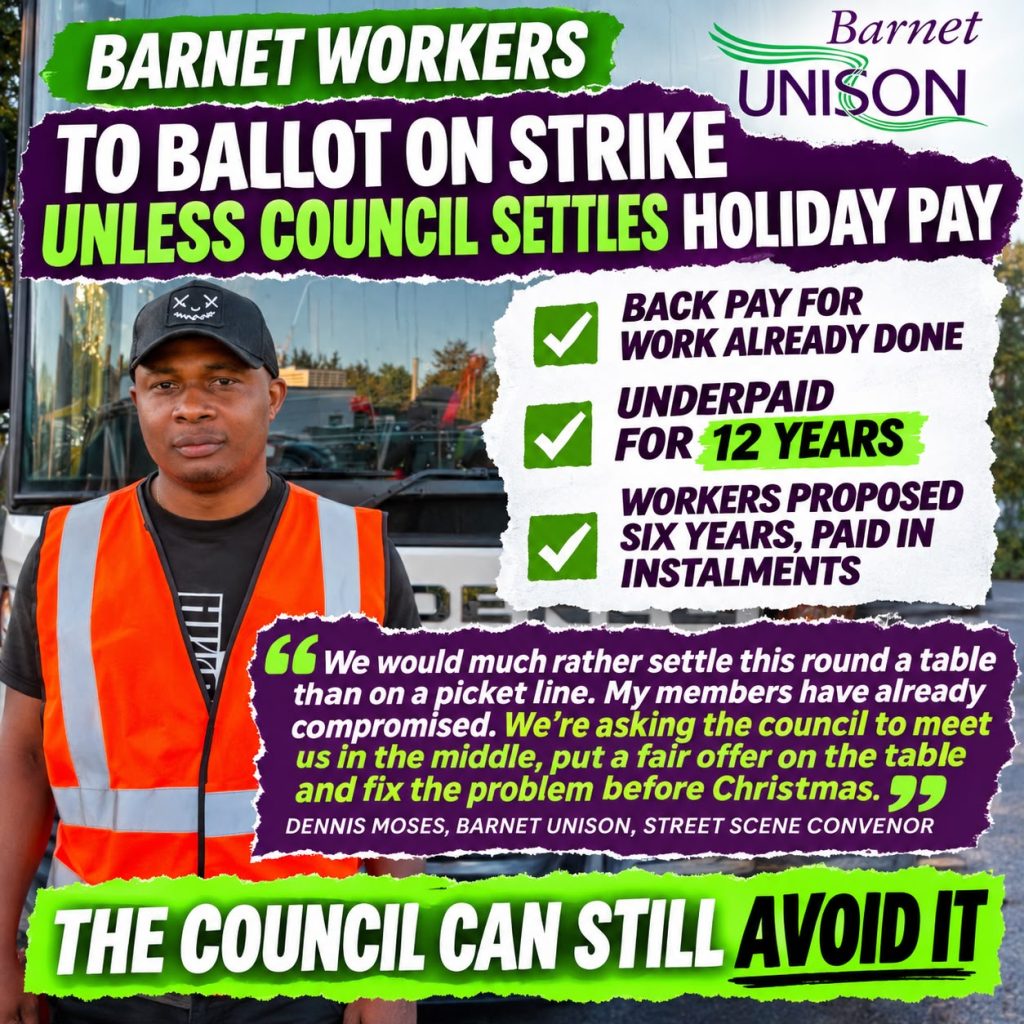
Barnet workers to ballot on strike unless council settles holiday pay

Barnet, 5 November 2026

Barnet’s bin, recycling and street cleansing workers will be balloted for strike action from 11 November, but their union says the council can still avoid it by making a fair offer.

For twelve years, while Capita ran the council’s payroll, staff who regularly worked overtime received holiday pay that did not include it. This is back pay for work already done, not a pay claim. The error was put right when payroll moved to a new provider in 2025.

UNISON has tried to settle this by negotiation. Workers proposed a six-year settlement, paid in instalments, and accepted they would not recover the full twelve years. The council rejected it and has restated an offer of 18 months. UNISON believes the talks have been too adversarial. At a time when the Prime Minister is calling for a more cooperative approach between employers and unions, we would like Barnet to show the same willingness to find a solution.

Capita is no longer in Barnet, but its legacy still affects staff, and potentially residents. The company’s problems with the Civil Service Pension Scheme, where retired workers waited months for payments, show how costly its failures can be for the people on the receiving end.

Many of these workers are on low pay and struggling with the cost of living. They cannot afford to write off what they are owed.

Dennis Moses, UNISON Street Scene Convenor, said: “We would much rather settle this round a table than on a picket line. My members have already compromised. We’re asking the council to meet us in the middle, put a fair offer on the table and fix the problem before Christmas.”

The ballot closes on 9 December. No strike dates have been set.

Ends


Barnet UNISON: Branch Secretary Weekly Message 2 November 2026

Monday 2 November 2026


Weekly Blog — speaking truth to power – Support for Disabled Members. 

We’ve seen a real rise in casework supporting disabled members over the past while, across schools, care settings, depots and council offices. Some of that is members coming to us once things have already gone wrong. I’d rather hear from you earlier than that. So this week’s blog is a straightforward message: if you’re a disabled member, or living with a long-term health condition, we’re ready to help, and you don’t need a crisis to pick up the phone.


What we can actually help with

A lot of the casework we see starts with sickness absence. The Council’s own policy says that where someone has an underlying health condition or disability, the usual absence review points don’t have to apply in the same rigid way. In practice that only happens if someone pushes for it. We do that pushing.


We also deal regularly with reasonable adjustments, whether that’s changes to your hours, your equipment, your workstation, or how a task is structured. The duty to make those adjustments sits with the employer, not with you to just cope. If a request has gone quiet, or you’ve been told something isn’t possible without much explanation why, that’s exactly the kind of thing we can chase.


Where health affects someone’s ability to do their current role, there are routes for temporary or permanent redeployment, with pay protection built in for a temporary move. And where absence management, performance management or a disciplinary process is running alongside a health condition, we make sure that connection isn’t ignored or brushed past.


You know your situation. We know the process.

Nobody expects you to be an expert in the Equality Act or the Council’s Managing Absence Policy on top of managing your own health. That’s our job. What we need from you is to hear about it, ideally before a formal meeting gets scheduled rather than the night before it.

If you’re waiting on an adjustment that’s gone quiet, worried about a return to work meeting, or feel like your health isn’t being properly factored into a process you’re going through, get in touch. You’re entitled to bring a rep into any of these meetings, and it costs you nothing to ask one of us to come along, even if you’re not sure yet whether anything’s actually gone wrong.


This isn’t only for members with a visible or long-standing condition either. Long-term conditions, mental health, and anything covered under the Equality Act all count. If you’re not sure whether your situation qualifies for support, ask us rather than deciding on your own that it probably doesn’t.


Contact your steward or the branch office whenever suits you. We’d rather have the conversation early and it turn out you didn’t need us, than have it too late.


Best wishes John Burgess Branch Secretary, Barnet UNISON