URGENT Message from Barnet UNISON to members

URGENT Message from Barnet UNISON to members

We are working with The Barnet Group on exemptions to strike action to ensure life and limb cover in YCB residential settings.

This means care and support provided to ensure no serious harm comes to those being cared for.

The settings which are covered:

  1. Residential care homes
  2. Supported Living
  3. Respite setting
  4. Extra Care

We have agreed with TBG to have a list of members on standby willing to cover these essential services in an emergency.

For example, It is possible someone who was due to work a shift rings in sick leaving residents exposed to not having food or being able to use the toilet.

If you are taking strike action and are willing to go on the standby list then please let us know. Please also indicate which times of the day you would be willing to cover in an emergency.

Below is the message sent out by The Barnet Group to all staff:

“Dear colleagues,

You may be aware that UNISON has called for 24-hour strike action by its members on Tuesday 27 October 2026.

Management does not hold information about trade union membership. Managers may respectfully ask colleagues whether they intend to participate in strike action for the purposes of service planning and ensuring appropriate resourcing.

For any employee considering participation in strike action, please be aware of the following:

  • Your manager may ask you if you intend to take strike action. You may confirm or respectfully decline to do so.
  • If you take part in strike action, you will not be paid for that day.
  • If you participate in strike action, you will need to ensure that this is recorded with your manager. We ask that this is done as soon as reasonably practicable after 27 October 2026.

The Barnet Group’s Leadership Team recognises and respects employees’ legal right to participate in lawful industrial action. Employees who choose to take part in lawful strike action will not be subjected to any detriment for doing so.

TBG Executive Management Team”

They Were Heroes During Covid. Now They Are Fighting for Fair Pay. We Must Stand With Them.

They Were Heroes During Covid. Now They Are Fighting for Fair Pay. We Must Stand With Them.

 Branch Secretary Blog — John Burgess, Barnet UNISON

On Tuesday 13 October, Barnet UNISON announced that our members working for The Barnet Group had voted overwhelmingly for strike action.

 88% voted YES on a 55% turnout.

That is a powerful result, and I want to explain why this dispute matters to every Barnet UNISON member, not just those working for The Barnet Group.

 Who are The Barnet Group workers?

The Barnet Group (TBG) is a company wholly owned by Barnet Council. It includes Barnet Homes, which provides housing services, and Your Choice Barnet, which provides social care and support services.

These are not optional services. Housing and social care are essential public services which councils have statutory responsibilities to provide or arrange.

Our members include care and support workers looking after vulnerable adults, and housing workers helping residents with their homes, repairs and housing needs.

They are public service workers. They work for organisations owned by Barnet Council. But they are not treated the same as Barnet Council employees.

Many members reading this may be surprised to learn that TBG workers do not automatically receive the same pay, annual leave, sick pay, overtime rates or other terms and conditions as Council staff.

They also do not have the same access to the Local Government Pension Scheme (LGPS).

How can that be right?

Remember when care workers were called heroes?

I want members to think back to Covid.

When much of the country was told to stay at home, our care workers continued going to work.

They supported vulnerable residents who depended on them. They worried about catching Covid, about passing it on to the people they cared for, and about bringing it home to their own families.

They went to work because people needed them.

Remember the weekly applause? Remember people standing outside their homes banging saucepans to show their appreciation for NHS and care workers?

They were called heroes then. So why are they still fighting for fair pay, decent conditions and pension rights now?

You cannot pay the rent with applause. You cannot pay your energy bills with praise.

And you certainly cannot build a decent retirement on warm words.

One Council. Two Workforces. That Must End.

Barnet UNISON has been campaigning for years against outsourcing and the creation of a two-tier workforce.

Barnet Homes and Your Choice Barnet were once Council services. Moving them outside direct Council employment has left workers doing essential public service jobs without the same contractual protections and benefits as their Council colleagues.

Our members are demanding better pay and conditions, including improved annual leave, sick pay, working hours, overtime rates, a fair pay structure and access to the LGPS.

The Barnet Group has rejected the claim.

Our members have responded by voting for strike action.

Nobody takes a decision to strike lightly, especially workers who care for vulnerable people and support residents.

But when employers refuse to negotiate seriously, what choice are workers left with?

This is why Barnet UNISON is calling on The Barnet Group and Barnet Council to sit down with us and negotiate a fair settlement.

My Message to Every Barnet UNISON Member

I have spent 31 years representing workers in Barnet, including 23 years as Branch Secretary.

I have seen what outsourcing does to workers. I have seen the divisions it creates, the inequalities it produces and the damage it can do to morale.

I have also seen what happens when workers stand together.

Our TBG members have shown courage. They have voted to challenge their employer because they believe they deserve better.

Now I am asking every Barnet UNISON member reading this blog to do something simple.

Take a few minutes to send a message of solidarity to our housing and care workers.

It doesn’t have to be long. Just a few words to let them know they are not alone.

You might work in a school, a library, a depot, an office or another Council service. You might never have met a TBG worker.

That doesn’t matter.

We are all UNISON members, and when one group of workers is fighting for fair treatment, they deserve the support of the rest of us.

Please email your message of support to contactus@barnetunison.org.uk.

I will make sure our TBG members get to read your messages.

I want them to know that thousands of fellow UNISON members across Barnet recognise their fight and stand alongside them.

 They were there for our community during Covid.

 Now it’s our turn to be there for them.

Solidarity.

John Burgess
Branch Secretary
Barnet UNISON

ONE COUNCIL. ONE WORKFORCE. EQUAL TERMS.

ONE COUNCIL. ONE WORKFORCE. EQUAL TERMS.

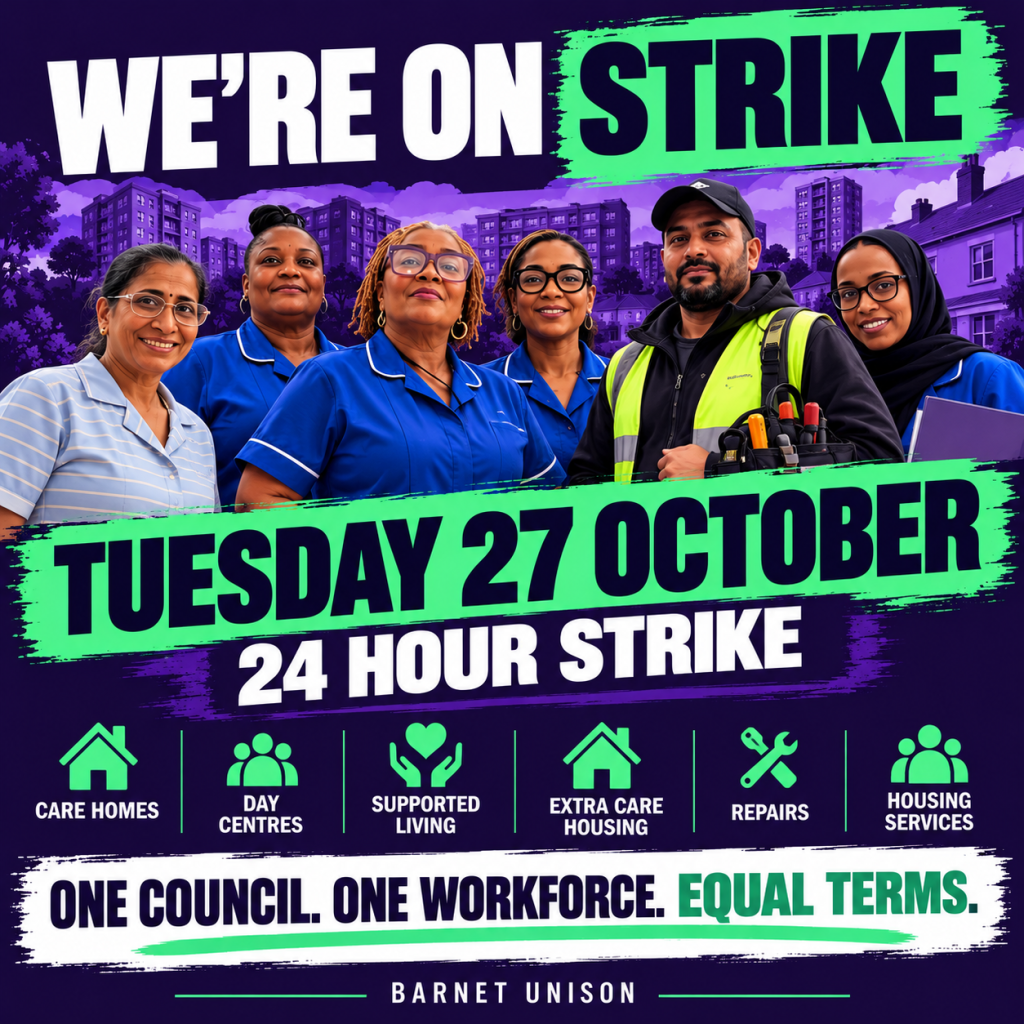
First day of strike action: Tuesday 27 October

15 October 2026

The first day of strike action for all UNISON members at The Barnet Group will be Tuesday 27 October. It will be a 24 hour strike.

Thank you to everyone who voted. A 55% turnout and 88% voting yes gives us a clear mandate.

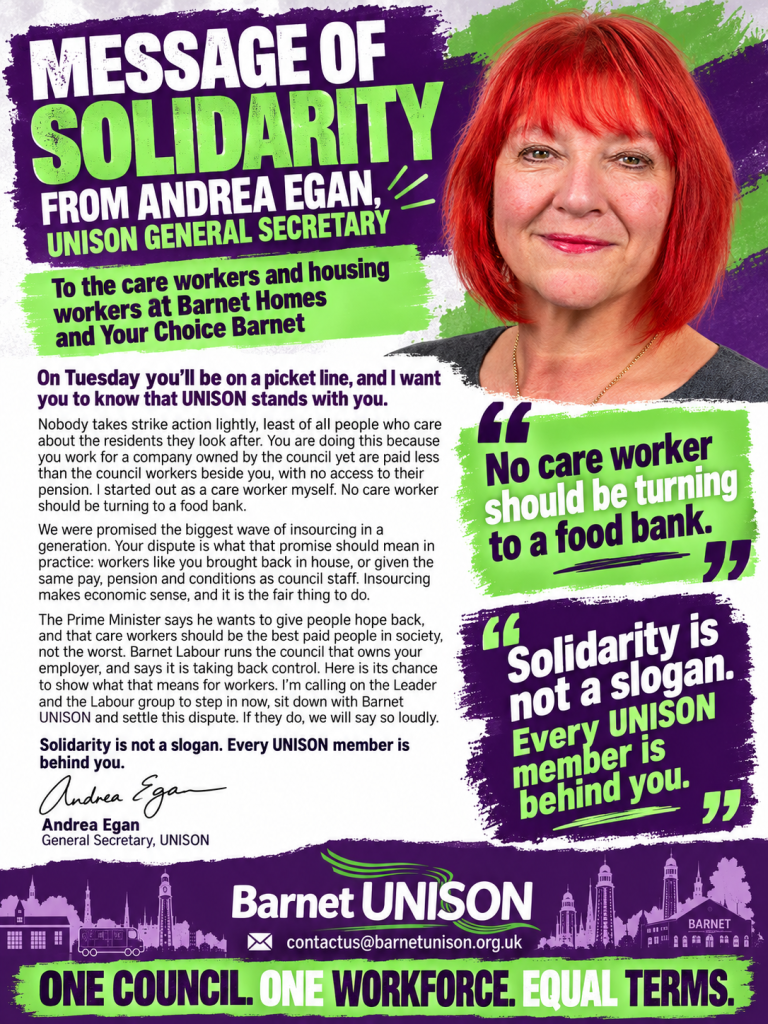
Message from UNISON General Secretary Andrea Egan to The Barnet Group workers

Dear colleagues,

Congratulations on a strong clear result. A 55% turnout and 88% voting yes is a strong, clear message, and everyone in UNISON is proud of you.

You care for vulnerable residents and look after people’s homes in one of the most expensive cities in the world. You do the same jobs as council staff, yet you are on worse pay and conditions, with many having no access to the council pension scheme. That is unfair, and you are right to say so.

UNISON is with you. You have the whole union behind you, from your branch and region to our national team. You voted because you want a fair deal, and I hope the employer will now sit down and negotiate one.

In solidarity,
Andrea Egan
General Secretary, UNISON

Talks have opened

Since the ballot, communication has opened up with the Group Chief Executive of TBG. He has agreed to review London Living Wage timing, annual leave and overtime. That is a step forward, but it does not go far enough.

We would much rather settle this dispute. On 15 October I wrote back to him with the points we want TBG to address:

  • Working week. Parity with LBB colleagues on 36 hours, instead of the 37.5 hours TBG Flex staff work now.
  • Annual leave. Movement towards 31 days.
  • Sick pay. Sick pay on LBB terms, with an indicative cost.
  • Overtime and night rates. A review that covers night, weekend and bank holiday rates, with a date for proposals.
  • Pay structure. Talks to start now on one clear pay structure.
  • Pensions. LGPS remains our aim. If TBG will not agree it, we have asked for a higher employer contribution to the Legal & General scheme, costed in stages, and for the joint meeting with the pension fund and LBB.
  • NJC pay awards. Written into contracts.
  • Policy review. A joint review of LBB and TBG policies.
  • London Living Wage. A firm date to pay the new rate, rather than waiting until April.

I have asked him to instruct TBG’s negotiating team to meet UNISON with proposals. We will also be approaching the Labour Party about funding contributions from LBB.

Message from Andrea Egan to Barnet’s Labour administration

To Barnet’s Labour councillors,

Barnet UNISON members at The Barnet Group, a company owned by your council, have voted for strike action. They want what their council colleagues already have: fair pay, decent terms and access to the council pension scheme.

They deliver housing and care services for your residents, in London, where the cost of living has never been higher. Labour came into government promising to end the two tier workforce and to put an end to poverty pay in care. Your own Prime Minister told conference that care workers deserve better.

I am asking you to work with UNISON to settle this dispute. That means backing proper negotiations now and supporting the funding to make a fair offer possible. Barnet UNISON is ready to talk. Please make sure The Barnet Group is too.

Andrea Egan
General Secretary, UNISON

What happens next

We will publish details of the picket lines, and where members should report on the day, as soon as they are confirmed.

If you have questions about the strike, please ask your local rep or email the branch at contactus@barnetunison.org.uk.

Barnet UNISON.

FOR IMMEDIATE RELEASE Barnet Group workers vote for strike action over poverty pay

FOR IMMEDIATE RELEASE

Barnet Group workers vote for strike action over poverty pay

13 October 2026

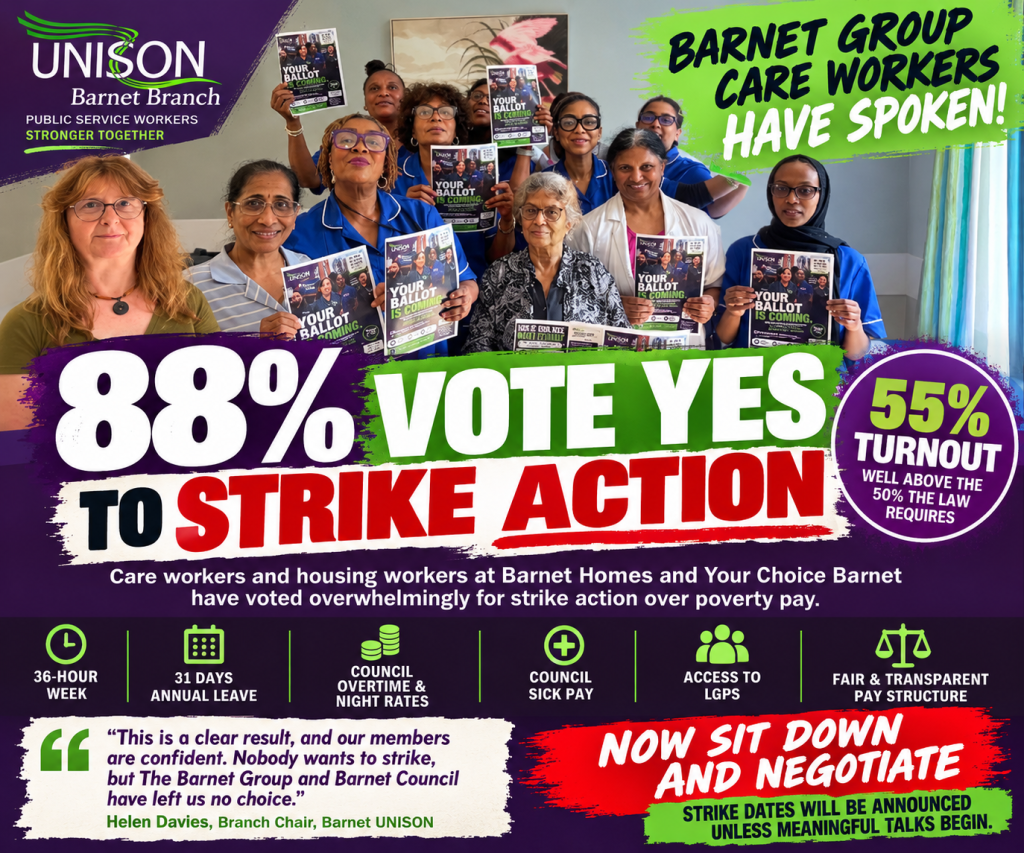
Care workers and housing workers at The Barnet Group have voted for strike action, with 88% voting yes on a 55% turnout, well above the 50% the law requires.

The workers are employed at Barnet Homes and Your Choice Barnet, both owned by Barnet Council. They provide housing and care services to Barnet residents. These services were once run in house by the council. They are now delivered by workers on inferior contracts, often alongside council staff doing similar jobs.

The ballot seeks to end that two tier workforce.

UNISON is asking for:

  • a 36-hour week, down from 37.5 (40 for repairs staff)
  • 31 days annual leave
  • council overtime and night rates
  • council sick pay
  • talks on a single, transparent pay structure
  • access to the Local Government Pension Scheme
  • annual NJC pay awards written into contracts
  • the new London Living Wage paid when announced in October, not the following April
  • a joint review adopting council policies wherever they are better

The Barnet Group has refused every part of the claim and has been unwilling to enter proper negotiations. Staff are angry and morale is low. With food, energy and rent costs still rising, many say they are struggling to get by on what they earn.

At Labour conference on 29 September, Prime Minister Andy Burnham spoke of care workers “caring for other people’s parents on poverty pay”. He said he wants “care that is about people not profit”. Care workers employed by a council owned company are on exactly that poverty pay.

Care worker, Your Choice Barnet: “I look after people who can’t look after themselves, then worry about my own gas bill. Council staff doing the same job get better sick pay and a pension. We just want the same.”

Housing worker, Barnet Homes: “We help residents who are struggling, and many of us are struggling too. People voted because they’ve had enough of being treated as second class.”

Helen Davies, Branch Chair, Barnet UNISON: “This is a clear result, and our members are confident. Nobody wants to strike, but The Barnet Group and Barnet Council have left us no choice. We are asking them to sit down and negotiate properly, starting now.”

Strike dates will be announced unless meaningful talks begin.

End.


Barnet council faces strike ballot over 12 years of underpaid holiday pay

Barnet, 12 October 2026

UNISON has registered a formal dispute with Barnet council on behalf of every member who was underpaid holiday pay on regular overtime while Capita ran the payroll. Depot workers, who asked first, will be balloted first.

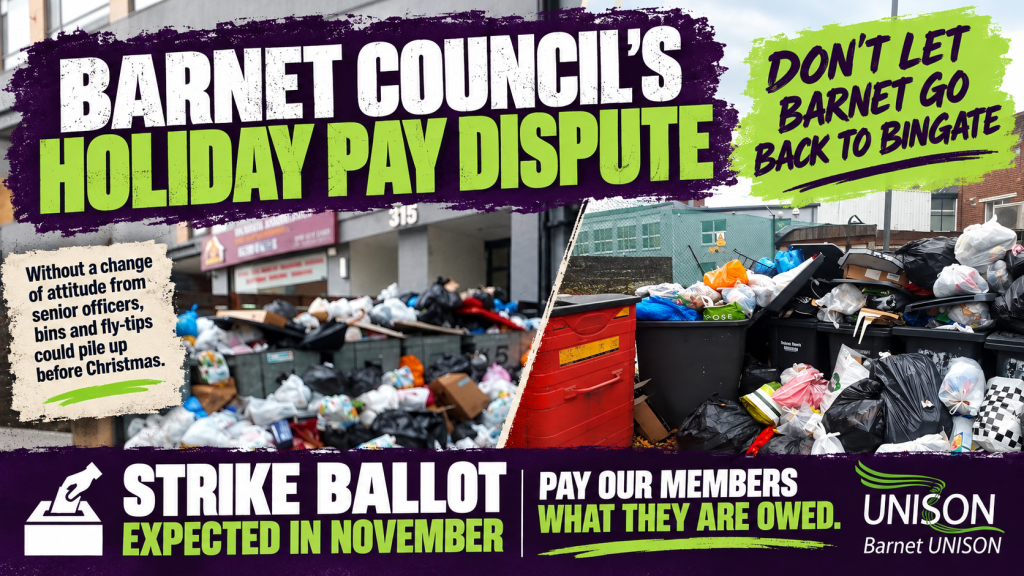
At an emergency joint meeting on 9 October, UNISON registered a formal Failure to Agree. UNISON has asked UNISON HQ for a lawful strike ballot of depot workers, expected to start in early November, with possible action just before Christmas. UNISON has reserved the right to bring other workers into the dispute, and any gains will apply to all members affected. The door remains open to serious negotiation.

This is not a pay claim. It is money owed for work already done while Capita ran the payroll. UNISON has tried patiently to settle it since July 2025. Members have already compromised, asking for six years’ backdate, half the period. That is the floor and UNISON will not be drawn lower.

At the meeting, the council rejected that proposal and repeated that 18 months is its final offer, which it called reasonable and affordable. The council also says that even if a legal claim existed, workers could only recover two years. That misses the point. The law cannot give back twelve years of underpayment, so industrial action is the only leverage workers have. Hiding behind the law shows no remorse and no grasp of the failure to pay them properly.

UNISON put six questions about Capita to the Chief Executive. The council’s written replies avoided most of them. It says discussions with Capita are “ongoing” but will not say what about. Members want answers:

  1. Why did correct payment only begin after Liberata took over payroll?
  2. Was the council aware payments hadn’t been correctly implemented before 2025?
  3. Has the council conducted a full investigation into the historic payroll arrangement?
  4. Has the council sought an explanation from Capita regarding the failure?
  5. Has the council considered recovering the financial loss from Capita?
  6. What evidence supports the council’s position that six months is an appropriate settlement?

The council put millions into its Capita contracts and employed staff to monitor and enforce them. It has found money for that, but not for the people it underpaid. On 1 October the Labour group said Barnet was “taking back control” from Capita, and said the contract cost £200 million more than expected. UNISON agrees that is an outrageous sum.

Many depot workers have worked six-day weeks for years because basic pay is too low, and it wears down their bodies. The Prime Minister told Labour’s conference that “everyone is talking about how life is too expensive”, and criticised Westminster for prizing “point-scoring over problem-solving”. Barnet’s senior officers are doing the same. They met a compromise from members with point-scoring, then stuck to 18 months. Meanwhile workers are told to wait for their own wages. UNISON has briefed Labour councillors in meetings and emails and has had little support so far.

UNISON does not want a Birmingham-style bin dispute in London. Residents may remember the 2018 bin collection changes that led to thousands of missed bins and a huge agency bill. Without a change of attitude from senior officers, bins and fly-tips could pile up before Christmas.

Depot worker: “Let’s take action not only because of the money they owe us, but also because of the lack of respect they show us. All these people earn huge salaries thanks to our hard work. We’ve never heard a ‘thank you’ – just a lack of respect!”

Depot worker: “We are binman. The dirt is in our veins.”

Helen Davies, Branch Chair, Barnet UNISON: “These workers keep Barnet clean, and in a cost-of-living crisis they are told to wait for their own wages. The council can end this by treating it seriously.”

Dennis Moses, Street Scene Convenor: “Members have already halved their original claim, which represents a significant compromise in an effort to reach a fair settlement. Yet, in return, the Council has failed to provide a clear explanation of what went wrong under Capita and why workers were underpaid for so many years. Our members deserve answers, accountability and a fair settlement.”

John Burgess, Branch Secretary, Barnet UNISON: “This dispute should never have happened. We have been patient since July 2025. Our members offered to meet the council halfway and got point-scoring and the same 18 months. If bins pile up before Christmas, that is down to the council’s failure, not the workers it underpaid.”

About Barnet UNISON: Barnet UNISON represents 3,000 members across Barnet Council, The Barnet Group, Barnet Education and Learning Skills and contracted services.

Contact: contactus@barnetunison.org.uk

Notes to editors: UNISON’s 2018 coverage of the bin collection changes: https://www.barnetunison.me.uk/wp/2018/11/29/100-of-barnet-unison-bin-workers-agree-new-round-changes-have-failed-barnet-residents-bingate/


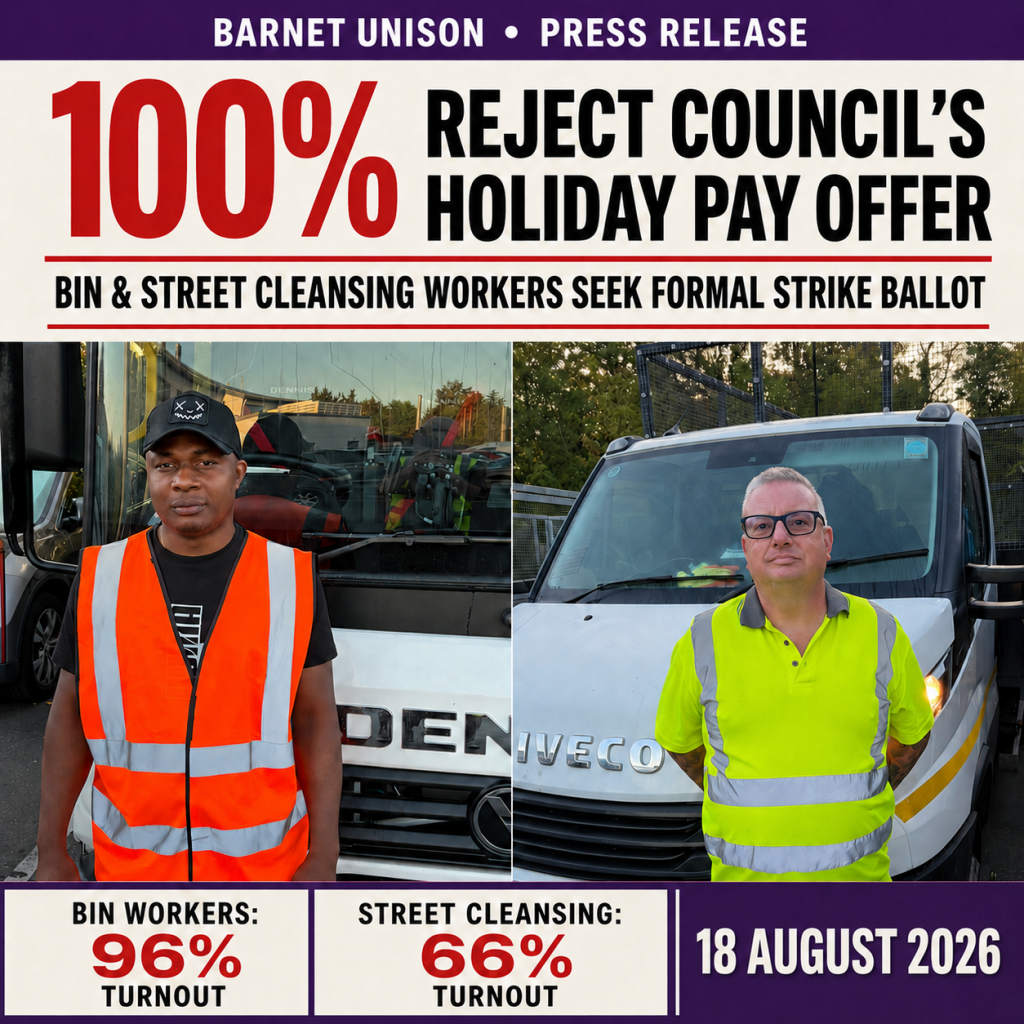
FOR IMMEDIATE RELEASE — 100% of Barnet bin and street cleansing workers reject holiday pay offer

18 August 2026

Barnet bin and street cleansing workers vote 100% to reject holiday pay offer, seek formal strike ballot

Council workers affected by Barnet Council’s 12-year holiday pay underpayment have unanimously rejected the council’s current offer, Barnet UNISON has announced and are now seeking a formal industrial action ballot.

In a consultative ballot, bin workers returned a 96% turnout with 100% voting to reject the council’s offer of six months’ backdated pay. Street Cleansing workers returned a 66% turnout, also with 100% voting to reject it — against underpayment that in many cases goes back to 2014.

The union has already written to the council’s Chief Executive and separately to Council Leader Barry Rawlings following the result, calling for urgent talks and asking the Leader to personally intervene.

A Joint Negotiating and Consultative Group meeting has since been confirmed for Monday 14 September, where the union will press the council on the questions it has raised.

UNISON has put a series of questions to the council that it says the public would reasonably expect answered, including why correct payment only began once a new payroll contractor took over in 2025, whether the council knew about the failure before then, whether a full investigation has taken place, whether Capita has been asked to account for the failure, whether the council has considered recovering the loss from Capita, and what evidence supports six months as an appropriate settlement.

The union is calling on the council to return to meaningful negotiation, provide full transparency on the payroll history, explain the basis of its offer, and come back with a significantly improved settlement that reflects the real duration and scale of the underpayment.

UNISON says that isn’t the outcome anyone wants — but with members having already signalled they’re ready to move to a formal industrial action ballot, continued council inaction risks strike action in Barnet as early as this autumn, which would mean bin collections and street cleansing grinding to a halt and the real prospect of fly-tipping building up across the borough.

“This result couldn’t be clearer. Not a single member who voted backed the council’s offer. We’ve asked the council for urgent talks — we’d much rather resolve this at the table than take it further. But if the council keeps standing behind Capita instead of doing right by the workers who kept this borough running, residents need to understand where that leads: a strike this autumn, bins left uncollected, and fly-tipping piling up across Barnet. That’s entirely avoidable, and it’s in the council’s hands to avoid it.”

The dispute follows a payroll error under former contractor Capita, which left overtime out of holiday pay calculations for staff who regularly worked it, including depot workers in waste, recycling, green waste and street cleaning.

ENDS

Notes to editors:

Barnet UNISON represents around 3,000 members working for the London Borough of Barnet and associated employers.

Contact: contactus@barnetunison.org.uk


Bus strikes – what you need to do now

Barnet UNISON depot members please read the advice below.

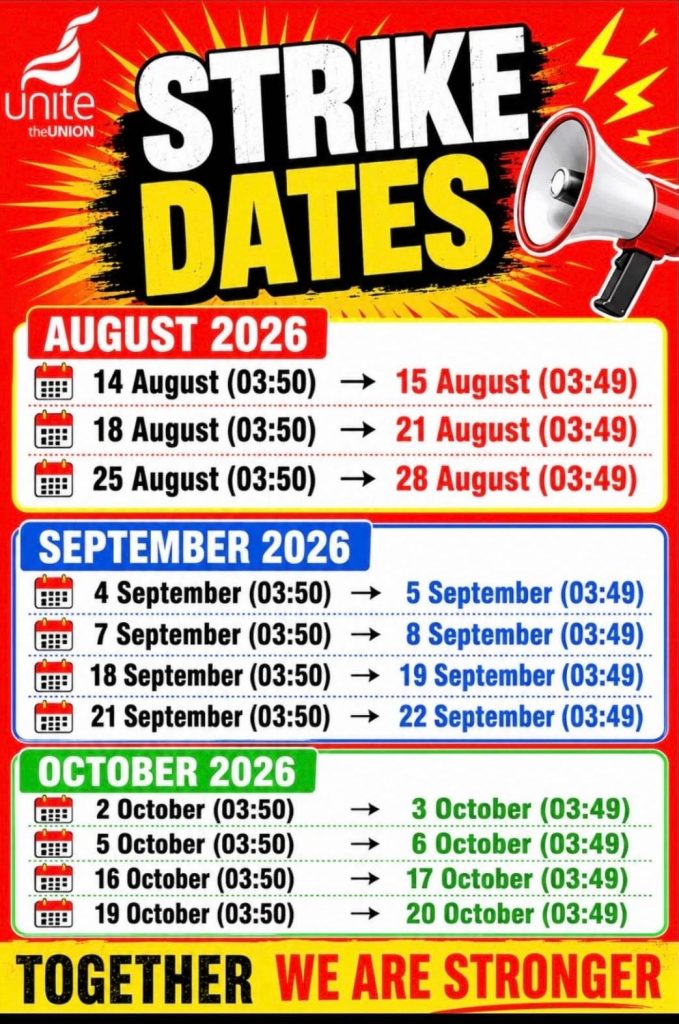
The Unite bus strikes affecting Arriva North London services start this Friday, 14 August, and continue on further dates through to October. If your journey to work depends on one of the affected routes, please read this and act now.

When the strikes are happening

Strike periods are: 14–15 August, 18–21 August, 25–28 August, 4–5 September, 7–8 September, 18–19 September, 21–22 September, 2–3 October, 5–6 October, and 16–17 and 19–20 October. Each period runs from just before 4am on the first date through to just before 4am on the day after the last date shown.

What to do now

If you think you’ll have trouble getting to work this Friday because your bus route is affected, speak to your supervisor today – don’t wait until the morning of the strike. The same applies ahead of every other date listed above. The earlier you flag it, the more time there is to sort something out.

What the Council is looking into

We’ve met with the Assistant Director, who is looking at practical ways to help affected staff get in on strike days. This includes putting on alternative transport, arranging car sharing, and asking supervisors to pick up staff who are struggling to get in. Nothing is confirmed yet, which is exactly why speaking to your supervisor now matters – it’s how you get included in whatever gets arranged.

If you’re not getting help

If you raise this with your supervisor and you’re not offered any practical support, or you’re told you’ll be marked late or absent through no fault of your own because of strike disruption, contact us straight away. Don’t just stay off work without speaking to your supervisor and to UNISON first.

Contact your workplace UNISON rep, or the branch office directly at contactus@barnetunison.org.uk , if you need help.

End.


Weekly Blog — speaking truth to power – National Care Service


This week I published a piece on the branch website about the National Care Service debate. I want to use this blog to explain why I wrote it, what it means for our members right now, and where the dispute with The Barnet Group stands.

Why I wrote about a National Care Service

Politicians talk about creating a National Care Service the way they talk about most things — as a funding question. How much will it cost? How will it be paid for? Those are fair questions. But they are not the only ones.

After 31 years as a UNISON rep, I have watched care workers praised in speeches and shortchanged in their pay packets. I have watched outsourcing strip away decent terms. I have watched workers transferred out of council employment, away from the Local Government Pension Scheme, onto weaker sick pay, weaker holiday entitlement, weaker everything — and I have watched management call it an efficiency.

A National Care Service built on that foundation is not a National Care Service. It is the same fragmented mess with a new name on the door.

If the Government is serious, it starts with the workforce. Fair pay, secure contracts, collective bargaining, and access to a proper pension. You can read the full piece here: https://www.barnetunison.me.uk/wp/2026/07/30/a-national-care-service-must-start-with-the-workforce/

The dispute on our doorstep

While politicians debate the future, our members in Your Choice Barnet and Barnet Homes are living the present. And the present is not acceptable.

Earlier this month, 97% of Your Choice Barnet members and 100% of Barnet Homes members voted for industrial action in consultative ballots. Those turnouts would have comfortably beaten the statutory thresholds needed for a formal ballot. The message could not have been clearer.

The Barnet Group’s response? They refused to negotiate. They rejected the claim in full and said they would not move. That is not a negotiating position. That is a refusal to engage with people who deliver first-class public services on second-class pay.

We have now requested formal statutory industrial action ballots. That process is underway. The Barnet Group is wholly owned by Barnet Council. The council cannot stand to one side and say this has nothing to do with them. It has everything to do with them.

The pension question

One of the central demands in this dispute is access to the Local Government Pension Scheme. This matters and it is worth explaining why.

LGPS is not a gold-plated luxury. It is a defined benefit scheme that gives workers a degree of certainty about their retirement — the kind of certainty that has been taken for granted by council employees for decades. Workers transferred into TBG and Your Choice Barnet were moved away from it. That means lower retirement income for some of the lowest-paid workers in the borough.

We often hear that LGPS employer contributions make it unaffordable. The employer contribution rate is currently 20.4%. That is not a secret. But it is worth pointing out that the people who find LGPS “unaffordable” for frontline care workers tend to be the same senior managers who are themselves in the scheme and drawing from it. If it is good enough for them, it is good enough for the people doing the actual care.

What happens next

The formal ballot process has begun. If members vote yes — and I expect they will — strike action becomes a real possibility. That is not where anyone wants to be. But it is where The Barnet Group has taken us by refusing to negotiate.

If you work in Your Choice Barnet or Barnet Homes, make sure your contact details are up to date with the branch. Watch for your ballot when it arrives. And vote.

Best wishes John Burgess Branch Secretary, Barnet UNISON


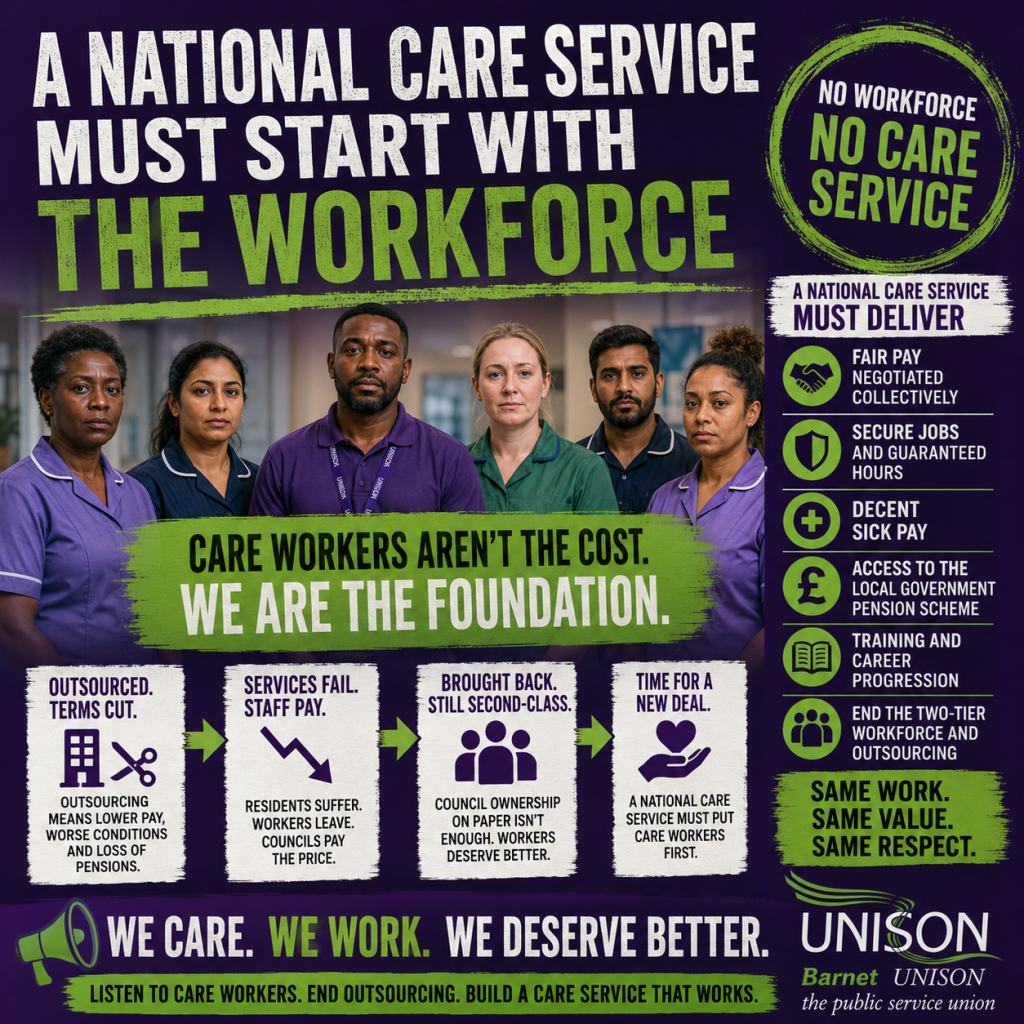
A National Care Service must start with the workforce

A National Care Service must start with the workforce

Rebecca Long-Bailey is right to argue that social care should become a universal public service, built on the same principle as the NHS: care according to need, not ability to pay.

But after 31 years as a UNISON representative, and decades organising and representing care workers in Barnet, I believe something fundamental is still missing from the national debate.

Politicians and the media repeatedly ask how much a National Care Service will cost and how it should be funded.

Those are important questions, but they are not the only questions.

We also need to ask who will provide the care, who will employ them, and on what pay, pensions and conditions.

There is no National Care Service without a national care workforce.

Three decades of outsourcing in Barnet

My first major involvement with care workers began in the late 1990s, when Barnet Council decided to outsource its residential care homes and day services.

The case put forward was that outsourcing was needed to secure investment in new and improved buildings.

Barnet UNISON opposed the proposal. We organised members and produced alternative reports challenging the argument that outsourcing was the only way to improve services.

At the same time, the council was implementing the national Single Status agreement. Care workers were moved from spot salaries onto a career-grade structure intended to provide fairer and more consistent pay.

The ink was barely dry on those new arrangements before the workers were told they were being outsourced.

The staff transferred to the Fremantle Trust. A few years later, the employer moved to impose significantly worse contracts.

Our members faced cuts to pay, sick pay and annual leave. Barnet UNISON members resisted through strike action, rallies, campaigning and meetings in Parliament.

We fought hard, but the cuts were imposed.

Much of the progress achieved through Single Status was undone. Skilled care workers delivering a public service were left with lower pay and weaker employment protections.

That experience taught us an important lesson.

Improvements negotiated through collective bargaining can be taken away when workers are transferred outside direct public employment.

The outsourcing model failed workers and services

The care-home contract later became the subject of a major financial dispute between Barnet Council and Catalyst Housing, which had partnered with Fremantle in the contract.

The dispute went to arbitration and resulted in substantial costs for the council.

Barnet Council eventually withdrew from the remaining contract. The services and staff transferred to Your Choice Barnet, part of the council-owned Barnet Group.

But the service did not return directly to the council.

The workers remained employed at arm’s length, outside council terms and conditions.

The history continued with the closure of Apthorp Care Home.

Residents had to leave their home and staff who had worked throughout the pandemic faced redundancy.

The building was reported to require millions of pounds of repairs despite being relatively new.

Once again, residents and workers carried the consequences of decisions made above them.

Home care followed the same pattern

Barnet UNISON also fought to retain the council’s in-house home-care service.

That service was outsourced.

Years later, part of the outsourced provision transferred to Aquaflo Care. The transfer ran into serious difficulties and the service was subsequently brought into The Barnet Group.

Several years later, The Barnet Group announced plans to close its Enablement Home Care Service.

The pattern has repeated itself throughout my time representing care workers:

A public service is outsourced.

The workforce is transferred.

Pay, pensions and conditions become fragmented.

The contract or provider runs into difficulty.

The service may eventually return to a council-owned organisation, but the workers do not necessarily regain council employment, council conditions or access to the Local Government Pension Scheme.

This is not history—our members are living it now

Today, Barnet UNISON is involved in a major dispute involving care workers employed by Your Choice Barnet.

These workers deliver essential adult social care services on behalf of Barnet Council.

They supported vulnerable residents throughout COVID. They carried on working when the risks to themselves and their families were very real.

Yet they remain part of a two-tier workforce.

They do not have the same core pay, terms and pension arrangements as directly employed council staff.

Our members are seeking fair pay, improved terms and conditions, a transparent pay structure and access to the Local Government Pension Scheme.

They should not have to consider strike action to secure basic fairness from an organisation wholly owned by the council.

This dispute exposes the gap between political promises about the future of social care and the reality experienced by the workforce.

The Prime Minister can speak about creating a National Care Service, but those words will mean little to care workers who remain underpaid, excluded from decent pensions and treated as second-class public-service workers.

A National Care Service cannot be credible if public bodies continue to deliver care through employment models that keep staff on inferior conditions.

The employment model matters

A National Care Service cannot simply be a new funding stream poured into the existing fragmented care market.

It cannot succeed while care remains dependent on outsourcing, low pay, insecure employment, inadequate sick pay and poor pension provision.

Nor is it enough to transfer services into council-owned companies while keeping the workforce outside council employment standards.

Public ownership must mean more than ownership on paper.

There must be no compromise about the employment model for care.

Care should be delivered as a public service through publicly accountable organisations.

Care workers should have:

  • fair pay determined through collective bargaining;
  • secure employment and guaranteed hours;
  • decent occupational sick pay;
  • nationally recognised training and genuine career progression;
  • equal treatment across the workforce;
  • and access to the Local Government Pension Scheme or an equivalent high-quality public-service pension.

There must also be a clear route for outsourced care services and their workers to return to direct public employment without losing existing contractual rights.

Listen to care workers

Any government serious about creating a National Care Service must speak directly to care workers and their trade unions before deciding how it will operate.

Care workers are not an afterthought.

They are not simply a cost in a funding model.

They are the people who make the service possible.

They understand what repeated outsourcing, fragmented commissioning and staff shortages mean in practice.

They know what happens when experienced workers leave because they cannot afford to remain in care.

They understand the impact that workforce instability has on older and disabled people who rely on consistent, trusted support.

For more than three decades, I have watched politicians praise care workers while supporting or tolerating employment models that hold down their pay, remove access to decent pensions and weaken collective bargaining.

Warm words are not enough.

Medals are not enough.

Calling workers heroes is not enough.

The care workforce is predominantly female, and many care workers are Black or Asian. They carry out skilled, physically demanding and emotionally demanding work.

They need justice at work, not another political promise that leaves their employment conditions untouched.

A National Care Service must be built around the people who provide the care.

It must end outsourcing and the two-tier workforce.

It must provide fair pay, decent conditions, collective bargaining and proper pensions.

The Prime Minister should start by looking at what is happening to care workers now, including those employed by council-owned companies such as The Barnet Group.

If the Government is serious about a National Care Service, it should support an employment model that treats care workers as public-service professionals—not as a source of savings.

Without a respected and properly rewarded workforce, there is no National Care Service.

Anything less is not good enough.

John Burgess
Branch Secretary, Barnet UNISON
UNISON representative for 31 years and lead representative for approximately 3,000 members




1 2 3 … 34