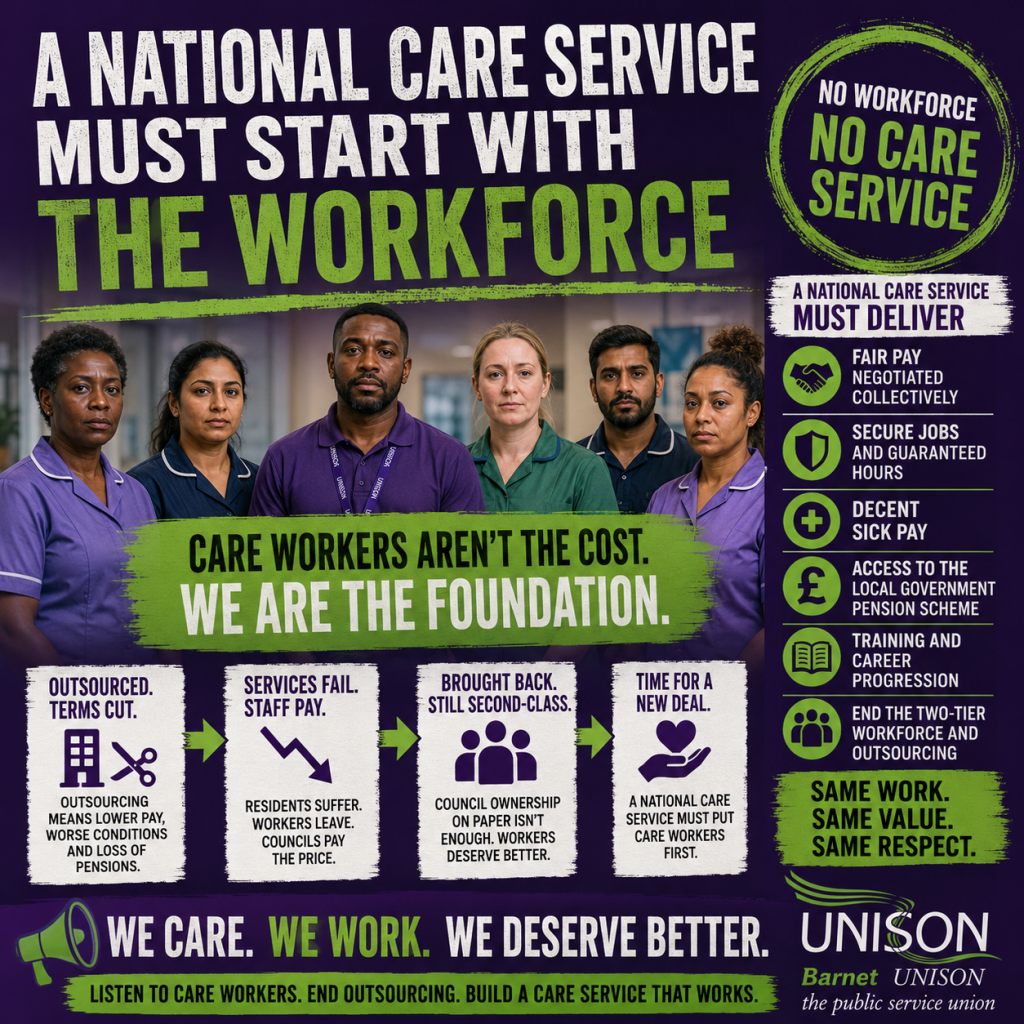
A National Care Service must start with the workforce

A National Care Service must start with the workforce

Rebecca Long-Bailey is right to argue that social care should become a universal public service, built on the same principle as the NHS: care according to need, not ability to pay.

But after 31 years as a UNISON representative, and decades organising and representing care workers in Barnet, I believe something fundamental is still missing from the national debate.

Politicians and the media repeatedly ask how much a National Care Service will cost and how it should be funded.

Those are important questions, but they are not the only questions.

We also need to ask who will provide the care, who will employ them, and on what pay, pensions and conditions.

There is no National Care Service without a national care workforce.

Three decades of outsourcing in Barnet

My first major involvement with care workers began in the late 1990s, when Barnet Council decided to outsource its residential care homes and day services.

The case put forward was that outsourcing was needed to secure investment in new and improved buildings.

Barnet UNISON opposed the proposal. We organised members and produced alternative reports challenging the argument that outsourcing was the only way to improve services.

At the same time, the council was implementing the national Single Status agreement. Care workers were moved from spot salaries onto a career-grade structure intended to provide fairer and more consistent pay.

The ink was barely dry on those new arrangements before the workers were told they were being outsourced.

The staff transferred to the Fremantle Trust. A few years later, the employer moved to impose significantly worse contracts.

Our members faced cuts to pay, sick pay and annual leave. Barnet UNISON members resisted through strike action, rallies, campaigning and meetings in Parliament.

We fought hard, but the cuts were imposed.

Much of the progress achieved through Single Status was undone. Skilled care workers delivering a public service were left with lower pay and weaker employment protections.

That experience taught us an important lesson.

Improvements negotiated through collective bargaining can be taken away when workers are transferred outside direct public employment.

The outsourcing model failed workers and services

The care-home contract later became the subject of a major financial dispute between Barnet Council and Catalyst Housing, which had partnered with Fremantle in the contract.

The dispute went to arbitration and resulted in substantial costs for the council.

Barnet Council eventually withdrew from the remaining contract. The services and staff transferred to Your Choice Barnet, part of the council-owned Barnet Group.

But the service did not return directly to the council.

The workers remained employed at arm’s length, outside council terms and conditions.

The history continued with the closure of Apthorp Care Home.

Residents had to leave their home and staff who had worked throughout the pandemic faced redundancy.

The building was reported to require millions of pounds of repairs despite being relatively new.

Once again, residents and workers carried the consequences of decisions made above them.

Home care followed the same pattern

Barnet UNISON also fought to retain the council’s in-house home-care service.

That service was outsourced.

Years later, part of the outsourced provision transferred to Aquaflo Care. The transfer ran into serious difficulties and the service was subsequently brought into The Barnet Group.

Several years later, The Barnet Group announced plans to close its Enablement Home Care Service.

The pattern has repeated itself throughout my time representing care workers:

A public service is outsourced.

The workforce is transferred.

Pay, pensions and conditions become fragmented.

The contract or provider runs into difficulty.

The service may eventually return to a council-owned organisation, but the workers do not necessarily regain council employment, council conditions or access to the Local Government Pension Scheme.

This is not history—our members are living it now

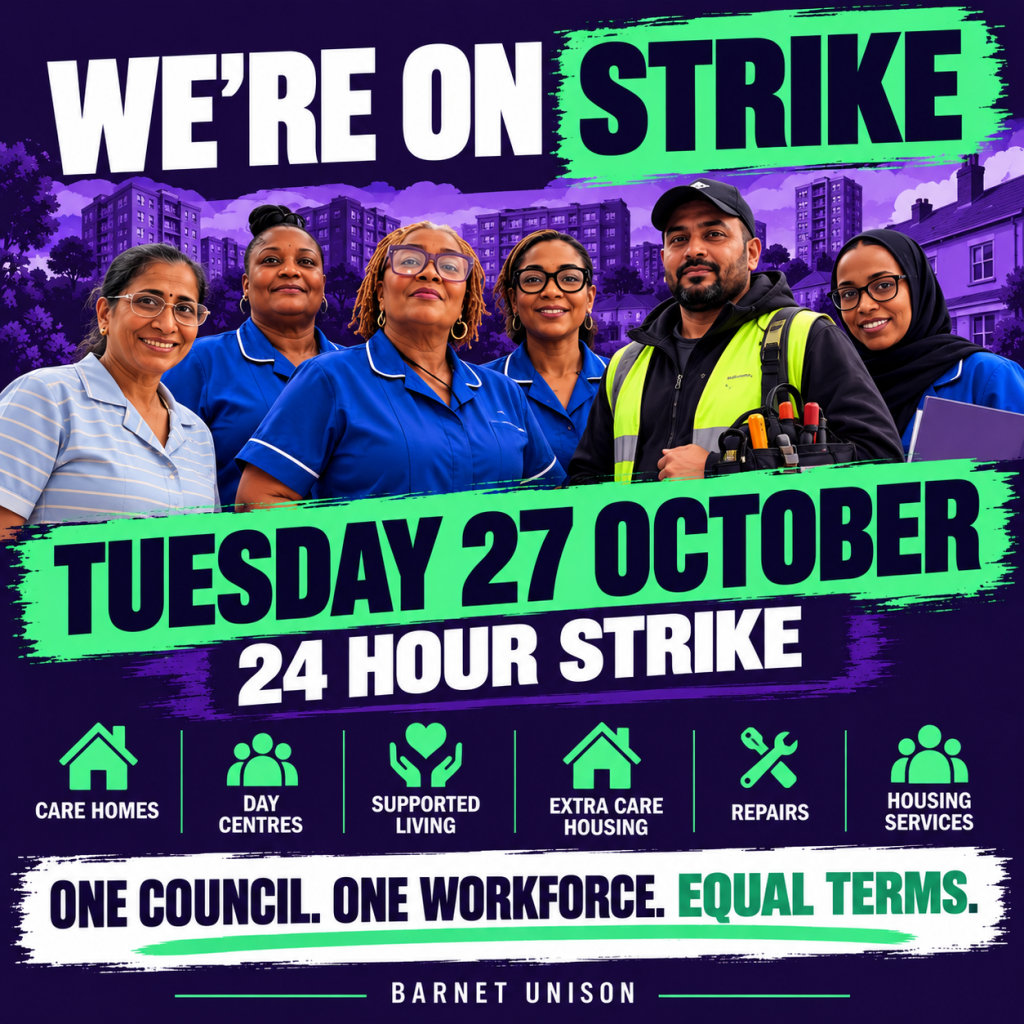
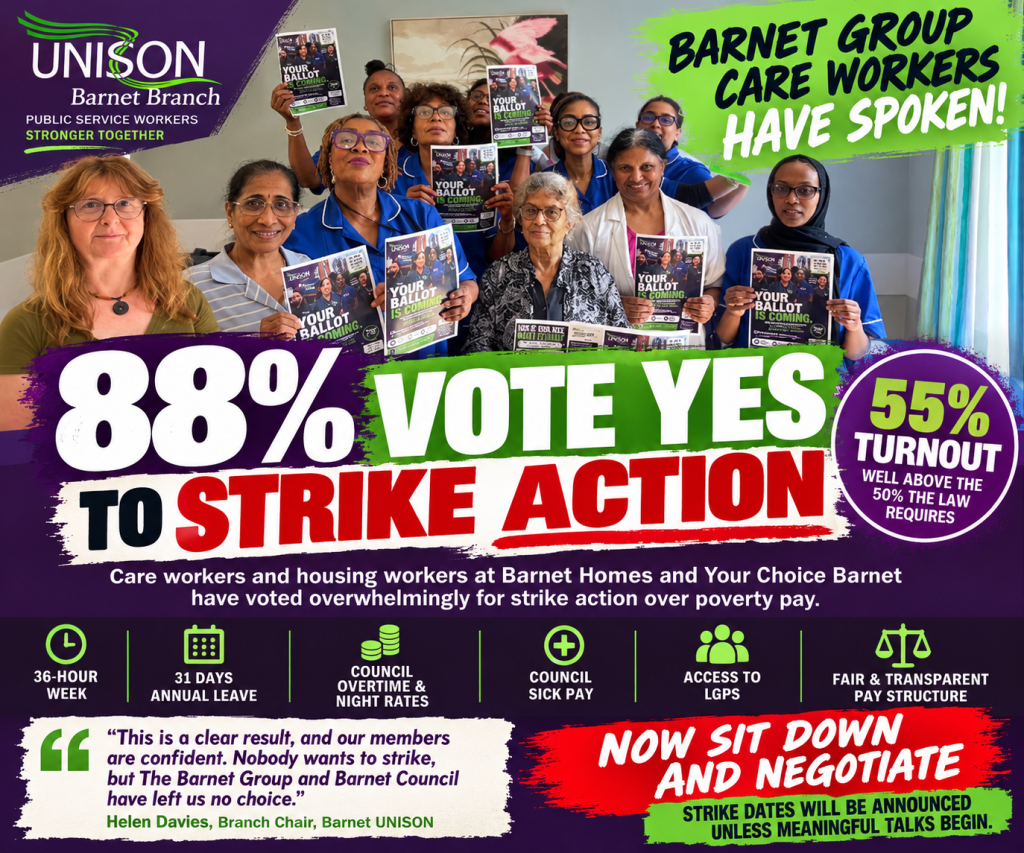
Today, Barnet UNISON is involved in a major dispute involving care workers employed by Your Choice Barnet.

These workers deliver essential adult social care services on behalf of Barnet Council.

They supported vulnerable residents throughout COVID. They carried on working when the risks to themselves and their families were very real.

Yet they remain part of a two-tier workforce.

They do not have the same core pay, terms and pension arrangements as directly employed council staff.

Our members are seeking fair pay, improved terms and conditions, a transparent pay structure and access to the Local Government Pension Scheme.

They should not have to consider strike action to secure basic fairness from an organisation wholly owned by the council.

This dispute exposes the gap between political promises about the future of social care and the reality experienced by the workforce.

The Prime Minister can speak about creating a National Care Service, but those words will mean little to care workers who remain underpaid, excluded from decent pensions and treated as second-class public-service workers.

A National Care Service cannot be credible if public bodies continue to deliver care through employment models that keep staff on inferior conditions.

The employment model matters

A National Care Service cannot simply be a new funding stream poured into the existing fragmented care market.

It cannot succeed while care remains dependent on outsourcing, low pay, insecure employment, inadequate sick pay and poor pension provision.

Nor is it enough to transfer services into council-owned companies while keeping the workforce outside council employment standards.

Public ownership must mean more than ownership on paper.

There must be no compromise about the employment model for care.

Care should be delivered as a public service through publicly accountable organisations.

Care workers should have:

  • fair pay determined through collective bargaining;
  • secure employment and guaranteed hours;
  • decent occupational sick pay;
  • nationally recognised training and genuine career progression;
  • equal treatment across the workforce;
  • and access to the Local Government Pension Scheme or an equivalent high-quality public-service pension.

There must also be a clear route for outsourced care services and their workers to return to direct public employment without losing existing contractual rights.

Listen to care workers

Any government serious about creating a National Care Service must speak directly to care workers and their trade unions before deciding how it will operate.

Care workers are not an afterthought.

They are not simply a cost in a funding model.

They are the people who make the service possible.

They understand what repeated outsourcing, fragmented commissioning and staff shortages mean in practice.

They know what happens when experienced workers leave because they cannot afford to remain in care.

They understand the impact that workforce instability has on older and disabled people who rely on consistent, trusted support.

For more than three decades, I have watched politicians praise care workers while supporting or tolerating employment models that hold down their pay, remove access to decent pensions and weaken collective bargaining.

Warm words are not enough.

Medals are not enough.

Calling workers heroes is not enough.

The care workforce is predominantly female, and many care workers are Black or Asian. They carry out skilled, physically demanding and emotionally demanding work.

They need justice at work, not another political promise that leaves their employment conditions untouched.

A National Care Service must be built around the people who provide the care.

It must end outsourcing and the two-tier workforce.

It must provide fair pay, decent conditions, collective bargaining and proper pensions.

The Prime Minister should start by looking at what is happening to care workers now, including those employed by council-owned companies such as The Barnet Group.

If the Government is serious about a National Care Service, it should support an employment model that treats care workers as public-service professionals—not as a source of savings.

Without a respected and properly rewarded workforce, there is no National Care Service.

Anything less is not good enough.

John Burgess
Branch Secretary, Barnet UNISON
UNISON representative for 31 years and lead representative for approximately 3,000 members




School Meals Workers — UNISON Needs to Hear From You

June 2026

If you work for ISS Catering in a Barnet school, please read this.

The council’s contract with ISS is coming to an end in March 2027. That does not necessarily mean your job ends — it may mean a change of employer, or it may mean staying with ISS under a new arrangement — but there will be changes, and UNISON needs to be on top of this from the start to protect your rights.

I have already been into meetings with Barnet Council management about what this means for catering staff and I will be going back in. I am pushing hard on the things that matter most — your pay, your London Living Wage, your pension, and making sure any transfer is handled properly and fairly. I am also making the case directly to the council and to elected councillors that bringing this service back in-house — so that you become council employees again — is the right thing to do. That fight is ongoing.

But I need to hear from you.

Our membership records are not always up to date, and things may have changed since many of you moved from the council to ISS back in 2016. I cannot represent you properly without knowing your current situation.

Please get in touch and let me know:

  • What job you are currently doing and which school you are based at
  • Whether your terms and conditions have changed since you moved to ISS — for example your pay, your hours, your holiday entitlement
  • Whether you are still in the Local Government Pension Scheme (LGPS) or whether your pension arrangements have changed
  • Whether your contact details or home address have changed
  • Whether you have any concerns or issues you want me to know about

Everything you tell me is treated in confidence. It comes to me directly and stays with me — I am not passing anything to ISS or to the council.

I know many of you will have questions I cannot fully answer yet. Things are still being worked out and I would rather be honest with you than give you information that turns out to be wrong. What I can tell you is that UNISON is in the room, I am attending every meeting, and your rights under TUPE mean your core terms and conditions are legally protected through any transfer.

Even if you have no concerns right now, please still get in touch with your current role and contact details. Every reply strengthens our position.

Contact Barnet UNISON directly: 📧 contactus@barnetunison.org.uk 📞 020 8359 2088

Not yet a UNISON member?

If a colleague has shared this with you and you are not yet in UNISON, now is exactly the right time to join. You can sign up at unison.org.uk/join or contact John directly and he will help you join over the phone.

End.

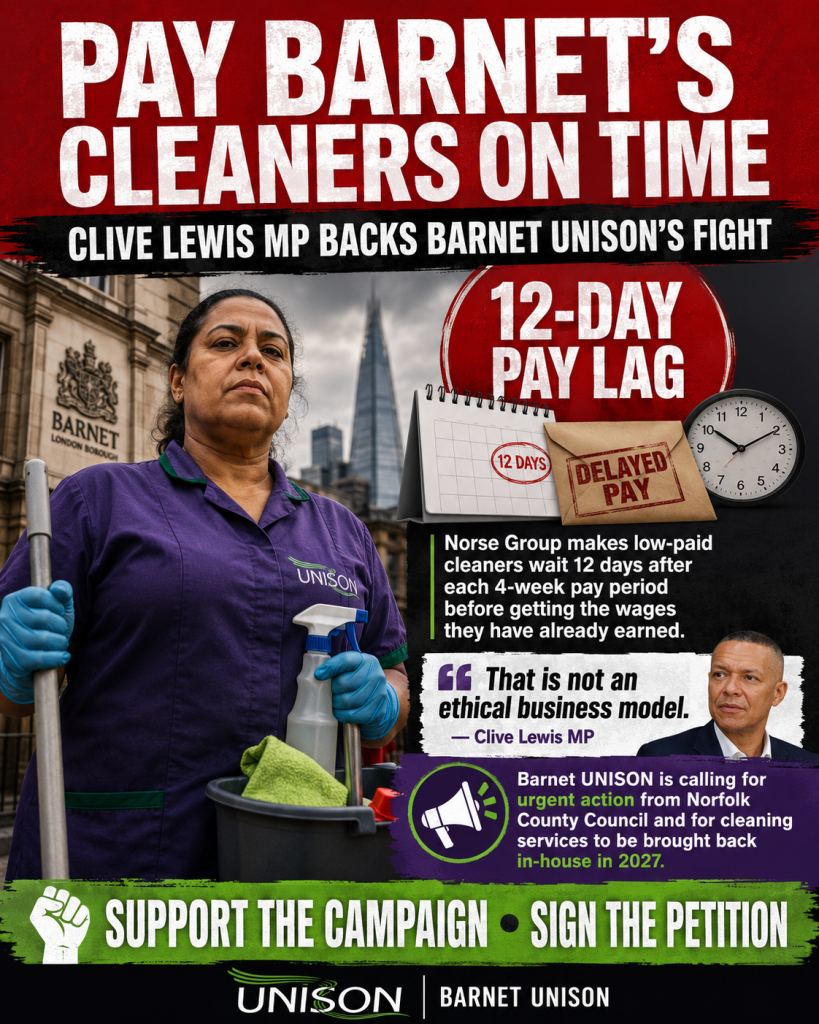
CLIVE LEWIS MP BACKS BARNET’S CLEANERS IN FIGHT AGAINST NORFOLK-OWNED CONTRACTOR

Norwich South MP writes to Norfolk County Council demanding action over Norse Group’s 12-day pay lag

Barnet UNISON has welcomed the intervention of Clive Lewis MP, Member of Parliament for Norwich South, who has written to Norfolk County Council demanding it use its ownership powers to force Norse Group to pay its lowest-paid workers on time.

Read letter to Leader of Norfolk Council RE Norse Group Clive Lewis MP

https://www.barnetunison.me.uk/wp/wp-content/uploads/2026/06/26-06-04-Letter-to-Leader-of-Norfolk-Council-RE-Norse-Group-Clive-Lewis-MP.pdf

Norse Group — the largest Local Authority Trading Company in the country, wholly owned by Norfolk County Council — operates the cleaning contract for the London Borough of Barnet. The company imposes a pay arrangement that forces cleaners to wait 12 days after completing every four-week working period before receiving their wages. Norse’s own pay schedule confirms the 12-day gap applies to every single pay period throughout the year without exception.

These are London Living Wage workers in one of the most expensive cities in the world. At any given moment, Norse holds approximately six weeks’ worth of earned wages belonging to its lowest-paid staff.

Clive Lewis MP wrote to the Leader of Norfolk County Council stating:

“The lowest-paid workers on the contract are subsidising Norse’s payroll operation with 12 days of their earned wages per period. That is not an ethical business model, and it is not consistent with the values that a publicly owned company ought to embody.”

His letter directly challenges Norse’s claim that the arrangement is required for HMRC compliance, calling it a commercial and administrative choice rather than a legal requirement, and rejects the company’s suggestion that workers should take credit union loans to bridge the gap as “an indictment of the arrangement.”

Helen Davies, Branch Chair of Barnet UNISON & UNISON SGE rep for London Region, said:

“We are grateful to Clive Lewis for acting quickly and decisively. He has gone straight to the heart of the matter — Norse is owned by Norfolk County Council, and the Council cannot wash its hands of responsibility for how this company treats its workers. Norfolk created Norse, Norfolk owns Norse, and Norfolk receives an annual dividend from Norse. The workers making that dividend possible deserve to be paid on time.

“We now call on Norfolk County Council to respond without delay and direct Norse to change this arrangement — not just for our members in Barnet, but for all 1,725 Norse employees across the country subject to the same pay lag.”

Barnet UNISON has also written to all 31 Barnet Labour Councillors, the four Barnet Labour MPs, and Green Councillor Charli Thompson calling for urgent intervention and a commitment to bring the cleaning contract back in-house when it expires in 2027.

The Barnet UNISON petition calling on Norse to pay workers on time and for the cleaning service to be insourced in 2027 remains open.

Sign the petition: https://www.megaphone.org.uk/petitions/pay-barnet-s-cleaners-on-time-and-bring-cleaning-back-in-house?source=rawlink&utm_source=rawlink&share=67ca7052-c387-43a8-bd8f-201c05771705

ENDS

For media enquiries contact: Barnet UNISON contactus@barnetunison.org.uk


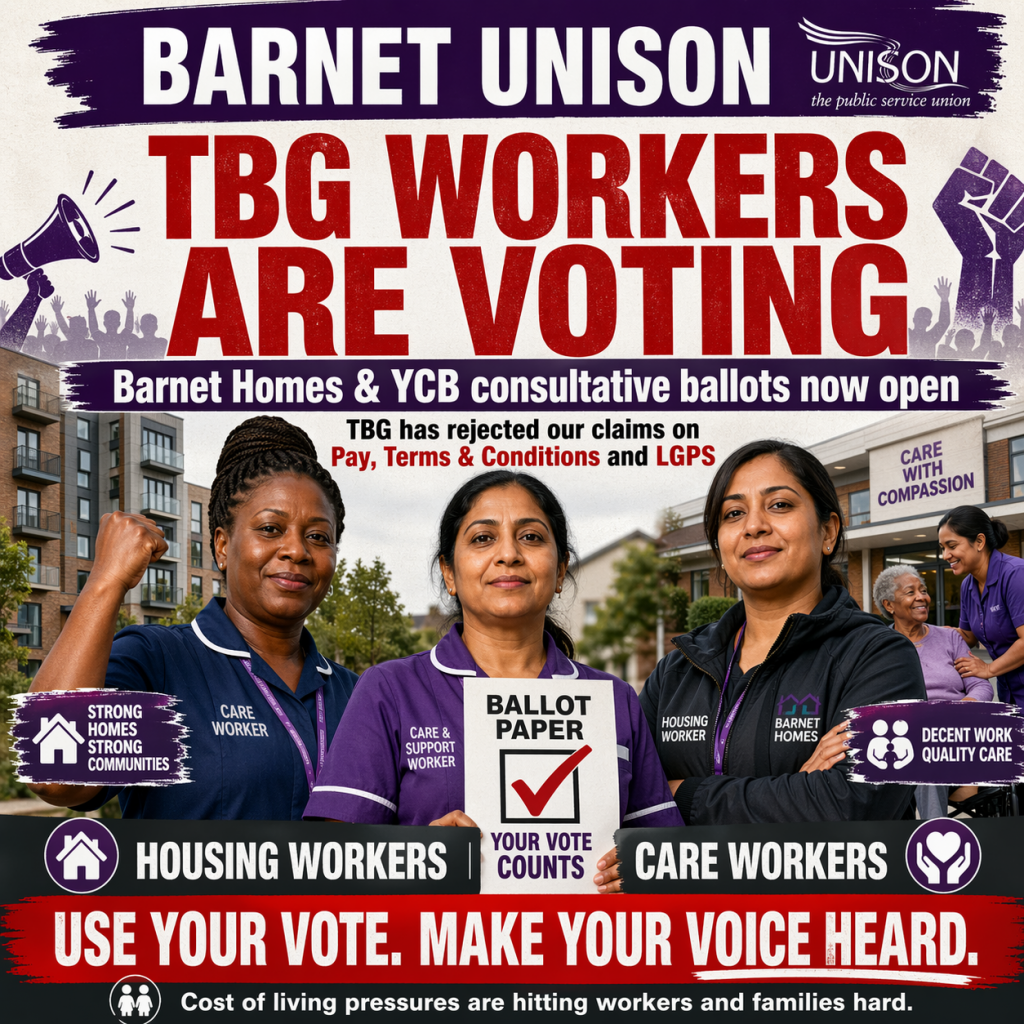
BARNET HOMES & YCB BALLOTS OPEN: TBG WORKERS VOTE ON NEXT STEPS IN PAY AND PENSION FIGHT

Housing and care workers employed by Barnet Council-owned TBG say “we can’t keep absorbing the cost of living crisis”

Barnet UNISON has opened two separate consultative ballots for members employed by The Barnet Group (TBG) — the council-owned company that delivers key services on behalf of the London Borough of Barnet.

The ballots cover:

  • Barnet Homes (Housing Services) workers, and
  • Your Choice Barnet (Adult Social Care) care and support workers.

The ballots follow TBG’s rejection of UNISON’s claims on pay, terms and conditions, and access to the Local Government Pension Scheme (LGPS). UNISON says the vote is needed to show management — and the council as owner and commissioner — that workers expect a serious response to the cost of living crisis.

A Barnet Homes housing worker said :

“People think housing is just admin. It isn’t. You’re dealing with residents in crisis, rising workload and constant pressure. Then you go home and you’re doing the same sums everyone else is doing — rent, bills, travel, food — and it doesn’t add up. The stress doesn’t switch off. It affects your head, your sleep, your family.”

A Your Choice Barnet care worker said :

“We support vulnerable adults every day. It’s physical work and it takes a toll mentally as well. But the hardest part is knowing you’re working flat out and still worrying about money — choosing between basics, falling behind, borrowing, trying to hold it together for your kids. This isn’t sustainable.”

Helen Davies, Barnet UNISON Branch Chair and UNISON SGE representative for London, said:

“These workers keep essential housing and care services running in one of the most expensive cities in the world. They are not asking for the moon — they are asking for fairness: decent pay, decent terms and access to LGPS. TBG is owned by Barnet Council, and Barnet Council cannot wash its hands of what happens to the workforce delivering its services. The ballots are open because members’ voices must be heard — and because the current situation is pushing too many working families towards hardship.”

Call to action:
Barnet UNISON is urging all eligible members in Barnet Homes and Your Choice Barnet to take part and return their ballot papers.

For media enquiries: contactus@barnetunison.org.uk

A London Cleaner’s Reality on Barnet Councils outsourced cleaning contract : Working Hard, Still Struggling

I’m a cleaner on a Council contract. I’m proud of the work I do — it matters. But I want people to understand what it’s really like trying to live and raise a family in London on the London Living Wage.

When people talk about the cost-of-living crisis, it can sound like something on the news. For me, it’s everyday life.

Food is so expensive now. Sometimes it’s hard to buy even basic food. And it’s even harder when you have children — they’re hungry all the time, and you can’t just tell them to wait. You do everything you can to make it work, but it never feels like enough.

Then there are clothes. Children grow so fast and they still need what everyone else needs: shoes that fit, warm coats, school things. On top of that I have to find money for gas and electricity. Those bills don’t stop. They don’t care what you earn.

Sometimes I have to borrow money from family. That’s not easy. It’s embarrassing and it’s painful, because you want to stand on your own feet. But when everything costs more and your wages stay the same, you end up with no choice.

What makes it even harder is the way we’re treated at work compared to other people around us.

It’s unfair that my employer holds onto my pay for another 12 days before they pay me. I’m working alongside council workers who get their pay at the end of the month. They don’t have to wait for the wages they’ve earned. Why are we treated differently?

We’re doing our jobs. We’re turning up. We’re keeping places clean, safe and working properly. But we are the lowest paid staff — and everything is made that much harder for us.

We only get the London Living Wage. We don’t get sick pay. That means if I’m ill, or if something happens, it’s not just a health worry — it becomes a money worry too. You start thinking, “If I can’t work, how will I pay bills? How will I buy food?” That’s not how anyone should have to live.

And another thing that doesn’t feel right is the delay in getting the London Living Wage increase. The new rate is announced in October, but a lot of employers don’t bring it in until 1 April. That’s about six months of waiting.

But prices don’t wait six months. Rent doesn’t wait. Food doesn’t wait. Gas and electricity don’t wait. If the London Living Wage is the rate people need to live on, then it should be paid from the moment it’s announced — not half a year later.

London is an expensive city. I work hard. I’m not asking for special treatment. I just want fairness — and to be treated like my council worker colleagues. I want to be paid on time. I want proper sick pay. And I want the London Living Wage paid when it’s announced, because that’s when families like mine actually need it.

That’s why I support Barnet UNISON’s campaign to make sure Council contracts include a clause so the new London Living Wage rate is applied from the announcement date — not months later. Because people like me shouldn’t have to struggle this much just to get by.


End.


***Barnet UNISON AGM Tuesday 25 February 2025 4-5.30 pm ***

It is your democratic right to attend and participate in your UNISON AGM.

It is important that members register to attend.

You have two choices:

You can join in person at the Colindale office, or you can join online.

Please click on the link below to register to join the meeting.

https://us02web.zoom.us/meeting/register/tZcrd-GorTsrGtQzqR9L3h9L-z1mKymCRU_i

End.


“No stone left unturned” What is The Barnet Group (TBG)? Number 7: Part Three

Ever since we published our article called Three Chief Executives and a Plumber, we have been inundated with questions about The Barnet Group (TBG).

Barnet UNISON published three animations which were put together with the help of our Barnet UNISON reps in TBG

Here is Animation Number Three which we noticed someone was watching it on a bus.


After watching this animation we strongly recommend you reading our article Three Chief Executives and a Plumber, here https://www.barnetunison.me.uk/wp/2024/10/18/barnet-council-the-tale-of-three-chief-executives-and-one-plumber/

End.


“No stone left unturned” What is The Barnet Group (TBG)? Number 6: Part Two

Ever since we published our article called Three Chief Executives and a Plumber, we have been inundated with questions about The Barnet Group (TBG).

Barnet UNISON published three animations which were put together with the help of our Barnet UNISON reps in TBG

Here is Animation Number Two which appears to have been screened in London Docklands.


After watching this animation we strongly recommend you reading our article Three Chief Executives and a Plumber, here https://www.barnetunison.me.uk/wp/2024/10/18/barnet-council-the-tale-of-three-chief-executives-and-one-plumber/

End.

1 2